


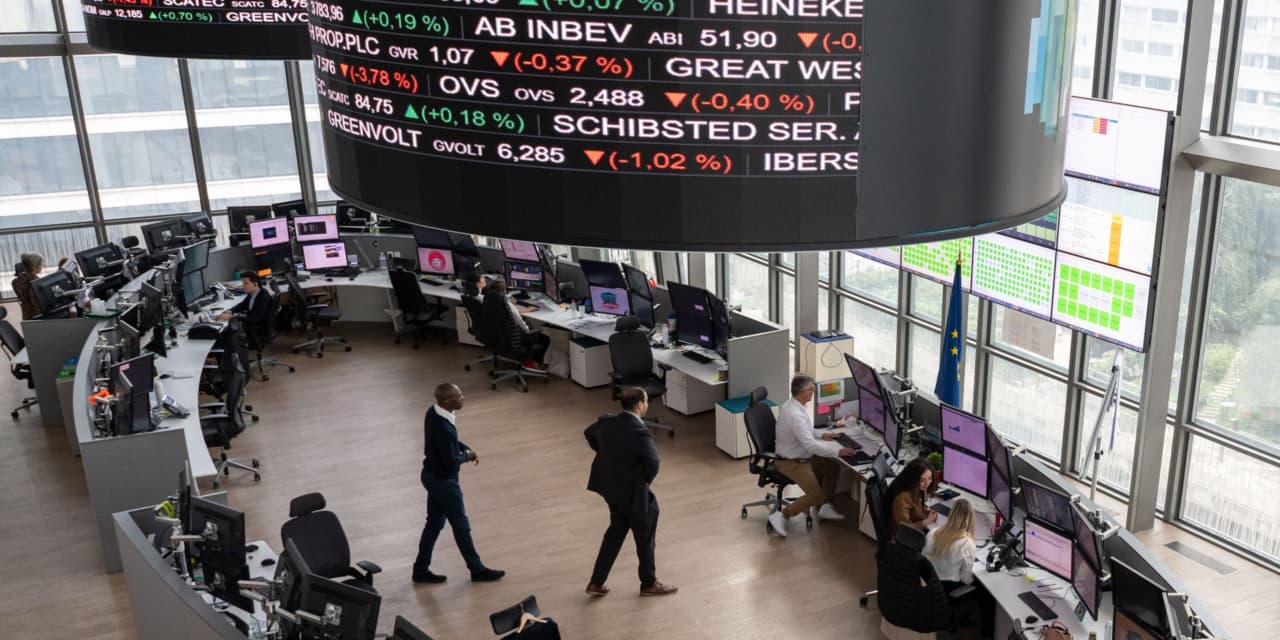
International stocks could be about to begin a multiyear stretch of outperforming U.S. equities.
I say that knowing full well that similar predictions have been made for several years in a row and, so far at least, they have all fallen flat. But there are several reasons to think that the tide is about to turn in favor of international stocks.
Reason No. 1: Trees don’t grow to the sky.
This famous phrase, from the late British economist John Maynard Keynes, reminds us that trends don’t continue forever. And the U.S.-over-non-U.S. trend has been going on for an awfully long time—at least since the 2008-09 financial crisis, as you can see from the accompanying chart. The top of the dot-com bubble was the only other time since the 1970s in which the
S&P 500 index’s
trailing 10-year return was further ahead of the
MSCI EAFE Index
(for Europe, Australasia, and the Far East) a benchmark of non-U.S. large-cap stocks.
Reason No. 2: The dollar is overdue for a fall.
This doesn’t guarantee that the trend is about to end, needless to say. With data extending back to just the 1970s, there aren’t enough nonoverlapping 10-year periods to support a confident prediction. But even though historical data before the 1970s is tentative for some foreign countries, researchers tell us that U.S. and non-U.S. equities have produced largely similar inflation-adjusted returns over the past century. So unless “this time is different” (a dangerous assumption, as the Wall Street aphorism tells us), non-U.S. equities will eventually have their day in the sun.
One of the factors that in recent years has favored U.S. equities over others, at least for a U.S. investor, is the strength in the dollar. That’s because a stronger greenback reduces the dollar-equivalent value of a non-U.S. stock’s return. And the
U.S. Dollar Index
has been in a strong uptrend since the financial crisis, coincident with the
S&P 500’s
growing alpha relative to the EAFE.
One of the factors propping up the dollar has been U.S. interest rates, which have been higher for longer than many investors had expected. But this trend appears to be changing, if it hasn’t already. With the unexpectedly low inflation numbers reported earlier this month, traders are now betting on at least four interest rate cuts in 2024. The Dollar Index is now trading at more than a two-month low.
Reason No. 3: Valuations favor foreign stocks.
A third factor favoring non-U.S. over U.S. equities in coming years is favorable valuations. Other factors—such as sentiment and technical indicators—play a far more important role over the short term. But valuation does play a strong role over the very long term.
My favorite analogy for making this point comes from Ben Inker, head of asset allocation at Boston-based GMO. Likening the market to a leaf in a hurricane, he says, “You have no idea where the leaf will be a minute or an hour from now. But eventually gravity will win out, and it will land on the ground.”
One of the best ways of gauging the relative valuations of various countries’ stock markets is with the cyclically-adjusted price/earnings, or CAPE, ratio. This is the valuation indicator made famous by Yale University finance professor Robert Shiller. The accompanying chart shows that the U.S.’s CAPE ratio is currently higher than 77% of all monthly U.S. readings since 1981. That percentile is higher than the comparable reading for any other developed country’s stock market for which data are available over the past four decades.
The equity market outside the U.S. is hardly monolithic, so it’s important to diversify your exposure. The easiest and least expensive way to do that is with an index fund, such as the
Vanguard Total International Stock
exchange-traded fund (ticker: VXUS). The fund, which tracks the FTSE Global All Cap ex U.S. Index, has an expense ratio of 0.07%.
If you want to make more targeted bets in the non-U.S. equity arena, below is a list of the international equity mutual funds and ETFs that currently are recommended for purchase by at least one of the investment newsletters tracked by my performance auditing firm.
Mark Hulbert is a regular contributor to Barron’s. His Hulbert Ratings tracks investment newsletters that pay a flat fee to be audited. He can be reached at [email protected].
Write to [email protected]
Read the full article here

