


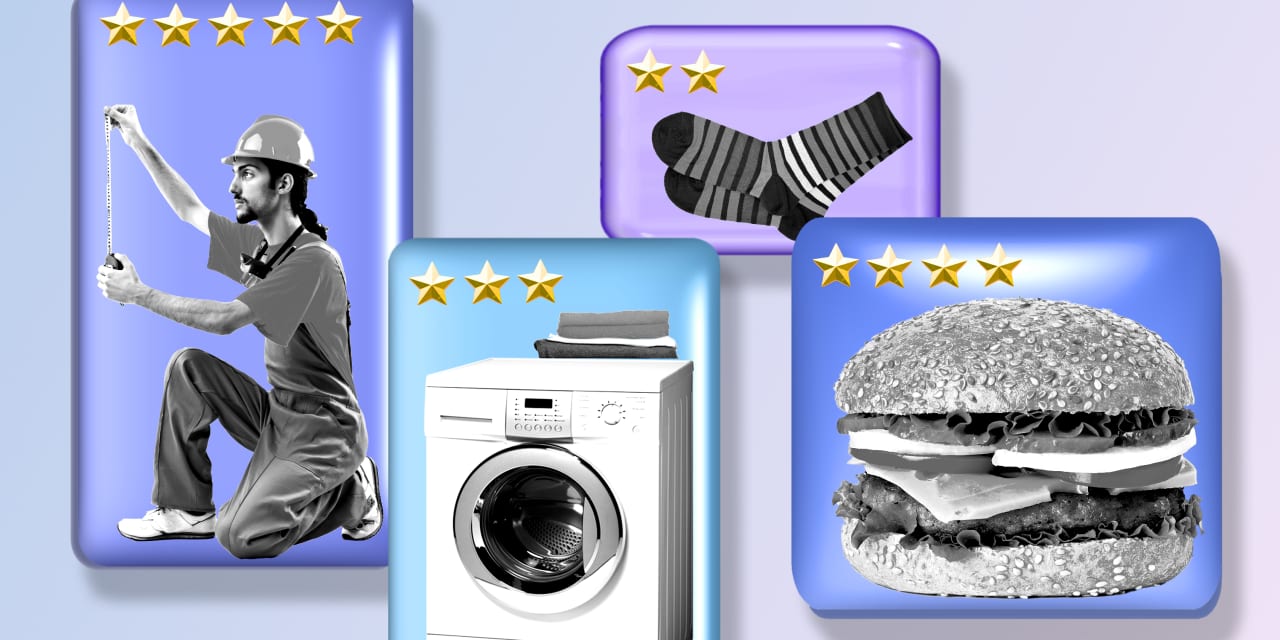
You’re not imagining it. You are being asked to review every business you interact with, every product you buy, every service you get. Your kid’s dentist, the
Airbnb
you stayed at, the socks you bought last month. Have you posted a review yet?
Consumer reviews have been around for a while—
Amazon
first launched product reviews in 1995—but they have seemingly flooded every corner of the internet in recent years.
Blame the pandemic. When the economy shut down and people were forced to stay home, e-commerce experienced 10 years of growth in the first quarter of 2020 alone in the U.S., according to McKinsey. That came with a surge in online ratings and reviews, which rose by 87% from December 2019 to December 2020, says McKinsey.
Don’t expect the reviews to disappear soon. As customers seek increased transparency from companies they do business with, online reviews have taken on greater importance and credibility.
Chasing more stars
Research has shown a connection between the number of reviews and higher sales. Mercer studied the link between online star ratings and sales on a “major online platform” and found that across all categories, 95% of units sold had 3.5 or more stars. Products with three- or four-star ratings saw sales that were three times higher than those with one-star ratings.
Research done by Northwestern University’s Spiegel Research Center found that as products begin displaying reviews, the percentage of website visitors buying products rise. Products with five or more reviews were purchased nearly four times more often than products with no reviews.
Reviews have become the digital equivalent of word-of-mouth. Forty-nine percent of consumers look for customer ratings and reviews when researching purchases, according to
Gartner.
Similarly, 49% of consumers trust reviews as much as personal recommendations from friends and family members, according to another survey.
Consumer reviews build “immediate trust and authenticity,” says Eric Wagatha, head of consumer life at GfK, a market research firm. “If a consumer gives a review, it must be trustworthy, and it cuts down on advertising spend because a consumer’s honest response to a product serves this purpose.”
The sales impact of reviews is perhaps the biggest reason for their growing prevalence. Across all industries measured in Gartner’s Digital IQ tool, Gartner found that 59% of companies show consumer ratings and reviews on their websites in 2023, up 12.5% from just the year before.
Pestering consumers
David Godes, a professor at Johns Hopkins Carey School of Business, co-wrote research aiming to assess if sending review-solicitation emails to customers of a European travel platform affected online review content, like average ratings. His team found that sending emails increased the overall number of reviews by eight percentage points while reducing the number of extreme (very positive or very negative) scores. People who have moderate experiences with a product or service are less likely to write a review, so the reminder pushed them to weigh in. Consumers with positive or negative comments tend to post reviews on their own, says Godes.
“We saw a significant increase in the number of reviews just by sending these reminders, though I know a lot of people are irritated by them,” Godes says.
In that vein, many companies ask customers to review their product or service in an effort to lift average scores. If many of the organic reviews skew negative, companies nudge the people who had an OK or moderate experience to submit a review, says Gavan Fitzsimons, a professor of marketing and psychology at Duke’s Fuqua School of Business.
Fierce competition in any industry spurs demands for reviews, “if my competitor has all these reviews, it leaves me with no recourse but to also solicit reviews to keep pace with my competitor,” says Fitzsimons. “And nothing changes—just customers get pestered constantly.”
Another incentive behind soliciting reviews: When you ask someone a question and they give an answer, they’re more likely to act on that sentiment going forward—a phenomenon also known as the question-behavior effect. So if a customer, when prompted, rates a product 4 or 5 stars, that positive attitude is more likely to drive their behavior later on. People may not be aware of it, but “the question is leading the consumer to use the service or product later,” says Fitzsimons.
The AI impact
The spread of artificial intelligence is already impacting reviews. Fake online reviews have been around for nearly as long as reviews themselves. Now popular AI tools like ChatGPT can produce a product review in seconds and are emerging as a new front in the continuing battle against policing fraudulent reviews.
Amazon, which has long dealt with fake reviews of products, said in November that the company “uses the latest advancements in AI to stop hundreds of millions of suspected fake online reviews, manipulated ratings, fake customer accounts, and other abuses before customers see them.” The company also uses AI to produce summaries of reviews, making it easier for shoppers to get a sense of a product without having to sift through hundreds of reviews.
Fakespot, a start-up bought by Mozilla, offers a browser tool that uses AI technology to help users identify fake or unreliable reviews. Saoud Khalifah, Fakespot’s founder, says the main driver of fake reviews now isn’t AI (it’s fake review farms), but there are signs of increasing use of AI.
“As AI models continue to improve and mimic authentic language, AI-generated reviews will become harder for the average shopper to detect without assistive technology,” he says.
Write to [email protected]
Read the full article here

