



Market Recap
The strong returns from the last two months of 2023 did not extend into the new year, Vanguard’s High Dividend Yield ETF (VYM) mustered a mere 0.75% gain to start 2024. The SPDR S&P 500 ETF Trust (SPY) kicked off the year with a more impressive gain of 1.59%. My watchlist, on the other hand, did not get off to a great start, it posted a loss of 1.55% during the month of January. Despite this poor start, since inception, the watchlist remains very competitive with both VYM and SPY. The annualized return for the watchlist declined, yet remains at a respectable level, 14.57%, compared to 14.8% for VYM and 14.51% for SPY.
My watchlist prioritizes growth and therefore tends to underperform when market sentiment is weak and outperform when market sentiment is strong. Given the historical tendency of more positive market periods than negative market periods, I am optimistic that in the long run my watchlist will deliver strong total returns.
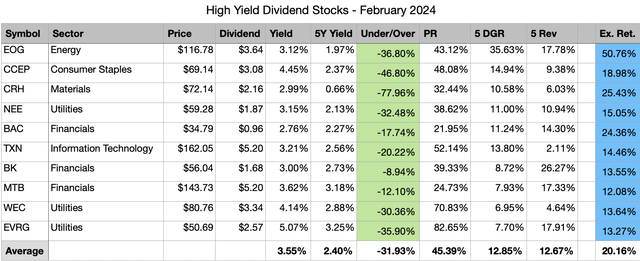
The main purpose of a high dividend yield portfolio is not to outperform the broad market, but to generate a passive income stream that is relatively safe, reliable, and one that can grow in the future. The top 10 stocks on my watchlist for February 2024, collectively, offer a 3.55% dividend yield that is more than double the dividend yield of the S&P 500. These 10 stocks have also grown their dividends at a historical rate of 12.85% per year during the last five years. Collectively, all 10 stocks appear to be potentially about 32% undervalued right now based on dividend yield theory.
The best way to create a strong high-yield dividend portfolio is with a buy-and-hold strategy. This strategy forces you to think about the stocks you decide to invest your capital into, as the plan is to hold the positions indefinitely. Applying this approach over the long term while focusing on potentially undervalued stocks allows investors to generate alpha through capital appreciation. While this may not pan out for every position, diversifying your high-yield portfolio across 20 or more unique stocks will increase the odds of picking up shares of certain stocks when they are trading for bargain prices. The beauty of a long-term outlook is time; you can sit back and wait for the valuation to revert to historical norms, all the while collecting a generous passive income stream.
Watchlist Criteria
Creating the high-yield watchlist, I had four areas of interest that I focused on: basic criteria, safety, quality, and stability. First off, the basic criterion aims to narrow down the list of stocks to those that pay a dividend, offer a yield above 2.75%, and trade on the NYSE and NASDAQ. The next set of criteria focuses on safety because that is a crucial part of a high-yield investing strategy. The filter excludes companies with payout ratios above 100% and companies with negative 5-year dividend growth rates. Another level of safety can be associated with larger companies; therefore, the watchlist narrows in on stocks with a market cap of at least $10 billion. The next set of criteria set out to narrow down the list to include higher-quality businesses.
The three filters for quality are: a wide or narrow Morningstar moat, a standard or exemplary Morningstar stewardship, and an S&P quality rating of B+ or higher. A Morningstar moat rating represents the company’s sustainable competitive advantage, the main difference between a wide and narrow moat is the duration that Morningstar expects that advantage to last. Companies with a wide moat are expected to maintain their advantage for the next 20 years, whereas companies with a narrow moat are expected to maintain their advantage for the next 10 years. The Morningstar stewardship evaluates the management team of a company with respect to shareholders’ capital.
The S&P quality rating evaluates a company’s earnings and dividend history. A rating of B+ or higher is associated with above-average businesses. The last set of criteria focuses on the stability of a company’s top-line and bottom-line growth. The filter eliminates companies with negative 5-year revenue or earnings per share growth rate. I believe a company that is growing both their top line and bottom line has the ability to provide growth to its investors in the future.
All of the stocks that pass the initial screener criteria (42 this month) are then ranked based on quality and valuation. Further, I sort the stocks in descending order based on the best combination of quality and value and select the top 10 stocks that are forecasted to have at least a 12% annual long-term return.
February 2024 Watchlist
Here is the watchlist for February 2024. There are four changes from the prior month: Goldman Sachs (GS), Morgan Stanley (MS), Truist Financial (TFC) and Essential Utilities (WTRG) dropped out and are replaced by Bank of New York Mellon (BK), Evergy (EVRG), MT Bank (MTB) and WEC Energy Group (WEC). The data shown in the image below is as of 1/31/24.
Created by Author
All of the selected stocks this month appear to be potentially undervalued based on dividend yield theory.
The expected rate of return shown in the last column is computed by taking the current dividend yield plus a return to fair value over the next 5 years and a discounted long-term earnings forecast.
Please keep in mind that my return forecasts are based on assumptions and should be viewed as such. I am not expecting that these 10 companies will hit the forecasted returns. What I do expect is that these 10 companies have the potential to offer better returns during the next 5 years compared to the 32 high-yield stocks that passed my initial filters but ranked worse in quality and valuation.
Past Performance
The top 10 list kicks off 2024 with a lackluster performance, posting a loss of 1.55% while both VYM and SPY locked in positive returns. After the exceptional returns in November and December of last year, a little pull back was to be expected. The watchlist is still grossly outperforming both VYM and SPY in the trailing 3-month return, +22.85%, compared to +13.07% and +15.93%, respectively. Since inception, which was 39 months ago, the watchlist has an annualized return of 14.57%, placing it 0.23% behind of VYM and 0.06% ahead of SPY.
I do not expect that this watchlist will beat VYM or SPY every month. However, I believe that a buy-and-hold investing approach leveraging the stocks presented on this watchlist will generate long-term alpha compared to the broad market. I also have a personal target rate of return of 12% that I believe will be attained by this watchlist when measured over long periods of time. Thus far the watchlist is performing adequately and remains ahead of target as it embarks on its 4th year.
|
Date |
Top 10 List |
ALL |
VYM |
SPY |
|
1 month |
-1.55% |
-0.84% |
0.75% |
1.59% |
|
3 month |
22.85% |
15.59% |
13.07% |
15.93% |
|
6 month |
5.39% |
2.44% |
3.71% |
6.28% |
|
YTD |
-1.55% |
-0.84% |
0.75% |
1.59% |
|
2020 |
16.44% |
16.44% |
16.09% |
14.99% |
|
2021 |
26.31% |
27.91% |
26.21% |
28.76% |
|
2022 |
-11.95% |
-4.25% |
-0.45% |
-18.16% |
|
2023 |
22.07% |
9.56% |
6.58% |
26.18% |
|
2024 |
-1.55% |
-0.84% |
0.75% |
1.59% |
|
Since Inception |
55.61% |
54.92% |
56.61% |
55.33% |
|
Annualized |
14.57% |
14.42% |
14.80% |
14.51% |
Individual watchlist returns for January 2024 were:
- Bank of America (BAC) +1.01%
- CRH plc (CRH) +3.76%
- Coca-Cola Europacific Partners PLC (CCEP) +3.24%
- EOG Resources (EOG) -5.16%
- Goldman Sachs (GS) -0.46%
- Morgan Stanley (MS) -5.54%
- NextEra Energy (NEE) -3.47%
- Truist Financial (TFC) +0.38%
- Texas Instruments (TXN) -5.31%
- Essential Utilities (WTRG) -3.99%
Top 5 performing past and present watchlist stocks in January 2024:
- Verizon (VZ) +14.25%
- Progressive (PGR) +12.47%
- Merck (MRK) +10.79%
- Advance Auto Parts (AAP) +9.97%
- Amgen (AMGN) +9.11%
Top 5 Stocks by total return since joining the watchlist:
- Broadcom (AVGO) +179.10% (33 months)
- Principal Financial Group (PFG) +127.19% (39 months)
- General Dynamics (GD) +117.84% (39 months)
- Progressive (PGR) +110.53% (36 months)
- JPMorgan (JPM) +94.88% (39 months)
Top 5 Stocks by Average Monthly return since joining the watchlist:
- CRH plc (CRH) +7.80% (2 months)
- Discover Financial Services (DFS) +3.39% (5 months)
- FedEx (FDX) +3.26% (16 months)
- Coca-Cola Europacific Partners PLC (CCEP) +3.24% (1 month)
- Broadcom (AVGO) +3.16% (33 months)
In total, there have been 83 unique high-yield dividend stocks that have appeared in the top 10 list during the past 39 months. Out of these 83 unique stocks, 65 have a positive total return since first appearing on the top 10 list. The average total return for these 65 stocks is 36.23%. The average loss for the 18 stocks that have negative total returns is -17.57%. Here are all 83 stocks, their total return since inception, and the number of months since they first appeared in the top 10 list.
|
Symbol |
Since Inception |
Count |
|
AVGO |
179.10% |
33 |
|
PFG |
127.19% |
39 |
|
GD |
117.84% |
39 |
|
PGR |
110.53% |
36 |
|
JPM |
94.88% |
39 |
|
MRK |
85.13% |
33 |
|
BMO |
81.73% |
39 |
|
BK |
77.11% |
39 |
|
FDX |
67.05% |
16 |
|
AMGN |
60.45% |
39 |
|
TD |
57.46% |
39 |
|
RY |
55.13% |
39 |
|
CSCO |
54.14% |
39 |
|
PAYX |
49.91% |
36 |
|
MTB |
48.14% |
39 |
|
SNA |
46.61% |
24 |
|
CVS |
44.80% |
39 |
|
EPD |
42.94% |
30 |
|
HBAN |
42.05% |
39 |
|
CM |
41.80% |
39 |
|
FAST |
40.12% |
12 |
|
STT |
38.94% |
39 |
|
PEP |
38.34% |
39 |
|
SO |
37.75% |
39 |
|
SRE |
35.84% |
35 |
|
CMCSA |
34.37% |
17 |
|
LMT |
34.12% |
39 |
|
HD |
33.94% |
19 |
|
ATO |
32.70% |
26 |
|
QSR |
32.61% |
29 |
|
BNS |
30.62% |
39 |
|
BLK |
30.29% |
21 |
|
RCI |
27.10% |
39 |
|
PM |
26.85% |
35 |
|
SWKS |
26.45% |
16 |
|
CMI |
23.07% |
23 |
|
TRP |
22.43% |
39 |
|
PXD |
22.28% |
11 |
|
USB |
21.96% |
39 |
|
DRI |
21.27% |
30 |
|
GS |
20.51% |
8 |
|
VZ |
18.68% |
14 |
|
DFS |
18.11% |
5 |
|
GIS |
16.83% |
30 |
|
CRH |
16.20% |
2 |
|
CPB |
15.56% |
28 |
|
MDT |
15.54% |
14 |
|
CMS |
14.77% |
35 |
|
OKE |
13.77% |
10 |
|
DLR |
13.08% |
23 |
|
K |
12.70% |
35 |
|
NTRS |
12.39% |
39 |
|
XEL |
11.66% |
35 |
|
DTE |
11.47% |
39 |
|
TXN |
9.87% |
19 |
|
BAC |
8.01% |
6 |
|
INTC |
7.56% |
39 |
|
EOG |
5.83% |
11 |
|
BX |
5.12% |
22 |
|
EVRG |
4.20% |
39 |
|
CCEP |
3.24% |
1 |
|
TFC |
2.37% |
39 |
|
KMB |
1.93% |
36 |
|
PNC |
0.42% |
11 |
|
UL |
0.23% |
11 |
|
MS |
-0.75% |
30 |
|
GLW |
-1.65% |
11 |
|
LNT |
-2.45% |
39 |
|
WEC |
-3.41% |
37 |
|
XOM |
-3.77% |
10 |
|
WTRG |
-3.99% |
1 |
|
AMT |
-4.36% |
16 |
|
CLX |
-6.45% |
29 |
|
NEE |
-11.52% |
5 |
|
BEN |
-12.83% |
25 |
|
CMA |
-17.04% |
34 |
|
BBY |
-21.66% |
25 |
|
TROW |
-23.50% |
24 |
|
UPS |
-28.11% |
23 |
|
MMM |
-32.11% |
39 |
|
HAS |
-33.34% |
39 |
|
PARA |
-44.11% |
39 |
|
AAP |
-65.28% |
23 |
Closer Look At New Stock
Here’s a closer look at the new stocks this month: Bank of New York Mellon, Evergy, MT Bank and WEC Energy Group.
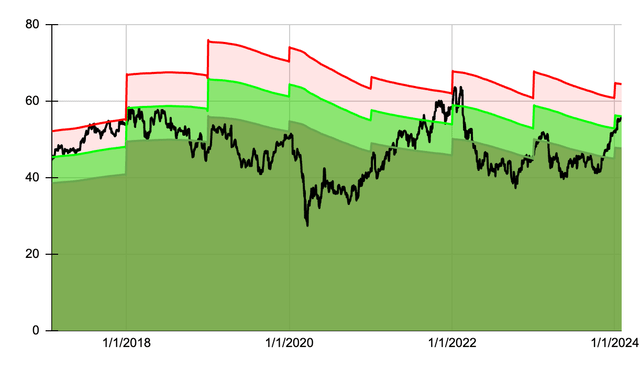
Let’s start with the 7-year dividend yield theory chart for BK.
Created by Author
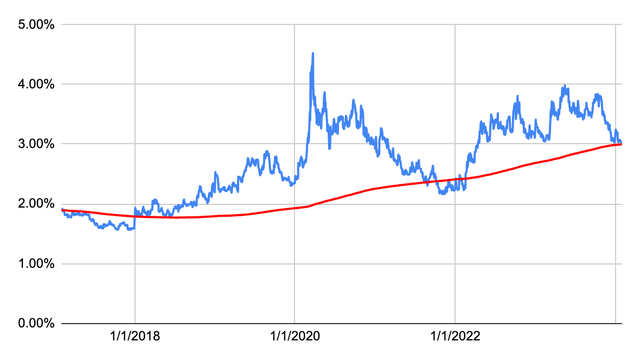
Here is the historical dividend yield.
Created by Author
And its dividend growth history.
| Year | Dividend | Growth | CAGR |
| 2024 | 1.68 | 6.33% | |
| 2023 | 1.58 | 11.27% | |
| 2022 | 1.42 | 9.23% | 11.27% |
| 2021 | 1.30 | 4.84% | 8.92% |
| 2020 | 1.24 | 5.08% | 7.89% |
| 2019 | 1.18 | 13.46% | 7.32% |
| 2018 | 1.04 | 20.93% | 8.32% |
| 2017 | 0.86 | 19.44% | 10.04% |
| 2016 | 0.72 | 5.88% | 11.17% |
| 2015 | 0.68 | 3.03% | 10.57% |
| 2014 | 0.66 | 13.79% | 9.79% |
| 2013 | 0.58 | 11.54% | 10.15% |
| 2012 | 0.52 | 10.27% |
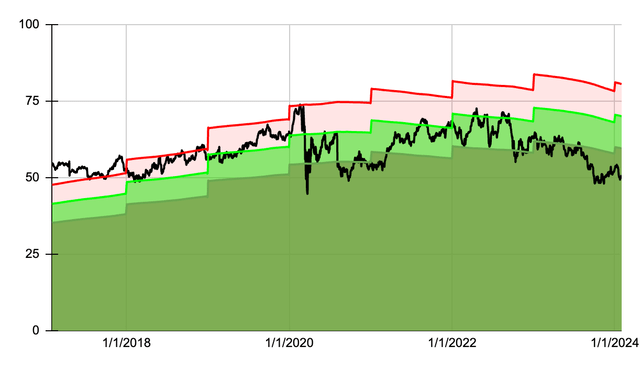
Here is the 7-year dividend yield theory chart for EVRG.
Created by Author
Here is the historical dividend yield.
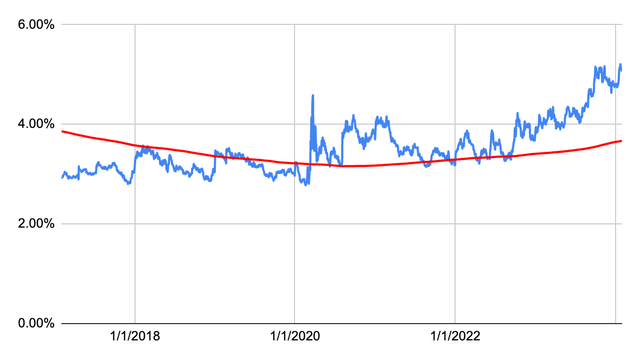
Created by Author
And its dividend growth history.
| Year | Dividend | Growth | CAGR |
| 2024 | 2.57 | 3.63% | |
| 2023 | 2.48 | 6.44% | 3.63% |
| 2022 | 2.33 | 7.00% | 5.02% |
| 2021 | 2.18 | 6.22% | 5.68% |
| 2020 | 2.05 | 6.22% | 5.81% |
| 2019 | 1.93 | 11.24% | 5.89% |
| 2018 | 1.74 | 8.44% | 6.77% |
| 2017 | 1.60 | 5.26% | 7.00% |
| 2016 | 1.52 | 5.56% | 6.79% |
| 2015 | 1.44 | 2.86% | 6.65% |
| 2014 | 1.40 | 2.94% | 6.26% |
| 2013 | 1.36 | 3.03% | 5.96% |
| 2012 | 1.32 | 5.71% |
I decided not to present the charts for MTB as the company failed to pay a dividend between 2016 and 2018, resulting in pretty goofy looking charts.
Here is the 7-year dividend yield theory chart for WEC.
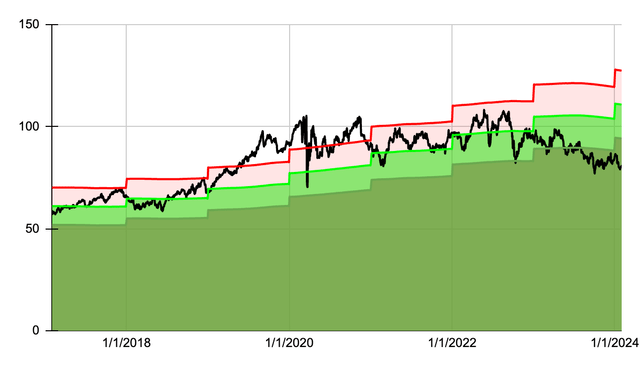
Created by Author
Here is the historical dividend yield.
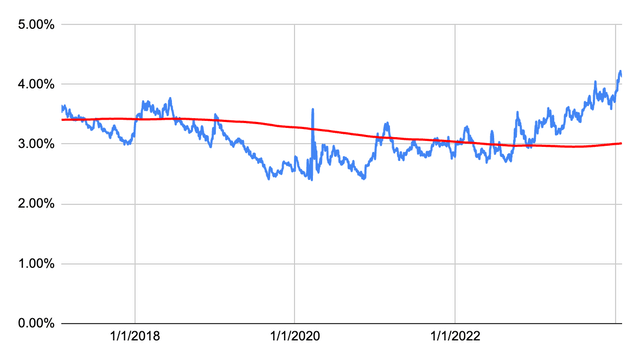
Created by Author
And its dividend growth history.
| Year | Dividend | Growth | CAGR |
| 2024 | 3.34 | 7.05% | |
| 2023 | 3.12 | 7.22% | 7.05% |
| 2022 | 2.91 | 7.38% | 7.13% |
| 2021 | 2.71 | 7.11% | 7.22% |
| 2020 | 2.53 | 7.20% | 7.19% |
| 2019 | 2.36 | 6.79% | 7.19% |
| 2018 | 2.21 | 6.25% | 7.13% |
| 2017 | 2.08 | 5.05% | 7.00% |
| 2016 | 1.98 | 13.60% | 6.75% |
| 2015 | 1.74 | 11.72% | 7.49% |
| 2014 | 1.56 | 7.96% | 7.91% |
| 2013 | 1.45 | 20.42% | 7.91% |
| 2012 | 1.20 | 8.90% |
Read the full article here

