


Brussels is changing its spending policies to potentially redirect tens of billions of euros to defence and security, as Russia’s war in Ukraine and Donald Trump’s return to the White House heap pressure on the EU to boost investment.
The policy shift would apply to about a third of the bloc’s common budget, or some €392bn from 2021 to 2027, money that is aimed at reducing economic inequality between EU countries.
Only about 5 per cent of these so-called cohesion funds have been spent to date, with the biggest beneficiaries, including Poland, Italy and Spain, spending even less.
Under existing rules, these funds cannot be used to purchase defence equipment or directly fund the military, but investment in so-called dual-use products such as drones is allowed.
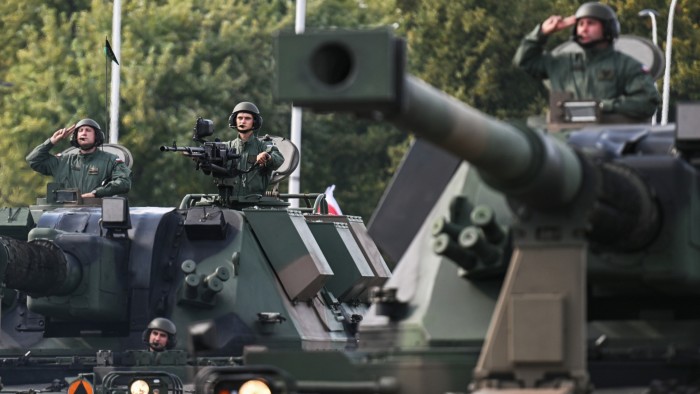
Capitals of member states will be told in coming weeks that they will now have more flexibility under the rules to allocate cohesion funds to support their defence industries and military mobility projects such as reinforcing roads and bridges to allow the safe passage of tanks, according to EU officials.
This will include permitting funding for boosting the production of weapons and ammunition, though the ban on using EU funds to purchase those weapons will remain.
A spokesperson for the European Commission said cohesion funds could be used for the defence industry as long as they contributed to the “overall mission to enhance regional development”, including military mobility.
Germany is the linchpin for European military mobility due to its location but its transport infrastructure is in poor shape. The Berlin economy ministry estimated in 2022 that the country needed to spend €165bn urgently on roads, rails and bridges. Germany is due to receive €39bn in cohesion funds through to 2027.
The move will also be welcomed by states on the EU’s eastern border, which have ramped up military spending since Russia’s full-scale invasion of Ukraine, while some suffered a drop in foreign investment.
“We have to invest into military mobility projects which are costly . . . [and] important not only to one country, but also the whole region,” said Gintarė Skaistė, Lithuania’s finance minister.
Trump warned Nato allies earlier this year that as president he would encourage Russia to do “whatever the hell they want” if alliance members failed to meet their defence spending target.
Poland in particular has been piling pressure on the commission to spend more on defence. Warsaw spent 4.1 per cent of its GDP on the military this year, double the Nato target, and it plans to reach 4.7 per cent in 2025.
EU countries have spent relatively little of their cohesion funds so far because they have instead prioritised billions in so-called recovery funds made available in the wake of the Covid-19 pandemic. These expire in 2026.
Poland has typically spent a relatively large amount of its cohesion funds compared to its peers, but has been a laggard in the current budget cycle because it could not access funds that were frozen by Brussels in 2022 amid concerns over the rule of law.
The money only started flowing after Prime Minister Donald Tusk took office in December last year.
The shift in policy to bolster defence-related spending will also be welcomed by net payers into the EU budget, such as Germany, the Netherlands and Sweden, which see the use of existing funds as preferable to issuing joint debt or providing more EU funding.
Shifting money away from other priorities such as green and digital infrastructure to the defence industry would require the commission’s approval, one official said.
“The fact that we should pay more attention to defence does not mean that we should forget about the green transition or cohesion,” Piotr Serafin, the incoming EU budget commissioner, said during his confirmation hearing last week.
Regional governments have mixed feelings about the push towards defence spending, worrying that the shift could come at the expense of regional development, and imply a centralisation of funding away from local authorities.
But at the same time, they welcomed support for projects that fail to attract private capital.
“In my region, I have a training field for troops that needs to be connected with an airport,” said Olgierd Geblewicz, president of Poland’s West Pomerania region. “If it is the regions who will decide . . . with local acceptance it will be possible.”
The shift in policy is a preamble to a stronger focus on defence in the next EU budget starting in 2028, which will be negotiated from next year. A recent report for the commission by former Finnish president Sauli Niinistö advocated reserving 20 per cent of that for defence.
“We are under stronger pressure than others, we need more military presence. Our defence expenditure is high, the next European budget should take that into account,” Jürgen Ligi, finance minister of the Baltic state of Estonia, told the FT.
Data visualisation by Alan Smith and Cleve Jones
Read the full article here

