


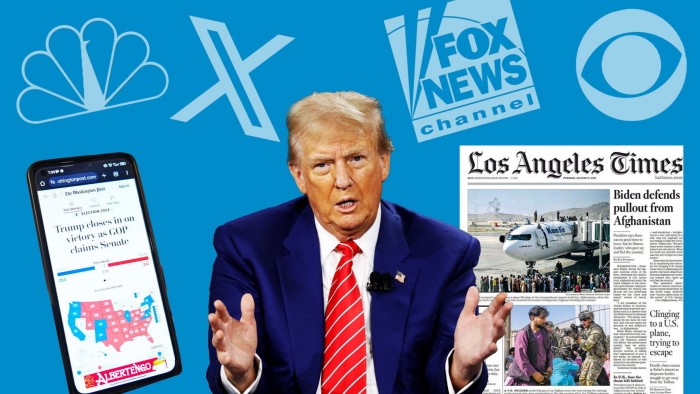
Media bosses are warning that Donald Trump’s second administration could bring a crackdown on press freedom as they face the return of a US president who has denounced journalists as “the enemy of the people”.
Since his first successful presidential campaign eight years ago, Trump has routinely castigated the “mainstream media”, which he derides as “fake news”. This time round he ratcheted up his criticisms, repeatedly threatening to revoke broadcast licences for news channels such as CBS, NBC, ABC and Fox, and saying last month it was time to “straighten out” the “corrupt press”.
As the former reality television star prepares to move back into the White House, US news groups fear he will make good on his threats through regulation, litigation or intimidation. The anxiety comes at a time of heightened vulnerability for the US news media, which is facing declining audiences, plunging trust and waning relevance as large groups of the country’s population find their information elsewhere.
“The demonisation of the press, which is part of the Maga message, has contributed to a dramatic erosion of trust”, said Andrew Heyward, who was the president of CBS News from 1996 to 2005.
Trump verbally “insulted, attacked or threatened the media” at least 108 times between September 1 and October 24, according to an analysis by Reporters Without Borders — and that is excluding his social media activity.
Project 2025, a Republican think-tank manifesto for Trump’s second term, outlines plans to defund public broadcasters National Public Radio and PBS, and to make it easier to seize journalists’ emails and phone records.
“Trump has a track record of ill favour to those who don’t report the world as he sees it,” said Geordie Greig, editor-in-chief of the Independent, who first interviewed Trump in 1993. “He complained that I had quoted banks who said he was in dire debt. He was.”
Trump often split his airtime during the campaign between Rupert Murdoch’s Fox News and podcasts hosted by “bro-culture” figures such as Joe Rogan and Logan Paul. But he shunned some other news outlets and broadcasters, declining to appear on CBS’s 60 Minutes — a tradition for US presidential candidates since 1968.
Trump is suing CBS News, accusing 60 Minutes of editing an interview with Kamala Harris in a way that flattered the vice-president. He also said his debate with Harris, which many observers judged her to have won, had been “rigged” by CBS. “They ought to take away their licence for the way they did that,” he said.
While Trump has previously lost defamation lawsuits against media outlets including CNN and The New York Times, the threats are costly and time-consuming for media organisations that are already under financial pressure.
“If you’re hit with a multibillion-dollar lawsuit, you still have to deal with that even if it’s frivolous,” said Marty Kaplan, professor of communication and journalism at the University of Southern California.

The chair of the Federal Communications Commission, which regulates US radio and TV, said in October that it “does not revoke licences for broadcast stations simply because a political candidate disagrees with or dislikes content or coverage”.
But Trump has pledged to bring the FCC, an independent regulatory agency, “back under presidential authority, as the constitution demands” — a misreading of the law, according to media scholars. “What he wants is to weaponise the FCC”, Kaplan said.
Brendan Carr, one of the agency’s two Republican commissioners and a leading contender to be future FCC chair, wrote a chapter in Project 2025.
Some believe Trump has managed to constrain the press even before winning the election.
Washington Post owner Jeff Bezos was criticised by his own newsroom last month after his decision not to endorse a candidate in the election. The move, which reversed a policy in place since the 1980s and resulted in an endorsement of Kamala Harris being pulled, sparked concern that the billionaire was kowtowing to Trump to protect Amazon and his other business interests. The Los Angeles Times, owned by billionaire Patrick Soon-Shiong, also broke with its own tradition by declining to endorse a candidate for president.
“[Trump] is the commander-in-chief of retribution,” Kaplan said. “What happened with the lack of endorsements at the Washington Post and LA Times arguably was self-censorship out of fear of retribution. If you’re a business person, you’re going to pay attention.”

Perhaps the biggest threat to the US press is its fading relevance, as trust in the mainstream media plummets and consumption habits shift.
Trump won despite largely bypassing traditional media outlets such as the Post and the LA Times in favour of podcasts and wall-to-wall posts by Elon Musk on X, the social media platform owned by the tech billionaire.
Viewership of this year’s election night coverage on cable news channels was down about 25 per cent from 2020. Part of this is the result of the move away from cable TV packages in favour of streaming. But Trump has also endeavoured since his 2016 campaign to discredit many mainstream media outlets by accusing them of bias and of shutting down free speech.
Trump has announced plans to “shatter the leftwing censorship regime”, blaming “depraved corporate news media” for “conspiring to manipulate and silence the American people”.
He has also promised that within hours of his inauguration, he will sign an executive order banning any federal department or agency from “colluding with any organisation . . . to censor, limit, categorise, or impede the lawful speech of American citizens. I will then ban federal money from being used to label domestic speech as mis- or disinformation”.
Yet despite the concerns over what the incoming administration might mean for journalism and few hopes of the same sort of “Trump bump” in audiences that was seen during his last administration, there is a sense of cautious optimism that dealmaking can return to the sector.
David Zaslav, chief executive of CNN owner Warner Bros Discovery, told analysts last week that Trump’s return would offer “an opportunity for consolidation”.
His comments landed with a thud with journalists at CNN, who are bracing for job losses and cost cuts in the coming months. But on Wall Street, Warner’s struggling stock price has risen 8.6 per cent.
“It is reasonable to assume a pro-consolidation regulatory climate,” wrote Rich Greenfield, analyst at LightShed Partners. “We would expect great urgency to pursue M&A”.
Read the full article here

