


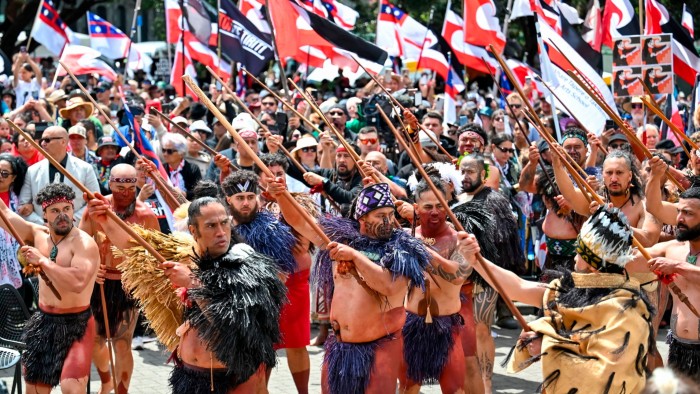
More than 40,000 people marched on the New Zealand capital this week, in a show of anger at a proposed overhaul of a treaty underpinning Maori rights, as a conservative backlash against the liberal policies of former prime minister Jacinda Ardern gained traction.
The protest — which included the famous “haka” dance — demonstrated the deep divisions in New Zealand, where the political pendulum has swung away from the progressive policies championed by Ardern.
Since taking power last year, the centre-right government of Christopher Luxon has swept away many of the preceding government’s landmark initiatives, empowered by a shift against the “Jacindamania” fervour that had delivered the Labour party a historic victory in 2020, but faded under the pressures of the pandemic and the rising cost of living.
“Liberal democracies around the world are under pressure. This is our version of it,” Helmut Modlik, leader of the Ngāti Toa tribe, told the Financial Times.
Luxon, a former Unilever executive and chief executive of Air New Zealand, has overseen a repeal of a “burp tax” on cattle farmers to reduce methane emissions, a ban on oil and gas exploration and one of the toughest smoking bans in the world.
His government has also backed away from Ardern-era initiatives related to the Maori population.
Oliver Hartwich, executive director of the New Zealand Initiative think-tank, said that Ardern policies including the establishment of a Maori health body, a proposal to hand control of water infrastructure to tribal groups and the renaming of government departments to Maori names — all since abandoned — had alienated many New Zealanders.
“That provoked a backlash but the pendulum has swung the other way,” he said, adding that the debate around Maori rights was “one hell of a mess”.
The protests this week followed the introduction of a bill on the Treaty of Waitangi, a document academics refer to as “New Zealand’s Magna Carta”. The British government and Maori chiefs signed the treaty in 1840 enshrining the rights of the country’s First Nations people and establishing guidelines on governance.
Under the proposed bill, championed by the libertarian ACT party, which is part of Luxon’s coalition government, the rights enshrined in the treaty would extend to all citizens, rather than just members of the Maori community. The bill would also allow parliament to define principles that until now have been interpreted by court rulings and then incorporated into law.
The introduction of the bill was in part the result of Luxon’s difficulty pulling together a coalition. His party agreed to introduce the bill to gain the support of the ACT party, which campaigned on the issue, to form a government.
Luxon has pledged that his National party will oppose the bill, despite backing its introduction, along with the other major parties. “You do not go negate, with a single stroke of a pen, 184 years of debate and discussion, with a bill that I think is very simplistic,” he told reporters last week.
ACT party leader David Seymour, who is himself of Maori descent, has denied accusations of undermining social cohesion by pushing for an overhaul of the treaty, insisting in a statement to the Financial Times that he merely wanted to challenge its interpretation in recent decades.
The treaty “has led to race-based preferences in healthcare, huge consultation requirements for development and even racial quotas within public institutions”, Seymour said. “New Zealanders were never consulted on this change.”
“ACT believes the Treaty promises what it says: nga tikanga katoa rite tahi — the same rights and duties for all New Zealanders.”
Alexander Gillespie, a law professor at the University of Waikato, said that Seymour was tapping into a public perception that the Maori population has unfair advantages. Social media has amplified that “prejudice”, he said.
Opponents of the bill argue that the Maori people still struggle. The Tūwharetoa Māori Trust Board, a tribal administrative organisation, said this month that indigenous unemployment rates have consistently been double those of the general population in the past three decades. Life expectancy of the Maori men is eight years lower than the New Zealand average, with a seven-year gap for Maori women, according to Health New Zealand’s annual report for 2023.
Even if the bill fails, as expected, some believe it could trigger a national referendum, which itself could deepen the political divide. Seymour has backed a referendum and believes that a public vote would support his view. “That is why other parties are so keen to shut down the debate — they know they’re on the wrong side of public opinion,” he said.
The debate has also echoed Australia’s failed “The Voice” referendum last year, which sought to enshrine recognition of indigenous communities in the country’s constitution. “Documents we assume are sacrosanct are not as safe as we think they are,” said Gillespie of the “dangers” of the debate.
Gillespie called on Luxon to restore the political and social consensus that had presided in New Zealand in recent decades.
Modlik took heart from the passionate response to the protest march, known as a hikoi. Many New Zealanders of European origin and other migrant communities had “turned out in force” to support the protest march, he noted.
“The vision for our nation was right before our very eyes as different communities united and said, ‘We are not accepting this divisive rhetoric’. It showed the unity of our people embracing our collective identity and saying [to Seymour] ‘It’s too late bro — the horse has bolted’,” he said.
Read the full article here

