


Unlock the White House Watch newsletter for free
Your guide to what the 2024 US election means for Washington and the world
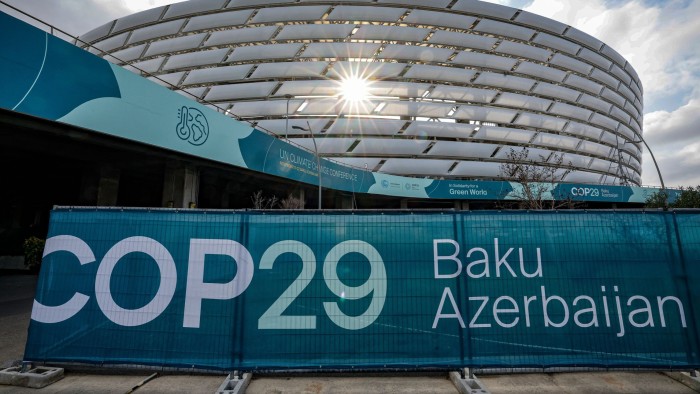
The host was rude to guests. The location was contentious and the agenda was declared unfit for purpose. The COP29 climate conference in Azerbaijan’s capital of Baku began in less than favourable circumstances. It did not help that voters in the world’s largest economy had just re-elected Donald Trump, a leader with no interest in fixing what he has repeatedly called the “hoax” of global warming. Nor that Trump’s ally in Buenos Aires, Javier Milei, hauled his country’s delegation home early amid speculation that Argentina might follow the US out of the 2015 Paris climate agreement that underpins the negotiations.
Despite these difficulties, COP29 showed multilateralism can still work, just, in an age of inflation-scarred economies and rising geopolitical turbulence. After fractious negotiations that ran more than a day over time and spurred vulnerable nations to stage an angry but temporary walkout, delegates from nearly 200 countries eventually met the meeting’s main goal by forging a new global funding deal to help poor nations manage climate change.
The agreement commits wealthy countries to lead a push aimed at tripling the amount of climate funding for developing countries to at least $300bn a year by 2035, via public finance, bilateral deals and multilateral efforts. That sum is far lower than the minimum of $1.3tn a year that the deal acknowledges should ideally be channelled by 2035, from both private and public sources.
Climate campaigners compared the outcome to putting a Band-Aid on a bullet wound and a handful of countries supported India’s condemnation of what it called an “abysmally poor” and paltry sum it could not accept.
But the far larger share of developing countries that reluctantly supported the deal reflects the political realities that shaped it. That includes the scramble for money in developed nations struggling to fund public services at home, and the fact that a better deal is unlikely at next November’s COP in Brazil, following nearly a year of the Trump administration.
In a welcome sign of how much COP climate finance talks have matured in the past three years, the Baku agreement also encourages the suite of financial reforms emerging to boost the deployment of private climate financing.
Wealthy nations struggled to meet a pledge to mobilise $100bn a year for developing countries by 2020. And the OECD reckons the amount of private finance mobilised by public climate funding has only grown from $14bn in 2021 to $22bn in 2022.
Multilateral development banks, not least the World Bank, are already working on measures to address investment barriers such as foreign exchange risks and regulatory uncertainty. Expanding these efforts is vital, as are other reforms intended to enhance the ratio of private climate finance generated from each dollar of public funding.
The Baku deal also underscores how fast the search for extra climate cash is growing to target activities once deemed too politically fraught to consider, such as international transport. It encourages governments to scale up “innovative sources” of finance, such as carbon levies on shipping and aviation.
In an ideal world, these sources would include a meaningful global price on carbon. In the real world, where prospects for such a measure look more remote than ever, pro-climate action governments are nonetheless aiming to encourage nations that already support carbon pricing to co-ordinate and expand their efforts ahead of COP30 in Brazil. All these steps will be needed in a world that has spent far too long avoiding the problem of climate change, and must now grapple with the bill.
Read the full article here

