


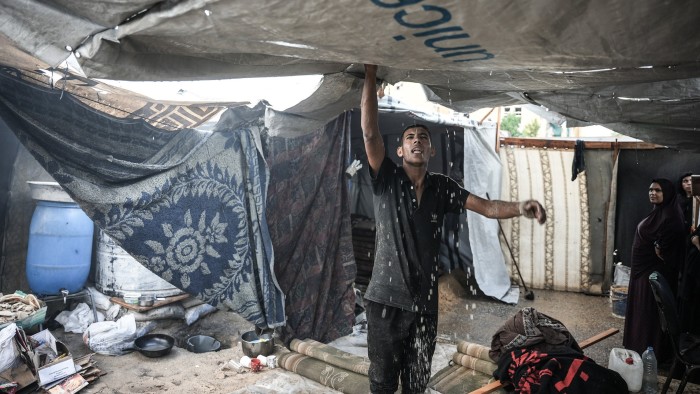
Aid officials warn that winter rains in Gaza threaten to unleash a deluge of sewage on to hundreds of thousands of displaced people living in tents more than a year into Israel’s invasion of the Palestinian enclave.
Winter in Gaza, which begins around November and lasts until February, is the rainiest spell of the year, exacerbating chilly conditions in which temperatures can drop as low as 8C.
Around 1.9mn of Gaza’s 2.3mn residents have been displaced during Israel’s ferocious onslaught conducted in retaliation for the Hamas-led October 7 attack on Israel last year.
They have little protection against the elements. More than a million people live in tents in the sandy al-Mawasi coastal area in southern Gaza where the lack of a sewage system has forced many to use pits in the ground as toilets. Severe Israeli restrictions on aid convoys have also led to shortages of winter essentials like warm clothes and blankets.
The UN has estimated that around half a million people across Gaza are in flood-prone sites that could be overrun with effluent once the rains start, said Louise Wateridge, a spokesperson for UNRWA, the main UN agency working in Gaza.
“When it rains, sewage is going to pile up in lower [elevation] areas,” she said. All displaced people “are using some kind of makeshift toilet and essentially trying to just get the sewage away from their shelter. But that doesn’t mean it’s not accumulating near somebody else’s or on the street.”
Hassan Abdallah, who has been displaced five times since he left his home in north Gaza at the start of the war, lives in a leaky tent with nine family members in Mawasi.
He said he had to dig holes 1.5 metres into the sand to use as latrines. He fears not just that rain will drench the family’s makeshift shelter but that overflowing sewage will ruin their meagre belongings such as mattresses and cause disease.
The shortages of goods have led to exorbitant prices for essentials. The number of aid trucks coming in fell to an average of 37 a day in October — compared with 500 a day before the war, according to the UN.
Armed gangs have also developed lucrative trades robbing incoming trucks and reselling the supplies at prohibitive prices.
The price of blankets has soared, for example, ranging from $50 to $100 depending on size. Abdallah’s tent is now worn out and torn, and to waterproof it he needs four tarpaulins, which could cost as much as $800.
“I don’t earn much as a barber and no one else in the family has an income,” he said. “Mawasi is like a desert by the sea with no buildings to shield us from the wind. When winter arrives, I bet half the tents here will be blown away.”
Wateridge said that 33 trucks loaded with mattresses had been parked for six months near the Gaza border in Egypt but had not been delivered because of the restrictions on aid deliveries. She said another 900,000 mattresses and a similar number of blankets were “under procurement, but we just have no way of getting them in”.
“At the current rate of aid entering it will take two years to get it to everybody, so that they can all have basic things like mattresses, blankets and waterproof tents and tarps,” she said.
Israel denies there is a humanitarian crisis in Gaza, and says it ensures that adequate volumes of aid reach the strip. But winter weather can only worsen the conditions endured by weary Gazans already weakened by hunger, aid officials say.
The IPC, an international panel of experts who monitor food insecurity, has warned that the entire strip is at risk of famine as early as this month. It said famine may be already occurring in northern Gaza, where Israel has been conducting a fierce military campaign for five weeks and has blocked the entry of food and other supplies almost completely.
Israel has said its offensive in the north is to prevent Hamas regrouping and to root out the militant group’s remaining fighters. It says it takes steps to protect civilians.
Wateridge said Gaza’s “extremely malnourished” population faced an additional risk of disease in winter. “People will get sicker because it all works together against their health and well being,” she said.
To help provide warm clothes for people in tents, Nidaa Aita, a displaced entrepreneur in Mawasi, launched the Thread and Needle initiative, a workshop of 20 women who recycle old and tattered blankets into winter clothes.

“There aren’t that many blankets on the market so we tell people, ‘You bring us your old ones and we provide the design and sew it up for you,’” she said. “For buttons we use seashells and the stones of dates.”
Aita bought a sewing machine for the workshop but, because there is no electricity, uses an upside-down bicycle to power it with an operator turning the pedals by hand.
Customers are charged a small sum, she said, which allows her to pay the women and make a small profit. “We are helping ourselves and helping others, but we can’t afford to buy another sewing machine,” Aita said.
In Deir al Balah in central Gaza, Om Hussam, a grandmother who also lives in a tent, said she had no warm clothes and could not afford a winter coat at $80.
“It has started to get cold and we don’t have enough clothes,” the former hairdresser, whose home and shop in Gaza City were destroyed, said. “Last year we borrowed a few items of clothing from people because we thought we would be returning home soon.”
Read the full article here

