


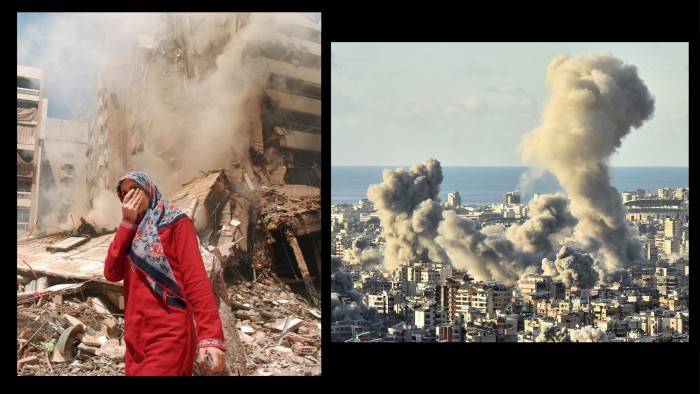
Following more than a year of spiralling conflict between Israel and Hizbollah, the guns are finally due to fall silent after President Joe Biden announced that a US-drafted ceasefire agreement will take effect on Wednesday.
If implemented, it will bring much-needed respite to Lebanon after months of relentless Israeli bombardment that has displaced about 1.2mn people and killed more than 3,750. In Israel, some 60,000 people displaced by Hizbollah’s constant rocket fire will be able to contemplate returning home.
A ceasefire would also reduce the risks of Israel and Iran — Hizbollah’s patron — engaging in another bout of direct conflict. At least for now.
That would diminish the danger of all-out war in the Middle East, which has been pushed to the brink during nearly 14 months of escalating hostilities from Gaza to Beirut and Tehran.
But it is likely to be a tenuous peace — a band aid that could come unstuck at any moment.
The agreement, which begins with an initial 60-day ceasefire, is based on UN Security Council Resolution 1701 that ended the 2006 war between Israel and Hizbollah but which neither side fully implemented.
Hizbollah’s forces are to withdraw from their stronghold of southern Lebanon and move north of the Litani River, which runs up to 30km from the border. Israel’s invading troops will pull back to their side of the frontier.
The task of ensuring security in Lebanon’s south and preventing Hizbollah regrouping will rest on soldiers from the Lebanese army and Unifil, the UN peacekeeping mission deployed along the border.
The two forces will also be expected to prevent Hizbollah rearming with Iranian weapons smuggled in via Syria or across the sea.
Yet over the past two decades, neither the Lebanese army nor Unifil have had the mandate, capacity or will to prevent Hizbollah doing as it wished.
One difference this time is that the agreement will include a reinforced, US-led monitoring mechanism that is supposed to call out violations, although the details of how it will be implemented remain unclear.
Crucially, Israel has repeatedly said it will retain the right to strike unilaterally if it believes Hizbollah poses an imminent threat — essentially a greenlight to violate 1701 and act as an “enforcer” with US cover.
How Netanyahu acts on that will go a long way to determining the sustainability of the ceasefire. Israel made similar threats in 2006, but has a very different mindset today.
Back then, many Israelis considered their military’s offensive a failure after Hizbollah fought the Middle East’s most sophisticated army to a standstill over 34 days.
Israeli commanders resigned and a government appointed inquiry was scathing in its criticism of political and military leaders.
Israel held its fire as a battered but emboldened Hizbollah re-took control of Lebanon’s south. Almost two decades of relative stability ensued, despite both sides violating the agreement.
But after Hamas’s October 7 2023 attack, Israel is far more abrasive and willing to pre-emptively go after its foes on multiple fronts. Battlefield gains have buoyed Israel’s confidence and reinforced its sense of military and intelligence superiority, and that it is in the ascendancy.
In particular, it has dealt devastating blows to Hizbollah, which is often described as the world’s heaviest armed non-state actor but is in a far weaker position today than in 2006.
Over 11 game-changing days in September, Israel decimated the group’s communications network by detonating thousands of pagers and walkie-talkies, killed senior commanders and Hizbollah’s leader of three decades, Hassan Nasrallah, and launched a ground invasion in the south.
The damage inflicted on Hizbollah, then and since, has no doubt convinced it to agree to deal before a ceasefire has been secured for Gaza, despite previously insisting it would only stop firing when Israeli troops were no longer fighting in the besieged strip.

The group will also be wary of US President-elect Donald Trump giving Netanyahu even greater licence to act when he re-enters the White House.
Hizbollah’s weakness also explains why it has accepted a deal with an apparent Israeli bias, and why Netanyahu is willing to ink the agreement despite opposition from far-right members of his cabinet.
It allows him to appease the outgoing president Biden, while eyeing the return of Trump and the expectation of an ever more pro-Israel stance.
But with confidence comes the risk of hubris.
Despite its battering, Hizbollah remains the dominant military and political force in Lebanon, a fractured, weak state.
It did not launch the scale of missile attacks on Israel many had predicted when after months of border clashes Israel launched a full-scale offensive, nor did it unleash its most potent precision guided missiles.
Israeli officials say this is because the bombardment of Lebanon destroyed its stockpiles and its capacity to strike. Others, however, believe the group held back some of its arsenal for another day.
The truth is probably somewhere in between. But Hizbollah has continued to strike deep into Israel and, with Iran’s support, will already be plotting its restoration.
It all makes for a combustible environment, and any optimism over the ceasefire will be tempered by fears about what may come next.
Read the full article here

