


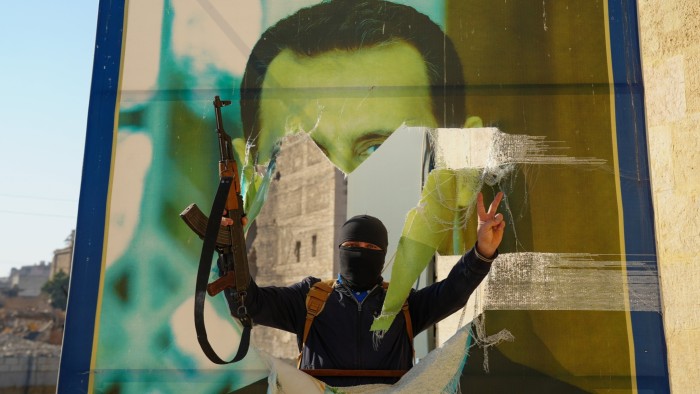
For more than a year, as conflicts between Israel and Iranian-backed forces spread across the Middle East and spilled into his own country, Syrian President Bashar al-Assad was conspicuously silent.
With a long civil war still simmering in Syria, the state broken and bankrupt, and the backers that propped up his regime — Russia, Iran, and Hizbollah — all distracted and weakened by their own conflicts, Assad lay low, seemingly hedging his bets.
But this week’s shock assault by Islamist rebels, who captured Aleppo, the nation’s second city, within 48 hours of launching their offensive, has dramatically exposed the instability in Syria, the fragility of Assad’s hold over his shattered country and the scale of opposition to his rule.
“Assad is extremely vulnerable,” said Haid Haid, a Syrian analyst at Chatham House. “Everybody is waiting to see [if] the regime can mobilise its forces and its allies to push back.”
Assad was already in a bind: Israel, which has launched scores of strikes against Iranian-affiliated targets in Syria over the past 12 months, publicly warned Assad he was in its crosshairs and had to choose sides.
But at the same time, Syria-watchers say, Assad may have seen a chance to regain a degree of autonomy from the foreign supporters on whom he depends, because Arab states and some European powers were beginning to wonder if they should rehabilitate the authoritarian leader.
It seemed the worst of Syria’s civil war was over, Assad was going nowhere and it might be a good time to deal with international issues such as refugees and drug smuggling, so the logic went.
But the startling rebel advance has underscored Assad’s dependence on Russia, Iran and Iranian-backed militants if he is to stave off domestic threats.
Pro-Assad forces melted away as the rebels, led by Hayat Tahrir al-Sham (HTS), marched on Aleppo, a city of 2mn people, and then advanced south towards Hama.
They appeared to be attempting to regroup on Sunday, as Syrian and Russian warplanes launched several air strikes on Aleppo and Idlib, the northwestern province that is HTS’s stronghold.
But analysts say the sense of demoralisation and hopelessness in Syria, 13 years after the civil war erupted out of a popular uprising against the regime, has spread to the rank and file of the army.
“Military units one after the other [were] just falling back and collapsing and abandoning their positions,” said Charles Lister of the Middle East Institute.
Syria’s economy has been teetering on the brink of collapse for years, hampered by unpaid debts to the regime’s foreign patrons, western sanctions, and the banking system’s collapse in neighbouring Lebanon, long a haven for Syrian businessmen.

Over the past five years, Syrians had grown poorer, and the regime had done little to improve people’s lives, said Syrian economic expert Jihad Yazigi. Added to the rising taxes, land expropriation and a crumbling economy “is the regime’s corruption, which is embedded in every aspect of the state”.
The Assad family’s perceived disregard for Syrians’ suffering and its own rapaciousness has helped spread discontent beyond the pocket of Assad opponents, and has metastasised across Syrian society, including among pockets of loyalists from Assad’s own Alawite minority community.
“Many are furious that after years of loyalty, they are even worse off than before,” Yazigi said.
Corruption and demoralisation now extends across many government institutions in Syria, as civil servants help oversee a state where very little functions.
Although there were recent attempts to professionalise the army, “it was a case of too little, too late”, Yazigi said. Morale has remained low with forcible conscription and the removal of subsidies continuing to hit soldiers hard.
In a rare instance of criticism of the regime from inside Assad’s most loyal community, one Syrian Alawite said: “We are prepared to protect our own villages and towns but I don’t know that Alawites will fight for Aleppo city . . . The regime has stopped giving us reasons to keep supporting it.”
The sense of despair has been deepened by the regime’s apparent unwillingness to compromise with its opponents, even as its patron Russia has tried to push Assad towards engaging in a political process, analysts say.
Yet efforts by Arab and some European states to re-engage with Assad had been revived after a devastating earthquake in February 2023 hit Turkey and northern Syria.
In July, Italy reopened its embassy in Damascus, joining a roster of smaller European states that have restored diplomatic relations with Syria.
Arab states, including some that initially backed rebels when the civil war erupted, have also sought to bring Assad in from the cold, with a Saudi-led push that saw Syria readmitted to the Arab League last year for the first time since 2011.
They hoped to draw concessions from Assad on drug smuggling which has fomented regional instability and to create a safe environment to allow refugees to return.
But Damascus has made negligible progress on either front.

Turkey, the main backer of the Syrian opposition groups, similarly showed interest in normalising ties with Assad, an overture he rebuffed.
Iraqi officials who helped broker talks between Damascus and Ankara this year said Assad’s government refused to give an inch on refugees, a flashpoint in Turkey’s domestic politics.
Instead, Assad continued to pound rebel-held Idlib, pushing thousands more people towards the border of Turkey, which hosts about 3mn Syrian refugees and has troops deployed in northern Syria, where it backs the rebels.
Analysts say Turkey may not have explicitly approved the HTS-led offensive, but they say the assault will serve its interests and potentially give Ankara more leverage in any negotiations.
“Assad had a chance since the summer to sit down with [Recep Tayyip] Erdoğan and work out a plan where essentially Turkey would take a zone of influence in northern Syria,” said Malik al-Abdeh, a Syrian analyst. “He had a chance to negotiate this in a face-saving way politically, but he refused.”
Assad has always regarded concessions as a sign of weakness, but the HTS offensive has underlined his dependence on Russia, Iran and Iranian-linked groups and the outsized role of foreign powers in Syria.
Assad’s first public appearance since the crisis erupted came only when Iran’s Foreign Minister Abbas Araghchi visited Damascus on Sunday night. Russia, Iran, and the United Arab Emirates have pledged to support the regime.
But with Assad backed into a corner, a diplomatic solution might be his only way out, despite his refusal to engage in one for years. “Assad can survive . . . but in the long run, there’s no way he can avoid sharing power with the opposition, and that will be the end of the regime,” said Abdeh.
Read the full article here

