


Stay informed with free updates
Simply sign up to the Chinese economy myFT Digest — delivered directly to your inbox.
Yields on China’s benchmark 10-year bonds slipped below 2 per cent on Monday, their lowest level in 22 years as investors bet on further monetary easing to help stimulate the world’s second-largest economy.
Yields on the 10-year sovereign note, which moves inversely to prices, fell to as low as 1.9995 per cent in the morning session, their lowest level since April 2002. The 30-year note yields dropped 3.1 basis points to 2.17 per cent. Both yields rebounded slightly in the afternoon session.
Investors are betting on further cuts to rates as well as the deposits that banks must keep as reserves, analysts said.
The move for China’s benchmark bond comes as the country’s long-term bond yields have fallen below Japan’s for the first time, with investors worried about the potential for a “Japanification” of the economy in which it becomes mired in persistent deflation.
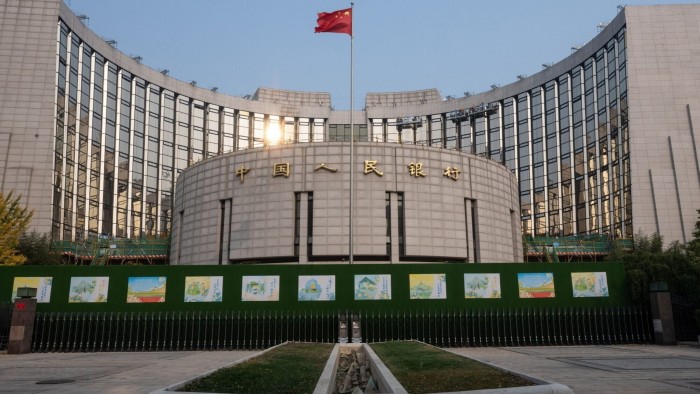
The People’s Bank of China has steadily guided rates lower in recent months to encourage more lending and kick-start the economy.
In September, it cut banks’ reserve requirement ratio by 50bp to an average of 6.6 per cent and the benchmark seven-day reverse repo rate by 20bp to 1.5 per cent. In October, it cut the one-year loan prime rate, the benchmark rate for banks to price their own loans, by 25bp to 3.1 per cent.
The economy is struggling to overcome years of crisis in the property sector and is beset by concerns about deflation. The election in the US of Donald Trump, who campaigned on a pledge of higher tariffs for Chinese goods, has added to broader anxiety.
Analysts and investors increasingly believe that these factors will push Chinese policymakers to ease monetary policy.
“The market in general expects that the monetary policy will continue to be proactive,” said Zhou Guannan, an analyst with Huachuang Securities. “The ample liquidity on the market and the expectation of easing measures will further boost the bond prices.”
A recent cut in non-bank financial deposits pressured yields, said Ju Wang, head of greater China foreign exchange and rates strategy at BNP Paribas. Investors also anticipate the central bank will fix the interbank repo rate at a lower level as well as cut the reserve requirement ratio by up to 50bp, she said.
Overall, the yields on China’s long-term sovereign debt have declined since the start of the year, as smaller Chinese banks with limited domestic investment options pile into the relatively safe asset of government debt. The 10-year note yielded 2.56 per cent at the start of the year, with the 30-year note yielding 2.84 per cent.
“Sovereign bonds remain highly appealing for investors as we approach year-end,” said Ming Ming, chief economist at Citic Securities. “There’s strong seasonal demand, particularly as bond issuance for the year has nearly concluded, reducing supply-side risks.”
The PBoC had previously intervened in the bond market, fearing high demand would create a bond market bubble, but the lack of fresh supply in December has tempered this concern.
Conditions favour declining yields, Ming said. “[Lower sovereign note yields] help lower financing costs for the real economy,” he noted. Looking forward, Ming expects the 10-year note yield to hover around the 2 per cent level, or slightly lower.
Also on Monday, the Chinese renminbi weakened to a four-month low after Trump said he would impose 100 per cent tariffs on Brics countries that supported attempts to “replace the mighty U.S. Dollar”.
The renminbi dropped 0.3 per cent to Rmb7.27 per dollar, its weakest level since late July as the US dollar index gained 0.5 per cent.
Additional reporting by William Sandlund in Hong Kong
Read the full article here

