


Unlock the Editor’s Digest for free
Roula Khalaf, Editor of the FT, selects her favourite stories in this weekly newsletter.
The writer is author of ‘Black Wave’ and an FT contributing editor
In late December, influential Lebanese Druze leader Walid Jumblatt visited Damascus and sat down with Syria’s new de facto ruler, Ahmed al-Sharaa. As Jumblatt nodded, Sharaa spoke the unspoken, in what was one of the frankest exchanges between Syrian and Lebanese politicians in more than half a century.
“To the leader Walid Beyk, we say, may God have mercy on your father’s soul, the [Assad] regime killed him,” al-Sharaa said, referring to the assassination of Kamal Jumblatt in 1977. The murder was widely blamed on Syria at the time, after Kamal stood in the way of then president Hafez al-Assad’s designs over Lebanon.
Al-Sharaa’s sad litany continued: “To the Gemayel family we say, the regime killed Bashir Gemayel. To the Hariri family, we say, rest your father’s soul, the Syrian regime killed Rafiq Hariri.” President-elect Gemayel was assassinated in September 1982, as Damascus attempted to stem its losses in Lebanon in the wake of the Israeli invasion and the election of the pro-western, pro-Israeli politician. In February 2005, Hariri was killed after he defied Syria’s continued military occupation of Lebanon.
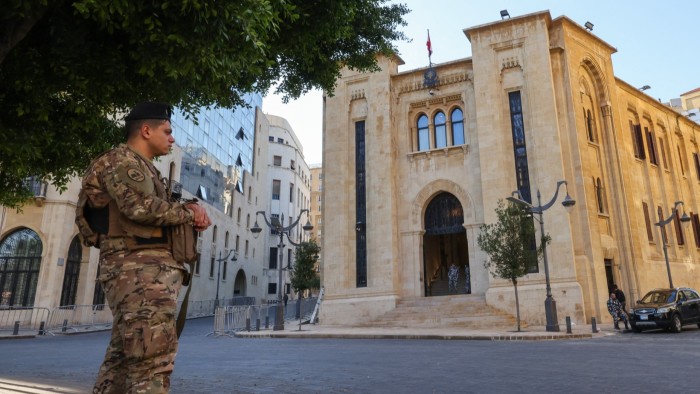
Since the fall of Bashar al-Assad, Hafez’s son, the focus has understandably been on the elation and catharsis that Syrians are experiencing, mixed with the uncertainties of a still nebulous new dawn. But across the border, in Lebanon, the traumatic weight of decades of Syrian interference and control has also lifted, ushering in a new sense of possibility — just as Lebanon’s parliament attempts, for the 13th time in two years, to elect a new president on Thursday.
Even after Syrian troops withdrew in April 2005, Damascus left behind a well-entrenched system, enforced by Hizbollah and Iran, which in turn upheld a corrupt political establishment that bankrupted Lebanon in 2019. For decades, Syria and then Iran had a chokehold on Lebanese politics and the ultimate say in who became president. Other regional and international powers have long had influence too. But standing in the way of Damascus or Tehran could get you murdered.
The ousting of Assad came barely two weeks after a ceasefire that ended a devastating Israeli military campaign against Lebanon and Hizbollah. The Shia militant group finds itself weakened and discredited. The Iranian axis is in disarray. This provides a unique opportunity to reimagine Lebanon’s future without the threat of violence, in a region that is in flux. This year, Lebanon also marks the 50th anniversary of the outbreak of civil war, a good time to shed the remaining vestiges and sclerotic politics of that era.
For decades, Lebanese politicians complained that outside forces prevented them from truly delivering for the country’s citizens — or elect a president for the past two years. Judging from the bickering and political manoeuvring over the past few weeks, they have proved they’re just as guilty of failing the Lebanese people.
Most of the country’s leaders and legislators of all religions and sects seemed focused on advancing their own narrow interests. Hizbollah is trying to salvage what it can from the ashes while the Speaker of parliament, Nabih Berri, also a Shia and traditionally an ally of the group, is trying to push for a malleable president after his preferred option is no longer viable.
One can bemoan how this moment emerged in the region after a decade of international indifference to Syria’s plight and a year or more of devastating Israeli military campaigns in Gaza and Lebanon. One can also despair at the spectacle of Lebanese political wheeling and dealing, as well as arm-twisting ahead of Thursday’s vote by French, Saudi and American diplomats exasperated by the paralysis. But Lebanon’s parliamentarians can also show they have agency and do their job by electing a president who can unite the country, rebuild the state, promote accountability and make Lebanon a player again in the region, rather than an irrelevant irritant. The 60-day ceasefire agreement with Israel ends later this month. The spectre of renewed war is still on the horizon. Lebanon needs a president and a government that can negotiate the next phase.
In spring 2005, as people took to the streets to protest against Syrian occupation, Lebanese-Palestinian intellectual Samir Kassir, a staunch critic of the Assad regime, wrote that “when the Arab Spring blooms in Beirut, it announces the time of roses of Damascus”. Kassir was assassinated a few months later. He was also convinced that without a free Syria, democracy in Lebanon would remain incomplete. The path has been long and painful, but now is the time to test Kassir’s proposition.
Read the full article here

