


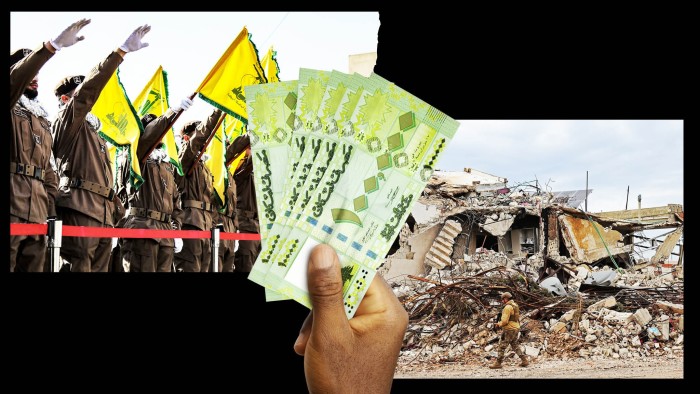
After her son, a Hizbollah military officer, was killed in an Israeli air strike in southern Lebanon last year, Umm Hassan made lapel pins of his image to commemorate him. When the pain was at its worst, she told herself he had chosen this path.
Umm Hassan, 56, was also consoled by the expensive private school her grandchildren would attend thanks to Hizbollah’s Martyr Foundation. Though she was not a party member, she said the group “had not left anyone behind”.
But her faith was mixed with contempt for Hizbollah’s bloated ranks, with middling leaders who stayed away from the front lines and, she said, included Israeli collaborators: “It would not have gotten this bad if there had not been traitors.”
Hizbollah, long Lebanon’s most powerful political and military force, is reeling from its worst ever defeat. In over a year of conflict before a ceasefire in November, Israel not only killed thousands of fighters and decimated its senior leadership, but caused enormous destruction in Shia-majority communities from which Hizbollah draws support. The fall of ally Bashar al-Assad in neighbouring Syria dealt another blow, cutting off vital supply chains between Hizbollah and its patron Iran.
With the group now under pressure, keeping the faith of constituents such as Umm Hassan is vital to its future. Central to this effort is Hizbollah’s sprawling network of social welfare organisations including schools, hospitals, and its construction arm Jihad al-Bina, which has deployed hundreds of engineers to survey damaged homes and start repairing its heartland.
“Hizbollah is asking itself questions . . . about its organisational structure, because their role has changed, and the task has changed from the regional to the domestic,” said Nassib Huteit, an academic close to the party.
The Financial Times spoke with more than 20 people about how Hizbollah is shoring up its base, including local officials, residents who benefit from the group’s social welfare system and people with knowledge of the party’s thinking.
After its last war with Israel in 2006, Hizbollah deepened support by making good on the vow of its longtime leader Hassan Nasrallah to rebuild “better than before”. With funds from Iran, its own commercial enterprises and state compensation payments, party-linked institutions took a prominent role in reconstruction.
But today the organisation faces far greater destruction and is without Nasrallah, who was killed by Israel last year. Israel’s offensive, which began after Hizbollah started firing rockets across the border following Hamas’s October 7 2023 attack, culminated with an invasion in October 2024. More than 4,000 people in Lebanon and at least 140 from Israel were killed.
Still, its postwar repair system is in full swing. In the battered south, every four or five villages is assigned a committee of about a dozen engineers, a local official said. These committees had inspected more than 270,000 homes as of late January, according to Jihad al-Bina.
Once the appraisals are reviewed by Jihad al-Bina’s Beirut headquarters, residents are told to pick up their compensation cheques and cash them at their local branch of Hizbollah’s microfinance lender al-Qard al-Hassan, more than 30 branches of which were hit by Israeli strikes.
In the central market of Baalbek, a paper sign fluttered from the rubble of what was once one of its offices: “We’re glad to welcome you at our branch down the road!”
The FT reviewed messages sent by a local Hizbollah official to a WhatsApp group of residents in a southern Lebanese village: multiple pages of spreadsheets complete with names and registration numbers.
“Hi everyone, these are the names of the people whose cheques have arrived,” the official said in a voice note. “You can come and collect them tomorrow morning.”
“And just so no one complains, ‘Oh, my cheque didn’t come’, these are just the cheques that have arrived so far,” he went on in a tired voice. “Also, the names that are struck out are people who are not from [the village] . . . Don’t think I removed a specific person.”
According to pro-Hizbollah daily al-Akhbar, the party has distributed $400mn worth of compensation payments to almost 140,000 people. People who lost their entire homes receive between $12,000 to $14,000, meant to cover a year of rent elsewhere and destroyed furniture.
But the official’s defensiveness came as some in Lebanon were aggrieved by the process. In the Hizbollah heartlands of the Bekaa Valley, southern Lebanon and Beirut’s southern suburbs, both supporters and non-supporters described what they saw as stingy or slow practices in appraising damage and compensating them.
Ahmed’s apartment in Baalbek, for example, was wrecked when an Israeli missile targeted the flats below, which he said the landlord had rented out to members of Hizbollah’s military wing.
He was sure the damage was worth at least $10,000, but the cheque that arrived was for $2,500. Ahmed was incensed. “We’re living in the house, trying to fix what we can ourselves, but it’s hard — we don’t even have running water,” he said. “We don’t have any trust in the state, and we hate the parties, but the parties made us hate the state.”

Many linked what they saw as Hizbollah’s tight-fisted payments to its new geopolitical reality, its coffers drying up following Israel’s offensive and Assad’s fall which cut off Syrian supply routes connecting it to Iran’s so-called Axis of Resistance, of which Hizbollah was once the star.
Others described how Hizbollah had thrown up bureaucratic hurdles, such as demands for receipts or vehicle registrations, that residents thought were designed to be so time consuming that they would give up. One man said he rejected a $905 cheque, to him an insultingly precise underestimate.
Hizbollah told the FT their “teams are working day and night”. “When people find there is a problem with the compensation amount, they object and their objection is considered if it is justified,” the group said. “Everyone will get what they deserve.”
Hizbollah’s bureaucracy was nonetheless more attentive than that of the state, residents of the south said. They cited the free medical care from Hizbollah’s health organisations and the aid payments doled out to the displaced throughout the war.
Many say, however, that Hizbollah and its patron Iran lack the means to lead reconstruction this time, given the scale of the task. The war caused at least $3.4bn in physical damage, according to the World Bank. Even Hizbollah’s leader Naim Qassem stressed the state’s responsibility, saying in December: “Fundamentally, restoration and reconstruction will be the government’s to follow-up on and we will be by its side.”
Hizbollah was also dealt a political blow last month with the selection of a president and prime minister seen as committed to reducing its influence in Lebanon. Their candidacies, which were championed by the west and the Gulf Arab nations, could help facilitate international funding for reconstruction which analysts expect to be diverted away from Hizbollah.
Hizbollah and allied party Amal also failed to negotiate a blocking minority in the cabinet appointed by those leaders on Saturday, reducing their leverage over government decisions.
But Hizbollah may not be sidelined so easily. Hussein Kamaleddine, a local official in the southern village of Srifa, said the group’s local networks were nimble. The party had been careful to placate its beneficiaries and smooth over disagreements because it knew the stakes, he said.
“Militarily, they’ve been depleted,” he said. “They need time. But they have institutions.”
Data visualisation by Aditi Bhandari
Read the full article here

