


Unlock the Editor’s Digest for free
Roula Khalaf, Editor of the FT, selects her favourite stories in this weekly newsletter.
How do you know when a bubble has popped?
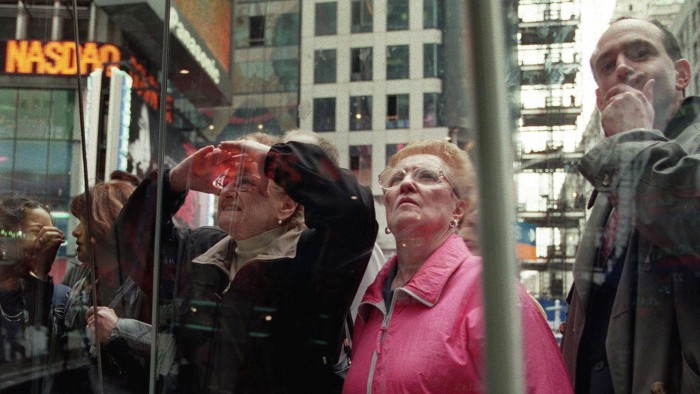
Twenty-five years ago on Monday, a multiyear US stock rally hit its peak and began a precipitous decline that would wipe 77 per cent off the value of the Nasdaq by the time it finally cratered two years later.
These days, the dotcom bubble has become shorthand for foolhardy enthusiasm for new technology and blind greed. So many investors were throwing money at blatantly unprofitable internet companies that the markets were bound to come to grief.
But if you look back at what people were saying in March 2000, it becomes clear that spotting the exact turning point is a lot harder than you might think.
Though regulators were already warning about biased investment advice and flimsy business plans, the Financial Times of that era was full of stories about the “phenomenal Nasdaq” reaching “dizzying heights”. Even five weeks after the index had begun to tumble, there was optimistic talk about “markets recovering their poise” and “extending the recovery”.
That history seems particularly relevant this week. Although the S&P 500 hit a new record less than three weeks ago, global markets are in turmoil over US President Donald Trump’s on-and-off again tariffs, and some key economic indicators are looking decidedly gloomy. American consumer confidence is falling and manufacturing orders have tumbled. By midday on Friday in US, the S&P 500 had given up all of its post-presidential election gains.
Particularly worrying for those who see parallels to 2000, the Magnificent Seven big tech stocks that powered the broader market last year are now in correction territory, down 12 per cent from the highs they collectively hit in December. Their fourth-quarter profits were not particularly bad — Google parent Alphabet reported double-digit increases in revenues and profits for one.
But investors are starting to ask more questions about the billions of dollars being spent on artificial intelligence and related data centres and power sources and when exactly it is going to translate into increased growth.
To some long time investors, that sounds eerily familiar to the loss of confidence in dotcom companies that took hold after the US Federal Reserve started raising interest rates in 1999. Once funding became more expensive, lossmaking start-ups such as Pets.com and Webvan ran out of money. Their telecom and technology providers started to struggle as well, pulling down the broader market. The US entered a recession in March 2001.
To be sure, the parallels are not exact. They never are. While most of the dotcom companies were ephemeral newcomers, the Mag 7 include some of the world’s most profitable and impressive groups including Apple, Amazon and Microsoft, as well as the main supplier to the AI economy, Nvidia.
This generation’s splashy start-ups are harder to get a handle on because they have eschewed flotations and stayed on the books of venture capitalists and private equity firms much longer. But it cannot be a good sign that PE’s total assets are shrinking for the first time in decades.
When money is cheap, it does not matter as much if capital is being sprayed around inefficiently. But higher interest rates eventually force even the richest companies to focus their efforts, and the uncertainty around Trump’s tariffs will probably further discourage corporate investment. The consequences for the broader economy could be profound.
“Some things change, but human beings, bless them, do not. All the signs of a classic bubble are upon us,” says Jim Grant, a financial journalist and perma-bear who predicted both the dotcom crash and the subprime mortgage mess that triggered the 2008 financial crisis.
However, he warns that “the patterns are familiar but the timing is unknowable and contrived to torture the earliest adopting bear.” He should know. His forecasts were correct but so far ahead of the actual collapses that investors who followed his advice lost out on significant gains.
The experience this year of Nvidia is instructive. The emergence of DeepSeek, the Chinese company that claimed it could run AI on less computing power, wiped $600bn off the chipmaker’s market capitalisation in January while dragging down utilities and other tech stocks. Nvidia’s share price then clawed back most of its losses as investors convinced themselves that cheap AI would lead to more rapid adoption and more spending.
But that recovery hasn’t lasted either. Nvidia shares are down around 25 per cent from their 52 week highs. Is that the sound of escaping air or just the wind?
Follow Brooke Masters with myFT and on X
Read the full article here

