


Stay informed with free updates
Simply sign up to the Life & Arts myFT Digest — delivered directly to your inbox.
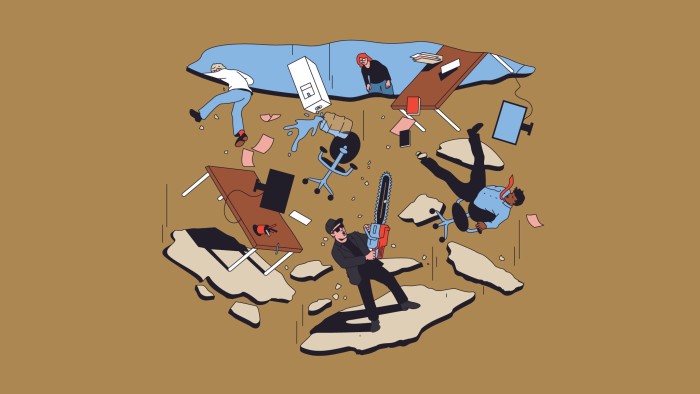
Elon Musk’s crusade to root out fraud in government is piling up evidence that, in fact, federal workers are overwhelmingly clean and useful. Musk’s Doge team keeps trumpeting discoveries of “fraud”, then quietly removing them from its Wall of Receipts, as it learns what government actually does. At one point, Doge “deleted from the website all five of the biggest savings it had claimed”, reports Reuters. Donald Trump told Congress that Doge has found “hundreds of billions of dollars of fraud”, but the fiscally conservative Manhattan Institute estimates Doge’s true saving is “closer to $2bn, or 0.03 per cent of federal budget”.
Cutting 100,000 plus federal workers may have downsides. Even libertarians might want government to do its unseen work of averting catastrophe, such as preventing sabotage of the electrical grid or nuclear weapon leakage. Doge’s initial mass firing of nuclear staffers removed, among others, the “acting chief of defence nuclear safety and other emergency personnel”. Waste and fraud indeed.
Doge is an extreme iteration of the Anglo-American tradition of bureaucrat-bashing pioneered by Ronald Reagan and Margaret Thatcher. Russell Vought, who heads the Office of Management and Budget, has said in private: “We want the bureaucrats to be traumatically affected. When they wake up in the morning, we want them to not want to go to work because they are increasingly viewed as the villains.” This “villain” fantasy misunderstands why most people enter public service.
First, a caveat. Of course there’s waste in the public sector. There’s waste in the private sector too. Yes, “bureaucrats” want higher pay and better conditions. Everybody does. Sometimes this impulse descends into self-dealing: during the pandemic, certain American teachers’ unions kept schools closed long after vaccines arrived. Some people only joined government for the job security, though that has eroded.
But most underpaid civil servants, teachers, nurses or police officers chose their work. Last October, I attended a discussion about the state of the UK in Ilkley, Yorkshire, where audience members would get up and say, “I spent 40 years in the probation service, and one issue is . . . ” And, “As a retired headteacher . . . ” These people had asked what they could do for their country. Bafflingly to Musk, the profit motive didn’t apply.
Some stars join central government as the place to make a large-scale impact. Michael Lewis’s 2018 book The Fifth Risk, about the workings of the federal government, cites examples: “A guy in the Energy Department (Frazer Lockhart) organized the first successful cleanup of a nuclear weapons factory . . . and had brought it in sixty years early and $30 billion under budget. A woman at the Federal Trade Commission (Eileen Harrington) had built the Do Not Call Registry, which spared the entire country from trillions of irritating sales pitches. A National Institutes of Health researcher (Steven Rosenberg) had pioneered immunotherapy . . . ”
Somebody else lent money to an electric-vehicles start-up called Tesla “when the private sector would not”, writes Lewis. He cites an expert observing that the best US “bureaucrats” were often “first-generation Americans who had come from places without well-functioning governments”. They knew government mattered.
How to improve it? You could sack and defund workers. Or you could assume — as Musk presumably did at Tesla or SpaceX — that employees are driven people wanting support.
The avatar of support was British educationist Tim Brighouse. In 2003, he took charge of London’s failing state schools. I myself had graduated in 1988 from a typically poor one, where working-class kids were expected to leave at 16. Brighouse assumed that teachers and pupils wanted the best. He handwrote thousands of letters to individual teachers. He advised one nursery teacher upset by a “reform” to set fire to the relevant paperwork in her garden and dance around it. He added: “It won’t make any difference, but it might make you feel better.”
His famed list, “20 Things that Teachers Do”, included these nuggets: “The morning: offer a welcome to every child”; “praise in writing”; “give them a cutting from a newspaper or magazine”, saying, “I saw this and thought of you.” Shortly before his death in 2023, he said, “the essence of teaching” was “to work on children’s self-esteem along with high expectations”.
For countless reasons, probably including Brighouse, London’s schools jumped from worst-ranked in England to best. I suspect Musk is rooting out quite a few Brighouses.
Email Simon at [email protected]
Find out about our latest stories first — follow FT Weekend Magazine on X and FT Weekend on Instagram
Read the full article here

