


Unlock the White House Watch newsletter for free
Your guide to what the 2024 US election means for Washington and the world
Sir Keir Starmer, Britain’s prime minister, is turning towards air and sea support to defend Ukraine, a shift from his previous focus on European “boots on the ground” to secure any peace deal with Russia.
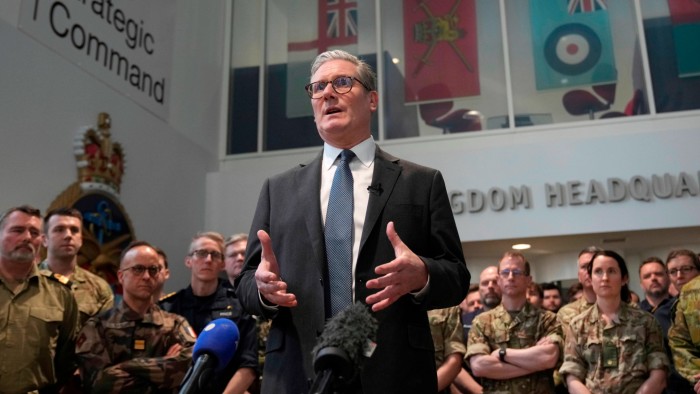
Speaking at a meeting of military planners from a 31-country “coalition of the willing” near London, Starmer said Russian President Vladimir Putin had to know “there will be severe consequences” if he broke a ceasefire.
But while Starmer has in the past focused on putting boots on the ground, on Thursday he stressed the role of sea and air power in “defending the peace”.
The prime minister said there could be different pathways to a permanent ceasefire, adding: “We’re looking at the sea in one scenario, the sky, obviously land and borders and regeneration.”
But he insisted the priority had to be to support Ukraine in defending itself, “They’ve got the capability, they’ve got the numbers and they’ve got the frontline experience,” he told journalists at the Northwood UK military headquarters.
“So we’re not talking about something that replaces that capability — we’re talking about something that reinforces that and then put around it capabilities in relation to air, water and sea and land.”
The last western leaders’ discussion among the ‘coalition of the willing’ — a video call last Saturday — also saw a noticeable shift from European troops on the ground to air and sea patrols instead, according to a person in the meeting.
Putin has made it clear that he would not tolerate the presence of troops from Nato countries in Ukraine under any peace agreement and the military complexity of a big multilateral troop deployment is considerable.
Starmer has also conceded that there is no sign so far of US President Donald Trump providing the military “backstop” that such a peace guarantee force would require.
One British official said Starmer on Thursday was merely “expanding on what the reality of our role might be and the nature of moving to the operational phase”.
The UK prime minister insisted that Putin did not have a veto over troop deployments by the coalition in Ukraine. “Putin wants a defenceless Ukraine,” Starmer said.
British officials have previously said a multinational force could include up to 30,000 troops. Russia and Ukraine have deployed hundreds of thousands of soldiers in the conflict.
Briefing several hundred military planners — mainly from Europe but also from countries including Australia, Canada and New Zealand — Starmer said it was essential to be ready to act swiftly in the event of a ceasefire.
The meeting followed a video call of political leaders convened by London last weekend, and an initial meeting of chiefs of defence staff in Paris last week.
Emmanuel Macron will host a meeting of European leaders and Ukraine’s Volodymyr Zelenskyy in Paris next Thursday to discuss support to Kyiv, the French president said on Thursday.
Starmer said that in the wake of “important talks” between Trump and Putin on Tuesday, “a timetable now is coming into focus” for a potential ceasefire.
Relations were dented earlier this week when the European Commission revealed it would exclude British arms companies from a new €150bn defence spending fund until London and Brussels agreed a fresh security pact.
Asked about the move, Starmer said he was “really pleased that the EU has brought together such a successful package”, saying Britain wanted to play a full part in boosting Europe’s collective self defence.
He said he was speaking to Ursula von der Leyen, European Commission president, “pretty well all the time” and was looking for ways to “take this forward together”. Starmer wants to negotiate a security pact with the EU as part of his wider “reset” of post Brexit relations.
EU officials have sought to downplay the UK’s exemption from the initiative and stress their desire to swiftly sign a deal with London that would allow British companies to take part, in a bid to rectify the irritation at Brussels’ Wednesday announcement.
“There is good momentum with the Brits on defence and we want to keep that moving,” said one of the EU officials, adding that bilateral discussions with senior UK counterparts had taken place since the publication of the terms.
Starmer insisted that any British move to reinforce security in Ukraine would not mean any “pulling back from our commitments to other countries”. UK forces are deployed on Nato’s eastern flank, including in Estonia.
Jack Watling of the Royal United Services Academy think-tank told its conference on air power on Thursday that any European contingent in Ukraine would likely be based around air power rather than ground forces.
“The Russians freed up a week ago 22 brigades worth of troops in Kursk, and they’re going reassign those to other bits of the front,” he said. “That constituted around 70,000 troops more combat power than the entire British Army could generate in the field.”
Read the full article here

