


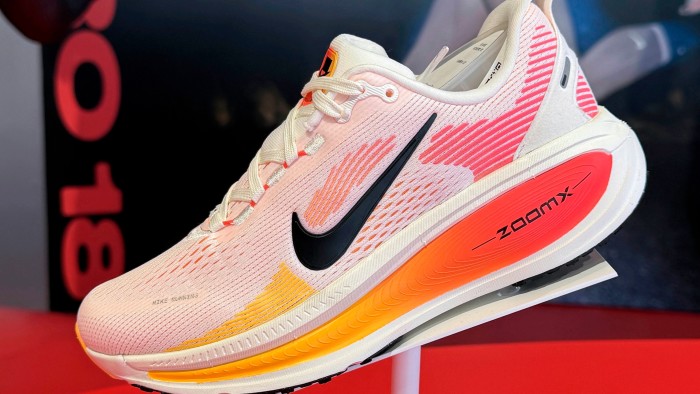
The Vomero 18 running shoe on display at a Nike store in New York features thick soles, a $150 price tag and tongue labels woven with the message “Made in Vietnam”.
That last fact is a big problem for Nike’s plans for a turnaround under chief executive Elliott Hill, who this year launched the Vomero 18 to win back runners who have switched to other brands. Vietnam has become the global centre of athletic shoe manufacturing — and it is subject to some of the most punishing US tariffs imposed by US President Donald Trump this week.
Trump has said he wants to bring manufacturing back to US shores. Analysts say the more likely effect will be higher prices for trainers, as the US lacks factories with the specialised equipment to make running shoes and workers with the knowhow to operate them.
US-based Nike began manufacturing in Vietnam in 1995, through five contract footwear factories, becoming one of the country’s earliest foreign investors and contributing to its exports and economic growth. The company expanded its supplier base rapidly in the following years and created thousands of jobs, attracted by the cheaper labour force.
Nike now has 130 supplier-factories in Vietnam producing shoes, clothing and equipment, and the country accounts for half of its footwear production.
Adidas, its Germany-based rival, gets 39 per cent of its shoes from the south-east Asian country.
Trump’s new 46 per cent tariff will be layered on top of 20 per cent duties already paid on US imports of athletic shoes with textile uppers, according to the American Apparel & Footwear Association.
Manufacturers could open trainer factories in new countries, but relocating footwear supply chains typically takes about two years, said Chris Rogers, head of supply chain research at S&P Global Market Intelligence. Companies typically plan such changes on a five-year cycle.
Adam Cochrane, a Deutsche Bank analyst, suggested that Mexico, Brazil, Turkey, and Egypt could be alternatives to Vietnam as manufacturing hubs. However, due to the length of order contracts with suppliers, it would take 18 to 24 months for any decision to result in tangible changes on the ground.
As well, Trump has imposed so-called reciprocal tariffs at a minimum rate of 10 per cent on virtually every trading partner. For major footwear hubs such as China and Indonesia, the new rates are more than triple that.
“Finding a cheaper market without leaving the planet is going to be tough,” said David Marcotte, senior vice-president of retail at consultancy Kantar.
Nike did not respond to a request for comment. In a quarterly report filed on Thursday, the company said: “We are navigating through several external factors that create uncertainty and volatility in the operating environment, including, but not limited to, geopolitical dynamics, new tariffs, tax regulation and fluctuating foreign exchange rates.”
The company last year appointed Hill as CEO after falling into a sales slump as running shoes from smaller competing brands such as On and Hoka grabbed market share.
Its shares plummeted to a nearly eight-year low this week as investors took fright at the costs associated with Trump’s new tariffs.
For a footwear brand, “You’ve got three primary avenues here from a cost mitigation standpoint,” said Dylan Carden, analyst at William Blair. “You can push back to get your suppliers [to] charge you less. You can try to push price on consumers, and charge more. Or you can eat it.”
Cochrane estimated that Adidas and Puma, another Germany-based brand with extensive manufacturing operations in Vietnam, would need to increase prices in the US by around 20 per cent to maintain gross profit margins following the tariffs, though price rises might spread out over time to curtail damage to market share and operating profits. Both companies could be better off than Nike though, as they sell less in the US, he said.
Felix Dennl, an analyst at Metzler bank, said that Adidas was “well positioned” for price increases due to its “broad-based brand momentum in both lifestyle and performance segments”.
Puma, on the other hand, would find it “significantly harder to pass on increased costs”, as its efforts to rebrand as a premium shoemaker have so far failed to gain momentum — one of the reasons for the replacement of Puma chief executive Arne Freundt on Thursday.
Overall, sporting goods manufacturers would “scrutinise their product range in the US”, Dennl said, phasing out less profitable products.
Adidas declined to comment. Puma said it had “a multi-country-of-origin strategy and many of the long-term partners in our supplier base can produce in several different countries”.
Vietnam received a new wave of manufacturing investments during Trump’s first term in office, when he started a trade war with Beijing that prompted companies to shift production away from China. Suppliers to footwear manufacturers in Vietnam are not only local companies, but also South Korean and Taiwanese groups operating there.
The migration to Vietnam led its trade surplus with the US to balloon to $123.5bn last year, the third largest after China and Mexico. The White House used trade balance figures to calculate each country’s “reciprocal” tariff rates.
Cochrane, the Deutsche Bank analyst, said that the trainer brands might have to “reduce order volumes and reroute more products to Europe, the Middle East and China”, which could result in increased competition in those regions.
In the US, where 99 per cent of footwear is imported, Carden said the market might become more like the Soviet Union, when Russian residents paid foreign visitors a handsome premium for Levi’s jeans.
“We’re behind the Iron Curtain,” he said.
Data analysis by Clara Murray
Read the full article here

