


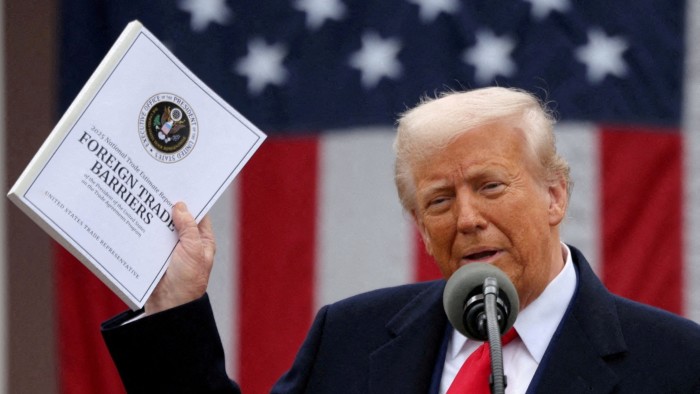
It would be hard to top last week’s hilariously misnamed “liberation day” for extraordinary drama, but it seems a defiant President Donald Trump regrets nothing and is bent on causing a full-on market crash. Any prediction I might make now is hostage to the markets — there must surely be some level at which he draws back — but there really does seem to be a lot of momentum behind his rank idiocy.
I’ve had lots of people asking if I was surprised by what he announced last Wednesday. The answer: yes and no. I had no idea the administration would use such a mad formula to calculate the bogus “reciprocal” tariffs, but some kind of chaos looked inevitable. I predicted before the election there would be turmoil because Trump was promising “at least five sometimes contradictory or outright impossible policies”.
In today’s newsletter I look at what might come next in the short, medium and long term, or at least what to watch for. Charted Waters, which examines the data behind world trade, is on last week’s market reaction to the tariff announcement. And now the first reader question for a while: how long do you think the tariffs will last? Answers to me at [email protected].
In the short term
Despite past performance, I have no crystal ball and I’ve already been wrong on one big thing, the size of China’s retaliation to Trump’s “liberation day” tariffs. But here’s my guide about what to watch, with a few vague guesses thrown in.
Barrelling ahead to disaster
What might put Trump off from going ahead with these tariffs and adding more in the next few weeks? Truly gigantic falls in equity markets or industrial production lines visibly grinding to a halt, I guess. But I think this has to be a decision he takes himself, not one that anyone can rationally persuade him of. There’s some chatter about Treasury secretary Scott Bessent, once billed as The Voice Of The Financial Markets, leaving the administration — though as Dorothy Parker said about the death of Calvin Coolidge, how could they tell? None of Trump’s officials who might counsel against the tariffs is able to convince him.
Business lobbies have been generally spineless standing up to him and I doubt he’s suddenly going to listen to them now unless he independently observes and comprehends economic chaos. Nor have the contradictions in his trade policy been addressed. There’s been open disagreement about whether the “liberation day” tariffs can be negotiated away or not. There’s some talk that the 10 per cent “baseline” tariff is permanent and will stay there for revenue-raising purposes, but it’s wildly implausible that the said tariff (or indeed any tariff) can make a significant contribution to federal finances. In terms of policy coherence, we’re where we were five months ago.
Hitting back or making a deal
China decided to hit back harder than many (including me) expected, though possibly only to give it more leverage to agree a deal. Meanwhile, the EU has been signalling retaliation and isn’t in the mood for big concessions. Economies highly dependent on exports to the US — Vietnam, Cambodia, and to a lesser extent Japan and South Korea — are rushing to agree what will be highly one-sided deals. So is Javier Milei in Argentina, for more ideological reasons. (Though if Milei thinks he’s going to get more access to the US market for his farmers’ soyabean exports, he can whistle.)
Otherwise the reaction is more muted. Some countries (Brazil, the UK) aren’t that affected. A lot of these deals won’t have much effect on US exports or production. Despite the latest stream of consciousness from commerce secretary Howard Lutnick, who has unwisely been allowed to roam the TV studios again, the US is not going to be assembling iPhones and shipping them to Vietnam. See below for the possible effect on the world trading system of such deals.
Congress and the courts are a long shot
I remain sceptical that the other two branches of government are going to do much to stop these and more tariffs coming. Republican lawmakers are obviously worried about the markets, but there has been very little appetite for resisting Trump. Mike Johnson, Speaker of the House of Representatives, has actually acted to reduce congressional influence on tariffs. A move in the Senate last week to block the state of emergency that Trump used as justification for his tariffs attracted a feeble four Republican votes and remained miles short of the two-thirds necessary to overcome presidential veto. One of those votes was Mitch McConnell, the former Senate majority leader who put up very little resistance to Trump’s agenda and is stepping down at the midterms. (There’s no one as brave and principled as a retiring US senator.) As for the courts, cases have already been filed against his use of the International Emergency Economic Powers Act, and some very eminent scholars argue they should have a chance. But the judicial instinct to defer to presidential executive authority on national security matters is a very strong one.
Down the line
Getting the tech bros on the coercion case
If Trump finds his tariffs aren’t working to coerce other countries as he might like, the possible next stage will be for him to start looking at a more modern set of instruments: wielding control of satellites through Elon Musk’s Starlink, tightening export restrictions on chip technology and, the big one, using dollar payment systems as leverage. For today’s FT Economics Show podcast (the transcript is here), I’ve interviewed Georgetown political science professor Abraham Newman on weaponised interdependence. (See also his piece in Foreign Affairs authored with Henry Farrell on whether US tech companies will lose out in a transatlantic digital war, and his paper with the European Council on Foreign Relations’ Agathe Demarais on how Europe should be preparing for geoeconomic conflict.) It’s interesting that Eutelsat, the European rival to Starlink, is trying to expand rapidly and deliver thousands of new internet terminals into Ukraine. I’d just make one observation: the Biden administration made sustained and determined efforts to use all these tools, yet they didn’t noticeably hold back China’s technological development nor stop Russia fighting the Ukraine war.
The distant rumble of currency war
Governments are understandably concerned that the diversion of trade out of the US market will leave a lot of cheap goods washing around the world trading system. They’re likely to impose a lot more anti-dumping duties, which have already risen sharply on imports from China after Beijing unhelpfully switched back to an export-led growth model. In the past couple of decades, this has often resulted in a currency war as everyone tries to depreciate their way to competitiveness. We might well get back there again. (Good luck to the Trump administration with its Mar-a-Lago Accord in that case.) Sander Tordoir and Shahin Vallée thought through some of the consequences in a paper for the European parliament here. One thing to note: this is not the same environment as the competitive currency devaluations of the 1930s. The main issue then was global monetary policy being too tight because of the gold standard. That, thank God, is one problem we don’t have now.
Beyond the horizon
The end of a trading era?
The big, long-term question: what does the global trading system look like? The thing to watch for is whether the kind of deals Vietnam and others are making with the US end up destroying the most-favoured-nation principle underlying the World Trade Organization by giving the US special treatment. I’m moderately optimistic on this one. Label these deals as preferential trade agreements (which is pretty dodgy under WTO rules, but there are plenty of weak PTAs about already), recognise that many won’t make much difference to US exports anyway and move on. It strikes me that, if anything, attachment to the multilateral system, particularly in open trading economies like the south-east Asian nations, has increased as a result of the US threatening it. If countries are looking for a framework of international trade law, the WTO provides it. Unfortunately, though, I don’t see much sign that India is going to stop playing its spoiler role and paralysing the negotiations part of the WTO (as the US tried with the dispute settlement system).
Charted waters
Basically everything is down except the two things (the euro and the yen) that by definition can’t be down if the dollar is down (which it was).
Trade links
-
The FT looks at the reliance of the sports shoe supply chain on Vietnamese production.
-
Trade Secrets favourite “Big Sam” Lowe in his Most Favoured Nation newsletter takes a deserved but rather unorthodox victory lap. In November, he devised a “simplistic and lazy” (Sam’s words) formula predicting what Trump would do. It turned out to be more sophisticated than the one the White House actually used.
-
Speaking of which, some estimates that went into the calculation of that incredibly boneheaded tariff formula have been repudiated by the academics who made them. Oops.
-
Ruchir Sharma, head of Rockefeller International, argues that the Federal Reserve shouldn’t save the US economy from Trump’s tariffs.
-
The Wall Street Journal looks at the effect of tariffs on Michigan, one of the states they were supposed to help.
Trade Secrets is edited by Harvey Nriapia
Read the full article here

