


Unlock the Editor’s Digest for free
Roula Khalaf, Editor of the FT, selects her favourite stories in this weekly newsletter.
As an idea, an aesthetic, a palette, I adore the summer. I love its languidness and its juiciness and its vividness, its long days and its balmy nights, the way it brings us to the water and to foreign places, the nostalgia and hazy memories of childhood it evokes. I even like the notion of its fleetingness — there is a sort of urgency inherent in it, a sense of needing to “live in the now”.
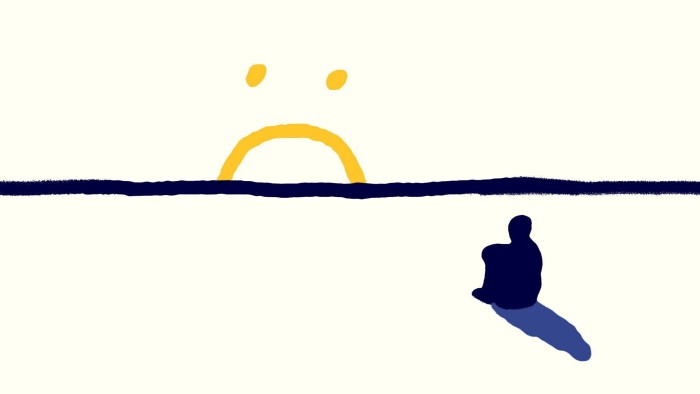
And yet in reality, it can be more complicated. Amid all the hedonism and the heat and the holidays, the summer can also bring a deep sense of melancholy and sadness and, for many of us, heightened anxiety. We worry that everyone else is having more fun than we are; we feel we should be outside socialising rather than indoors in front of the TV scrolling on our phones; we look at other people’s beach-ready bodies and feel bad about our own; we feel anxious that it’s all coming to an end too quickly.
At a wedding in Greece last weekend with a group of Americans, I was surprised to discover the universality of that last worry. It turns out it’s not just pessimistic Brits who start to fret about summer ending as soon as — even before — it has begun. “I hate Independence Day, it feels like the summer is already over,” a woman said to me. One man said he always started to feel like that in May.
Despite the summer solstice being, in astronomical terms, the official start of summer in the northern hemisphere and not the middle of it, the fact that the days start to slowly get shorter from that point leads to a sense that it is slipping away from us too quickly. We look forward to the summer all year, and then when it comes, we are often too worried about its ending — or too preoccupied with what’s coming next — to be able to properly enjoy it. When we are finally on that holiday we booked months ago, the first 24 hours might feel blissful, but then after that we often start to count down the number of days until it’s over. A metaphor for life itself, perhaps.
And then there are those among us who can’t bear the heat, or the very idea of summer, who are also counting down the days, but for different reasons. The people who hate the sun and the socialising and the skimpy clothing and long for the colder, cosier weather. A friend of mine consistently feels depressed in July and August, and then a sense of huge relief when September comes around, when all the pressure to appear as if one is having a great time is over.
There is, after all, nothing quite so miserable as feeling unhappy when we are meant to be feeling good. In the winter, we have an excuse to feel blue, a comfort in itself: it’s dark and grey and “miserable” outside, so of course we’re sad. We get to moan about it with others, too. It’s much more emotionally uncomfortable and isolating to be feeling gloomy on a sunshiny day. And yet it is also far more common than we imagine.
Every January, my inbox fills up with press releases about “Blue Monday”, usually the third Monday of the month, supposedly the most depressing day of the year. I have always naively assumed this is the day when suicide rates and societal depression levels are at their highest. But it turns out that this is a day that was made up by — surprise — a travel company two decades ago. There is no evidence that this is a particularly sad day, and neither is there evidence of an increase in suicides at this time of year.
Quite the contrary, in fact: research has consistently suggested that suicide rates in countries with temperate climates — non-tropical ones that have distinct seasons — spike in late spring or early summer, and tend to be at their lowest in the winter. A 2019 meta-analysis of 19 studies in various countries found that a 1C increase in average temperature was associated with a 1.7 per cent increase in the incidence of suicide.
And in our warming climate, summer brings with it more than just social factors and expectations to make us feel anxious — the physiological impact that very hot weather has on our bodies mimics that produced by high levels of stress and anxiety: a raised heart rate, rapid breathing, high cortisol levels, dizziness and lightheadedness. No wonder heatwaves can trigger panic attacks, insomnia, and psychosomatic sickness.
You may know someone who has seasonal affective disorder, or SAD; you might even have it yourself. But we should not imagine that it is only the colder, darker days that can make us feel blue, and nor should we imagine that the summer is some kind of months-long bliss state. Summertime sadness is not just a Lana Del Rey song.
Read the full article here

