


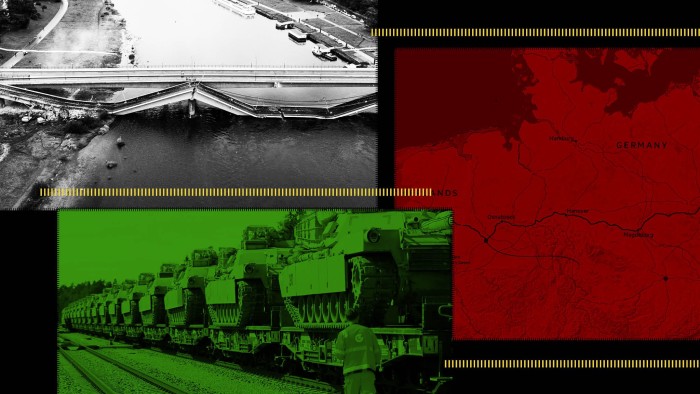
US general Ben Hodges was overseeing a military exercise in Europe when an unexpected incident occurred at a Polish railway station.
As dozens of Bradley infantry fighting vehicles thundered through, some of them had their gun turrets ripped off by the platform roof. “Nobody got hurt,” said Hodges, who was at the time the commander of US forces in Europe and has since retired. “But that was thousands of dollars of damage. And 10 vehicles that weren’t going to be ready to fight for some time.”
A decade later, crumbling bridges, mismatched rail gauges and labyrinthine bureaucracy remain significant hurdles to moving military assets across Europe. In the wake of Russia’s full-scale invasion of Ukraine in 2022, France was unable to send tanks to Romania on the shortest land route through Germany and instead had to ship them via the Mediterranean.
These examples serve as a stark reminder that Europe’s race to re-arm is not limited to procuring weapons or building up big armies. It must also be possible to swiftly transport troops, equipment and ammunition from the west — where the bulk of Nato’s forces are based — to the alliance’s eastern flank.
Currently it would take roughly 45 days to move an army from the strategic ports in the west to countries bordering Russia or Ukraine, EU officials estimated as they prepared to publish a new proposal on “military mobility” on Wednesday. The aim, they said, was to bring that down to five or even three days, officials said.
Alexander Sollfrank, the German lieutenant general in charge of readying his nation for its central role in such an operation, said every element must work “like a Swiss watch”.
The aim, he said, would be to send a strong message of deterrence to Moscow, saying: “We know what you’re up to and we are ready. Look, we are here.”
But before Nato troops started moving across the continent, the first challenge would be political recognition of a looming crisis, according to military officials.
When Russia amassed troops and weapons on the border with Ukraine in the months leading up to the 2022 invasion, some western leaders were sceptical that President Vladimir Putin would give the order to invade.
“How fast can we determine what they’re starting to do?” said Hodges. “Then it’s the speed of decision. Decision makers saying we need to mobilise, pull ammunition out of depots. The clock is ticking and you want to do something before the Russians attack.”
European leaders would also need to agree with the US’s president on the nature of the threat and the appropriate Nato response. Donald Trump’s oscillating attitude towards Russia has raised concerns in Europe as to the extent of American participation, but Washington has said it remains committed to the alliance and its mutual defence clause.
Once Nato approval was secured, the eastward movement of troops and equipment would begin.
The exact numbers planned for different scenarios are secret. So too are the routes they would take.
But Nato diplomats said analysts’ estimates of some 200,000 troops, about 1,500 tanks and more than 2,500 other pieces of armour being shipped from the US, Canada and the UK across mainland Europe were broadly correct.
“Military mobility is an essential component of effective security and defence and the right infrastructure helps allies ensure we can get the right forces to the right place at the right time,” said a Nato official.
Hodges, the retired American general, said US mapping of key European routes had improved significantly since the gun turret incident.
But Alberto Mazzola, executive director at the European rail industry body CER, said Europe was only just gathering a good overview of the problems. “We need to check which of tunnels in Europe are fit for this,” he said.
The EU’s standard loading gauge — the maximum dimensions of freight trains so that they can safely pass under bridges and through tunnels — is too narrow for military transport. The tilt of the tracks can also pose a problem. “If you have a heavy load then the load could just fall off,” one EU official said.
To tackle the issue of mismatched railway gauges in the Baltics, Estonia, Latvia and Lithuania are in the midst of a €24bn project to integrate them into the European rail network. The Rail Baltica project was designed with military movements in mind, readying it to carry oversized loads.
Aligning the rail gauge was critical from an efficiency and security point of view, said Rail Baltica chief executive Marko Kivila. Unloading and loading soldiers created a “bottleneck” and left them vulnerable to attack, he said.
Moving military assets from Spain and Portugal would hit similar snags, as the Iberian peninsula also operates on different gauges than the rest of the continent.
Significant work must also be done on the road network, particularly in Germany, whose geographical location and role as the host of 37,000 US troops makes it central to the plan.

Last year, a 100-metre section of Dresden’s Carola Bridge collapsed, in the process becoming a symbol of the dire state of the country’s roads.
The French Leclerc tank deliveries to Romania in 2022 took weeks instead of days after German customs rejected them because they were too heavy to be transported on roads. Instead the cargo was shipped from the port of Marseille to Alexandroupoli in Greece and then on by rail to Romania.
Across the EU, member states have flagged some 2,800 transport infrastructure “hotspots” in dire need of upgrading — a list officials in Brussels further cut down to 500 priority projects.
Nato countries, with the exception of Spain, agreed in June to increase defence spending by 2035 to 5 per cent of GDP a year, 1.5 per cent of which can be spent on infrastructure. In Germany, defence officials are lobbying to ensure that vital routes are prioritised as part of a €500bn plan to upgrade roads, bridges and railways.
One of the strange quirks of moving troops eastward is that they would cross countries that are not at war, meaning army chiefs would have to abide by customs rules and labour laws governing how long lorry drivers can spend on the road.
“If there’s an actual war that has been declared as such, all these bureaucratic obstacles fall,” said Jannik Hartmann, associate fellow at the Nato Defence College in Rome. “But if this is declared we are already too late. This is the crucial point . . . This isn’t yet a state of war.”
Officials are working on a “military Schengen” that at least standardises patchy regulations governing the movement of armies. Germany, Poland and the Netherlands last year signed an agreement to simplify cross-border military transport among themselves.
François Kalfon, a French lawmaker working on military transport, noted that “for the same convoy of trucks” you could have multiple sets of requirements in each country. The paperwork is unlikely to become digital — Nato prefers hard copies for fear of cyber attacks.

In an attempt to accelerate the upgrade, governments are turning to the private sector. The German armed forces this year signed a €260mn contract with a services division of the arms group Rheinmetall to provide support to convoys passing through the country. That means providing them with everything from beds and canteens to tank maintenance centres.
The Bundeswehr also has an agreement with the cargo division of the state-owned rail company Deutsche Bahn.
But Sollfrank, the German general, said there were still “an incredible number of different vehicles and an unbelievable amount of different ammunition”, making this a thorny task. “You can’t plan every single tiny screw in advance. That doesn’t work,” he said. “But you can think of options . . . And this planning is happening.”
A light division of some 15,000 soldiers and 7,500 vehicles could require up to 200 trains each with up to 42 carriages — 8,400 wagons in total, according to CER. The EU’s vehicle industry body ACEA has called for “joint tenders and harmonised specifications” in order to incentivise production of the heavier vehicles required.
This enormous Europe-wide effort might appear alarmist. But Sollfrank said it was essential.
“We have to think the unthinkable,” he said. “It’s about deterrence. Deterrence only works if we’re credible. And we are only credible when we have plans — and we are ready.”
Additional reporting by Henry Foy in Brussels
Read the full article here

