


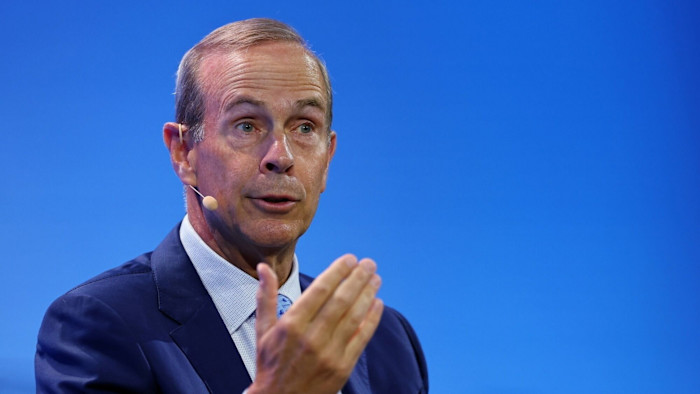
There is no Big Oil executive closer to Donald Trump than Mike Wirth.
The US president likes to talk business and speaks regularly to the Chevron boss on the phone, said several people familiar with the relationship.
Now those ties are paying off handsomely, as Chevron seeks to capitalise on its position as the only US oil company on the ground in Venezuela. Analysts and oil industry insiders said the company would have a multiyear advantage over its rivals as they weighed the risks and challenges of entering the unstable Latin American state, which has some of the biggest oil reserves in the world.
US Treasury secretary Scott Bessent on Thursday confirmed Chevron was “obviously at the front of the pack”. He also said he too had been regularly on the phone to Wirth. “I’ve been in contact with him for the past year just in dealing with the sanctions regime,” he said.
Chevron will be among the big oil companies at the White House on Friday for talks on how to rebuild Venezuela’s decrepit oil infrastructure, after the US toppled strongman leader Nicolás Maduro last week. Trump and energy analysts said the reconstruction effort could take years and cost many billions of dollars.
Chevron is negotiating with Washington to boost exports from its joint venture operations with Venezuela’s state oil company Petróleos de Venezuela (PDVSA) and is preparing to process more oil at its Pascagoula refinery in Mississippi.
Scott Sheffield, a Texas shale tycoon who lived in Venezuela during the country’s oil boom in the 1970s, said: “Anytime you stay in a country like Chevron has for such a long time, and taking big risks, and then a leader changes from a positive standpoint, I think it helps them.”
Trump’s effort to take control of Venezuela’s oil sector gives Chevron “an opportunity to ship more product to their Gulf Coast refineries and develop their upstream operations in the country”, Sheffield added. “There is so much potential in Venezuela.”
It would amount to a big success for Wirth, who joined Chevron 43 years ago when Venezuela — a founding member of Opec — was a global oil power pumping almost 2mn barrels per day. Despite the nation’s huge reserves, mismanagement, corruption and US sanctions have cut production, which is now less than 1mn b/d.
Oil industry insiders said Wirth worked astutely to build a relationship with Trump that helped Chevron win a special licence from Washington to operate in Venezuela, which is under US sanctions.
Rivals including Spain’s Repsol, Eni, France’s Maurel & Prom and Global Oil Terminals, a US company controlled by Harry Sargeant III, a Florida magnate who is a Republican donor, failed to secure that kind of exemption from the Treasury.
“Mike is driving it. By the end of Trump’s first term, he was on speed dial to Steve Mnuchin, who plugged him into Trump,” said one former Chevron executive referring to the former Treasury secretary. “That’s how we kept getting [Office of Foreign Assets Control] licences. Wirth’s relationship with the White House, especially Mnuchin and [former economic adviser Larry] Kudlow.”
Chevron spent $9.2mn on lobbying and made $10mn in campaign donations in 2024, mostly to Republicans. Like its rival ExxonMobil and a host of other big US companies, Chevron was among donors to Trump’s inauguration.
Wirth tried to ingratiate his company with the president, said industry insiders. This included being the first Big Oil boss to adopt Trump’s name for the Gulf of Mexico: the “Gulf of America”.
The importance of the relationship with Trump and the challenges and opportunities ahead in Venezuela suggest that the 65-year-old Wirth, who in December said he was discussing succession with Chevron’s board, may have to extend his tenure.
The close relationship with an administration that just snatched a foreign leader from his bedroom and flew him to New York is fraught with risk, say analysts.
Democrats in the US Senate have launched an investigation to find out what oil companies knew about the mission to capture Maduro.
The senators wrote in a letter to Chevron and other oil companies: “We would like to know the extent to which US oil and gas companies such as yours had either advance knowledge of or the ability to shape American foreign policy decisions — especially given that Congress was kept in the dark concerning the use of force until after the strikes occurred.”
Chevron has said it “had no advance notice” and did not “engage in any discussions with administration officials regarding governance for a post-Maduro Venezuela”.
Jeffrey Sonnenfeld, a Yale professor who previously advised the US government on sanctions policy, said oil companies should be concerned not to become co-conspirators in any violation of international law.
“This could be devastating for them and members of their boards, who represent other companies in different fields,” he said.
Experts said the “billions of dollars” Trump claimed US oil companies such as Chevron would spend to rebuild Venezuela’s industry also carried risk.
One oil industry veteran said: “Oil companies want a quiet life: they have to think about their shareholders and the legal basis of their actions. They cannot commit billions of dollars when they could be walking into quicksand.”
On the eve of the oil industry meeting with Trump, Mike Sommers, chief executive of the American Petroleum Institute, said companies would need the rule of law established and security guarantees before committing capital.
That also leaves Chevron primed.
“This is going to enable them to jump-start the Venezuela recovery,” said Ali Moshiri, the former head of the company’s Latin American operations. “Chevron are in a very good position.”
Read the full article here

