


Unlock the Editor’s Digest for free
Roula Khalaf, Editor of the FT, selects her favourite stories in this weekly newsletter.
A special income tax on high earners in France last year raised only a fraction of what the government had hoped for — partly because its late application gave taxpayers a chance to avoid it — and proceeds this year are again expected to be lower than budgeted.
The French finance ministry said that a so-called “differential contribution” applying to those earning more than €250,000 a year raised only €400mn for the 2025 tax year instead of the €1.9bn it initially projected. The tax was designed to ensure that such high earners paid at least 20 per cent of their income in tax.
For 2026, the tax is expected to raise €650mn, €1bn less than planned, the ministry said, creating a budgetary hole that the government has said will be filled with other taxes and spending cuts.
The finance ministry blamed the shortfall of the tax on high earners on a changed design of the tax. It was initially conceived as retroactive to 2024, but was instead applied only to 2025 because of a political stalemate that led the budget to be enacted late, making the tax’s retroactive application illegal.
“As a result, we did observe a certain number of dividend distributions at the end of 2024,” Bercy explained. “This affected the proceeds.”
The revelations are likely to fuel debate among political parties that have been fighting over how to cut the wide deficits plaguing France.
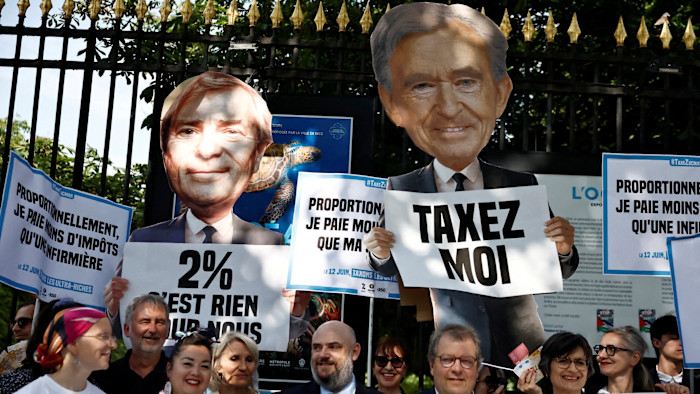
Leftwing parties last year mounted an unsuccessful push for a much harsher approach known as the “Zucman tax” after the French economist Gabriel Zucman, who has advocated for it globally. It would have required people with fortunes of more than €100mn to pay a minimum of 2 per cent tax annually on all their assets, including their companies, shares of companies and unrealised gains.
Instead, President Emmanuel Macron’s centrist prime ministers — who led fragile minority governments with three different figureheads in 18 months — have enacted a more modest version.
Under pressure to narrow a budget deficit that stood at 5.4 per cent of GDP last year, Macron’s governments have also hit France’s biggest companies with higher taxes. They were supposed to apply for only one year but have since been extended, prompting complaints from business lobbies.
Both measures represent an about-face for Macron, who has pushed for tax cuts on corporations, investors and income earned from capital so as to make France more competitive. But his weakened position domestically has made it impossible for his successive governments to hold that line.
The shortfall from the extra income tax on high earners, which was first reported by Le Monde newspaper, also shows the challenges of crafting taxes on the rich that work. Wealthy people often turn to “optimisation” or avoidance techniques to reduce their exposure, such as moving assets or keeping them in holding companies.
In the 1980s, about half of OECD countries had some form of wealth tax, while only a handful now do so, and they raise modest revenue for state coffers.
Éric Coquerel, a far-left member of parliament who heads the finance committee, decried what he cast as a government failure. “It shows that as long as we stick to little token measures to try to curb tax avoidance by the ultra-rich, we’re missing the point entirely,” he said on X.
Read the full article here

