


Stay informed with free updates
Simply sign up to the Global Economy myFT Digest — delivered directly to your inbox.
Will the war in Iran be short? That’s what US President Donald Trump promised the world just a few days ago. Yet already his defence secretary Pete Hegseth seems to be backing away from that prediction, warning last week that things are “accelerating not decelerating” as he promises more bombs and fighter jets. The conflict has spread throughout the region and even beyond, with the sinking of an Iranian frigate off Sri Lanka.
How does it all end? That may be less a question of drones, ships and artillery than supply chains, inflation and debt markets. Since the war in Ukraine began in 2022, we’ve seen how the weaponisation of energy and trade can create inflation shocks that result in short-term bond sell-offs. These in turn can change the course of political events.
The UK gilt crisis that sank Liz Truss’s short premiership occurred partly in this context. So did the sea change in European attitudes towards industrial policy and defence spending, which came after Russia’s invasion of Ukraine and America’s global tariff war.
More recently, bond market jitters around US tariffs and Chinese rare earth export bans gave birth to the “Taco” trade, as Trump was forced to pause most of his reciprocal tariffs amid big sell-offs in Treasuries that pushed yields sharply higher. Stocks and the dollar also weakened as a result, marking a rare triple sell-off.
So, what are the markets telling us now? How long might this war last? My bet: longer than you would wish.
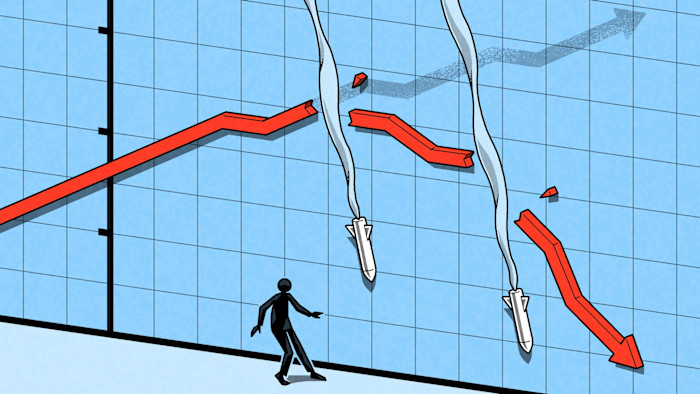
While the US has reason to want a quick end to the conflict, given that rising petrol prices will hurt Republicans in the run-up to the midterm elections in November, the Iranian regime has arguably much to gain by prolonging the pain with drone strikes and attacks on neighbours in the Gulf. These would further disrupt energy markets, driving inflation higher across the world. As analyst Luke Gromen put it in a recent newsletter, “Iran does not have to defeat the US military; it just has to defeat the UST market”, the idea being that a serious bond market downturn would force the US to pull back.
Is that likely? And how long would it take? Certainly, more than a few weeks and not all of it is in Trump’s hands. Yes, US gas prices are up (though not as much as in Europe’s) and the 10-year Treasury bond yield is back up above 4 per cent, which will pour cold water on a nascent housing market recovery in the US. It will also disappoint some traders who had recently looked to Treasuries as a hedge and many who anticipated rate cuts that might now not come. But the dollar remains strong, as an oil shock hits Europe and importers in emerging markets harder in the short term.
Still, as Ukraine showed us, inflation is not a single punch. It hits first in fuel, then in food, in part through fertiliser (which is heavy on energy inputs) and other petroleum-heavy goods. “The cost inflation [from the war] is currently working its way upstream through materials and logistics, as well as the extended transit time that is putting cash pressure on certain businesses,” notes Matt Lekstutis, a director at Efficio, a supply chain consultancy based in London. Those most at risk include petrochemicals, plastics and aluminium.
Meanwhile China, by far the largest purchaser of Iranian oil, may yet leverage its own geoeconomic advantage of having purchased ports all over the world and of “controlling most of the ships on the planet”, as Lekstutis notes. If it does, shipping costs and goods inflation in many more areas could skyrocket.
Then there are the vulnerabilities already lurking in global bond markets. As the 2026 OECD debt report released last week shows, short-term assets like Treasury bills have become “an increasingly important source of financing” for market participants, “surpassing fixed-rate bonds in terms of issuance volume and now accounting for 15 per cent of the debt stock”.
At the same time, more government and corporate bonds are held by short-term, price sensitive investors — in particular, hedge funds — than in the past. Their “propensity to sell into a downturn”, particularly during geopolitical events, and their lack of transparency makes markets particularly vulnerable. As the authors point out, “hedge funds tend to liquidate positions and withdraw from the market precisely when liquidity support is most needed”. Add to this other risk factors such as the amount of cryptocurrency in the financial system and it’s easy to imagine a rapidly unfolding markets crisis.
As complicated as geopolitics is today, geoeconomics is even more so. Yes, America seizing Venezuelan and Iranian oil has an obvious downside for China, which is surely part of Trump’s war calculation. But if the longer-term impact is to push up bond yields, inflation (which will only be partially mitigated by America’s own domestic energy supply) and US deficits and ultimately trigger a big UST sell-off, the US and global economy will suffer mightily. I suspect, sadly, that this war and this market story will be with us for some time.
Read the full article here

