


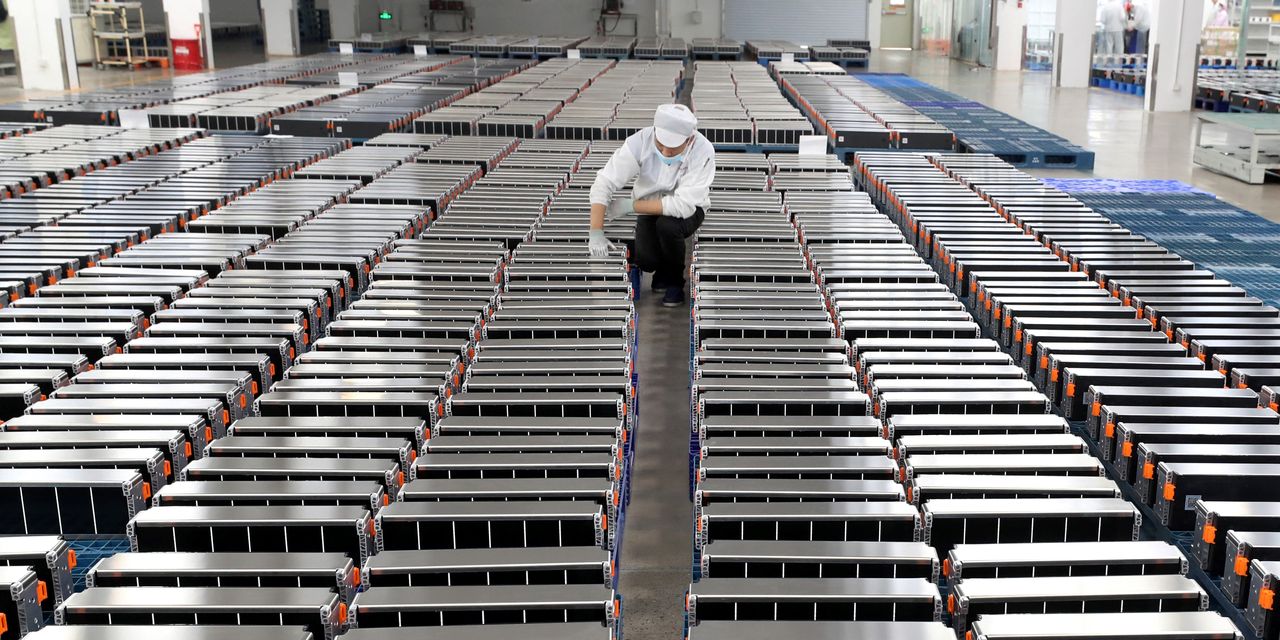
Everyone needs more lithium-ion EV batteries these days, including
Tesla.
Japanese electronics firm
Panasonic
(ticker: 6752.Japan) will expand production at an electric-vehicle battery factory that it jointly operates with Tesla (TSLA), Reuters reported.
The Gigafactory in Nevada will increase production by 10% by March 2026, the newswire said, citing a company spokesman. Panasonic and Tesla didn’t immediately respond to requests for comment from Barron’s early Tuesday.
Panasonic stock closed 1.8% higher in Tokyo trading. Tesla shares advanced 0.2% in the premarket.
S&P 500
and
Nasdaq Composite
futures were both down about 0.1%.
The news adds some detail to Panasonic’s and Tesla’s plans to team up on making EV batteries. Last month, the Japanese company said it planned to build at least two new factories to make battery cells for the electric-vehicles giant.
More auto makers, including Tesla, are building greater battery capacity in North America for a few of reasons. First, owning battery capacity can reduce costs for building EVs. Batteries cost and car companies don’t want to pay existing battery makers a profit margin.
Second, there are domestic sourcing requirements companies need to meet for their EVs to qualify for purchase-tax credits passed as part of the Inflation Reduction Act.
Third, demand for EVs is growing.
Bank of America
(BAC) says EV penetration of new car sales in the U.S. could hit 25% by 2025. EV penetration of new car sales was about 7.5% in the first quarter.
Tesla has more than 60% of the U.S. market for all-electric cars. Other auto makers want some of that business and that growth.
General Motors
(GM),
Ford Motor
(F), and
Stellantis
(STLA), among others, all have company-controlled battery capacity either operating or under construction.
Tesla was a pioneer in making its own batteries. The Nevada factory was built around 2014 with Panasonic, and was designed to produce 35 gigawatt hours of batteries each year. That is enough to make roughly 500,000 EVs. That was ambitious. Tesla was making about 35,000 cars a year in 2014.
Write to Brian Swint at [email protected] and Al Root at [email protected]
Read the full article here

