


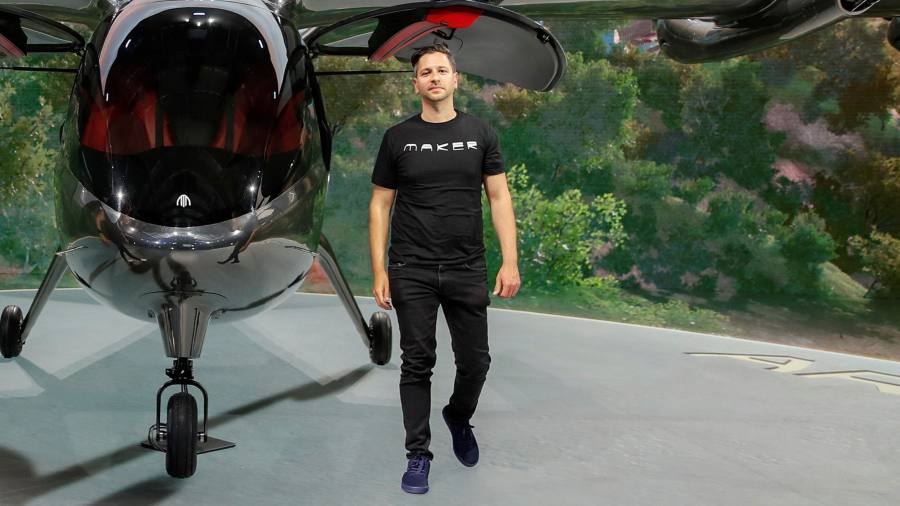
The head of a leading company in the race to bring electric aircraft to the skies has hit out at Europe’s aviation regulator, warning its rules threatened to put the fledgling sector out of business.
Adam Goldstein, chief executive of Archer Aviation, said in an interview that certification guidance published by the European Union Aviation Safety Agency would make it “extremely hard” to bring the new vehicles — often described as air taxis — to market.
“EASA has openly said, ‘We know our regulations are harder and not good for business, and we don’t care,’” Goldstein told the Financial Times.
California-based Archer is among the companies seeking approval to operate so-called electric vertical take-off and landing (eVTOL) aircraft to provide a range of services from short-hop flights over congested urban areas to longer regional flights. The company, co-founded by Goldstein, went public in 2021 and has a market capitalisation of about $800mn.
Several companies hope aviation safety regulators will begin to certify their vehicles for flight from as early as next year.
EASA is the only regulator to have published formal guidance for eVTOLs offering commercial services to passengers. Its approach assumes relatively large flight volumes over urban areas.
The agency has told developers to adopt the same standard for safety as the one applied to large commercial jetliners: the chance of just one catastrophic failure in 1bn flight hours, or “10 to the minus nine”, in industry parlance.
Goldstein criticised the regulation as too strict, saying there was no point in fostering an industry only “to regulate it out of business”, when it was possible to take “an approach that can still be at the highest levels of safety, but . . . that is more amendable to allowing companies to build around.”
Archer, whose second prototype, Midnight, will have its first test flight this summer, wants to build a vehicle that is “as safe as commercial airliners today”, Goldstein said.
EASA said in a statement: “Archer’s opinion is that high safety standards are not good for business. This point of view is not shared by EASA.”
The EU regulator said the safety objectives it had set out were based on “risk assessment” and had been “evaluated to be equivalent to bus transportation safety, once eVTOL operations have reached a moderate scale”.
It added: “EASA’s opinion is that setting such safety objectives enables business and protects future businesses.”
The US Federal Aviation Administration has yet to publish a standard. Industry publications have reported it was likely to set the target safety level at one catastrophic failure per 10mn or per 100mn flight hours.
The FAA said the new electric aircraft are mechanically simpler than commercial jets, allowing for a regulatory approach that uses certification standards “applicable to the size and complexity of aircraft and types of operations involved”.
The FAA’s approach to eVTOLs is philosophically different than EASA’s, but no less safe, US officials said. The regulator believes it can reach the same level of safety in operations without the same requirements for back-up systems to be built into aircraft because it will have accounted for risks in other ways, including counting the pilot as an extra safeguard, according to the officials.
Goldstein said that in the US, “it’s been a real positive for US-based companies because the regulator is so on board”.
Last Wednesday the regulator proposed rules that lay out training protocols for pilots of aircraft that lift off vertically and then switch to winged flight. David Boulter, the FAA’s acting administrator for aviation safety, said the proposals will “safely usher in this new era of aviation and provide the certainty the industry needs to develop”.
EASA has similarly put forward proposals on what kind of pilot training will be necessary to enable the operation of eVTOLs.
The two regulators are in talks to agree on a common certification approach towards the sector to ensure companies can fly between different regions. They will meet again next week in Cologne.
Meanwhile, disagreement over target safety levels has created a point of contention among competitors in the industry. European companies argued in public filings submitted last year that US companies should have to meet EASA’s safety standards. They also raised concerns about the lack of detail contained in airworthiness criteria set out by the FAA for some of their US rivals.
During a public comment period, UK-based Vertical Aerospace said that because of eVTOL’s “complex aircraft systems and complex commercial operating environment”, regulators should require the “10 to the minus nine” safety target.
Trevor Woods, Vertical’s director of regulatory affairs, said the differences between the regulators “will narrow as certification requirements become clearer. Ultimately we, and the rest of the industry, want to see rules for eVTOLs standardised across countries.”
Read the full article here

