


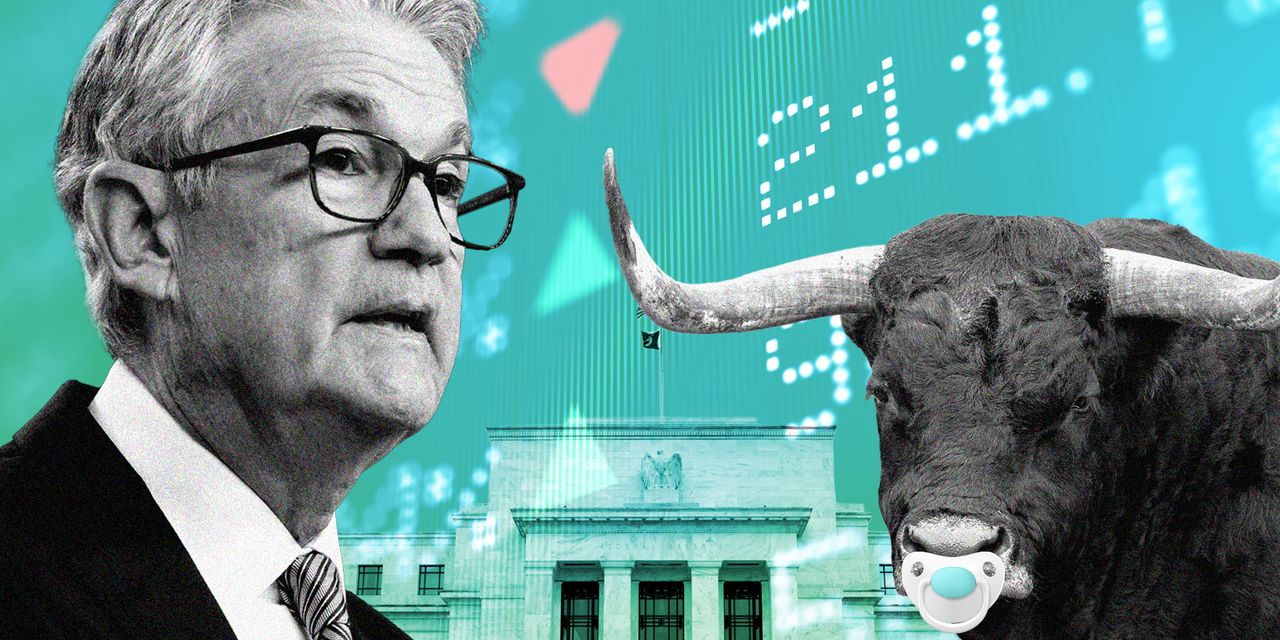
It’s the notion that the Federal Reserve could deliver a hawkish jolt to markets even if it refrains from raising rates when its two-day policy meeting ends on Wednesday.
Some on Wall Street are concerned that such an outcome could spark a turnaround in U.S. stocks, especially if an uncomfortably strong reading on May inflation — due this coming Tuesday just as the Fed’s policy meeting starts — pushes the central bank toward something even more extreme, like delivering a rate hike on Wednesday despite intimating that it plans to abstain.
The May consumer price index is forecast to rise 4.0% for the year, down from a rise of 4.9%, while the core index, excluding food and energy prices, is seen easing to a rise of 5.3% from 5.5%.
To be sure, signs that the economy is weakening and inflation has continued to fade would help the Fed to justify skipping a rate hike in June while signaling that a potential hike at its following meeting in July could be the final increase for the cycle.
“Softening US data should support calls that a June skip could eventually turn into a July pause. Next week, most of the data is expected to remain weak or little changed: retail sales could be flat m/m, the Fed regional surveys should remain in negative territory, and consumer sentiment will waver,” said Craig Erlam, senior market analyst at OANDA, in emailed commentary.
See: The Fed’s crystal ball on inflation appears off the mark again. Here’s comes another fix.
Stocks have seen strong gains since last October despite continued rate hikes from the Fed. The S&P 500 index has risen more than 20% from its Oct. 12 closing low, according to FactSet — an advance that has taken the S&P 500
SPX,
out of bear-market territory for the first time in a year.
The index is up 12% so far in 2023, reversing some of its 19.4% decline from 2022, its biggest calendar-year drop since 2008, according to Dow Jones Market Data.
But some argue that signs of weakness have persisted since the large-cap index’s advance has been largely driven by a handful of megacap technology stocks, along with a spate of other technology and semiconductor names, data show.
Any sign that the Fed plans to keep its policy interest rate higher for longer could finally bring some of these market leaders back down to Earth, creating an opportunity for small-cap and value stocks to extend an incipient streak of outperformance.
The so-called “Mega-cap eight” stocks — a group that includes both classes of Alphabet Inc. stock
GOOG,
GOOGL,
Microsoft Corp.
MSFT,
Tesla Inc.
TSLA,
Microsoft Corp.
MSFT,
Netflix Inc.
NFLX,
Nvidia Corp.
NVDA,
Meta Platforms Inc.
META,
— have driven nearly all of the S&P 500’s gains this year, according to Ed Yardeni, president of Yardeni Research, who included his anlaysis in a note to clients.
In recent weeks, small caps and other previously unloved corners of the market have started to outperform the technology sector.
The Russell 2000
RUT,
a gauge of small-cap stocks in the U.S., has risen more than 6.6% since the beginning of June, according to FactSet data. The Russell 1000 Value Index
RLV,
has also gained nearly 3.7% in that time.
The tech-heavy Nasdaq Composite
COMP,
has risen 2.9% in June, but since Jan. 1, it’s up 26.7%, having recouped much of its losses from 2022.
The changing character of the market became even more acute on Wednesday after the Bank of Canada delivered a surprise interest-rate hike, ending a four-month pause. It followed a similar move by the Reserve Bank of Australia. Partly as a result, U.S. Treasury yields rose and tech-heavy stocks tumbled, with the Nasdaq falling 1.3%, its biggest drop since April 25, according to FactSet. Meanwhile, small caps continued to outperform.
Consequences of a ‘hawkish pause’
Stocks could be in for more turbulence if the Fed signals it plans to follow suit with a hawkish suprise of its own — perhaps even going so far as to hike rates despite its usual protocol of carefully telegraphing its moves to the market in advance.
Some fear that emerging signs of complacency could leave U.S. stocks more vulnerable to a shock. That the Cboe Volatility Index has fallen back below 15
VIX,
for the first time since before the arrival of COVID-19 is one such sign, said Miller Tabak + Co.’s Chief Market Strategist Matt Maley.
Others likened the potential fallout from a hawkish Fed to the bad old days of 2022.
“If the Fed signals that rates will be going up again, the market playbook could read more like 2022 than what we have seen so far in 2023,” said Will Rhind, the founder and CEO of GraniteShares, during a phone interview with MarketWatch.
Perhaps the biggest wildcard is Tuesday’s inflation report. If it comes in hot, the Fed could be forced to make an uncomfortable decision without first priming the market.
This is one reason investors are underestimating the likelihood of a hike next week, Rhind said. Fed funds futures currently see a roughly 70% probability that the central bank will refrain from raising rates this week after 10 consecutive increases, according to the CME’s FedWatch tool.
Rhind isn’t alone with these fears. Leslie Falconio, chief investment officer at UBS Global Wealth Management, noted that the Tuesday inflation report could be a make-or-break moment for markets, summing up fears expressed elsewhere on Wall Street.
“We believe another rate hike is on the table, and that the CPI release on 13 June, a day before the Fed decision, will be decisive. In our view, another hike will not have a material impact on the pace of economic growth,” Falconio said.
What should investors watch out for?
Assuming the Fed does forego a hike in June, there are a few key tells that investors should watch for regarding the central bank’s plans.
Perhaps the most important will be how the Fed handles changes to its closely watched “dot plot.” A modestly higher median dot would send an unmistakable signal to the market that the Fed will continue with its campaign of tightening monetary policy, perhaps to the detriment of the market, said Patrick Saner, head of macro strategy at the Swiss Re Institute.
“If the Fed skips but wanted to avoid the impression of the hiking cycle being done, it would need to include a revision of the dot plot. They could justify that with a more resilient GDP forecast and a higher inflation outlook. So I think it’s the dots and then the statement that will be in focus,” Saner said during a phone interview with MarketWatch.
Beyond that, whatever the Fed does or says will likely be viewed through the lens of economic data that’s due out next week. In addition to the Tuesday inflation report, a report on May retail sales is due out Thursday, and a on consumer sentiment from the University of Michigan will land on Friday. All these data points could influence investors’ impressions of the state of the U.S. economy, and their expectations for how the Fed will behave as a result.
See also: Puzzled by the ebb and flow of recession worries? Then the MarketWatch weekly recession worry gauge is for you.
Read the full article here

