


Five months after China’s president Xi Jinping declared victory over the pandemic and relaxed stringent social controls, new data this week revealed that the country’s economy was far from returning to full health.
While consumers are venturing out to spend, buyers are shunning property, one of the Chinese economy’s central growth drivers. Exports, another important engine, are flagging as high inflation abroad saps demand for Chinese goods.
The government has already begun cutting interest rates, but analysts said fiscal rather than monetary stimulus would be needed to keep the recovery in the world’s second-largest economy on track. Here are the sectors imposing the greatest drag on the economy as well as those with a brighter outlook — and policymakers’ options for reviving growth.
Property warning signals
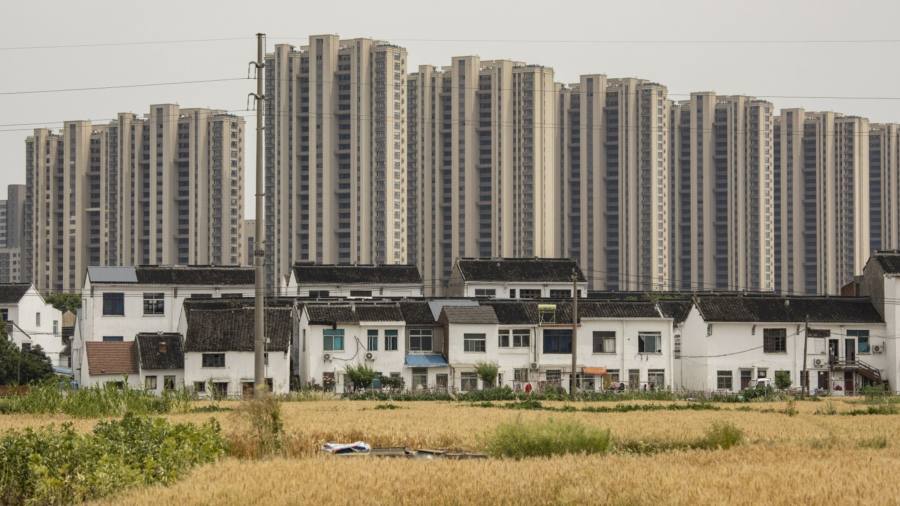
China’s property sector, which accounts for about 30 per cent of its economic output, is at the root of the economic malaise, according to analysts. “It’s not an exaggeration to say that property is at this point jeopardising the entire economic recovery,” said Chris Beddor, deputy director of China research at Gavekal Dragonomics.
Consumers are suspicious of the sector. Many bought flats before buildings were constructed, only to find the properties were not delivered after a regulatory crackdown on leverage levels sent a number of developers into default.
The real estate market showed signs of stabilisation in the first quarter following a prolonged slump, but it has begun to slip again in recent weeks.
Sales, new project starts and floor space under construction all declined in May when measured as a share of seasonally adjusted pre-pandemic 2019 levels, Gavekal said. Completions slowed to 24 per cent year on year, from 42 per cent a month earlier, the research group added.
The government is expected next week to cut the five-year lending rate that is used to benchmark mortgages, but analysts said more measures were needed to revive the sector, such as credit for cash-strapped developers and incentives including reductions in mortgage down payments.
Exports slow dramatically
Exports fell 7.5 per cent year on year in US dollar terms last month after rising 8.5 per cent in April as slower growth abroad hit demand, erasing what was a critical lifeline for the Chinese economy during the depths of the pandemic.
Analysts said the weakness in exports and property had also probably spilled over to industrial production, which decelerated in May. To cap it off, private fixed-asset investment also turned negative for the first time in more than a decade — with the exception of the start of the pandemic in 2020 — indicating that businesses were not investing.
“The manufacturing sector is dead on its feet at the moment and exports are poor,” said Rob Carnell, Asia-Pacific head of research for ING. He added that there might be a structural shift, with US export restrictions on high-tech goods, notably semiconductor components and chipmaking equipment, affecting China’s trade with regional powerhouses such as South Korea, Japan and Taiwan.
Policymakers could choose to stimulate trade by tolerating a weaker renminbi. Lower interest rates would support that tactic — after the People’s Bank of China trimmed its main policy rate on Thursday, the currency fell as much as 0.3 per cent against the dollar to Rmb7.1807, a six-month low and putting it down about 4 per cent year to date.
Retail sales a beacon of hope
Economists said the best hope for reviving growth across the economy was to fuel strong domestic demand, which would lead to a tighter job market, higher salaries and eventually a resurgence of confidence that could spill over into property and manufacturing.
Retail sales expanded 12.7 per cent year on year as rattled consumers returned to stores after last year’s tough pandemic restrictions. But economists said on a seasonally adjusted basis, the gauge fell month on month, as a boost following the reopening began to fade. Catering was the strongest component, followed by automotive purchases, helped by policy incentives and discounts.
Infrastructure loses momentum
Infrastructure investment grew 8.8 per cent in May year on year, according to economists. But the gauge also lost ground from last year, when it was growing at a rate of 10 per cent, and growth in the segment was probably not strong enough to offset the property and exports weakness, analysts warned.
“Infrastructure investment momentum is slowing,” said Michelle Lam, greater China economist at Société Générale, which she attributed to “very weak land sales from local governments”.
Economists said Beijing would need to resort to infrastructure to spur growth, suggesting policymakers could unleash local government special bonds (LGSBs) to spur investment.
Analysts at Nomura forecast that this could amount to an extra Rmb500bn ($70bn) of LGSBs, on top of the untapped portion of this year’s annual quota of Rmb1.86tn. The bank also noted that Beijing could consider issuing special central government bonds to raise additional funds.
No ‘bazooka’ expected
China’s economic bounceback is fragile — a challenge the government itself has acknowledged. “The foundation for the economic recovery is not yet solid,” the National Bureau of Statistics said this week.
More stimulus will be needed to return growth to pre-pandemic levels, and the central bank is expected to enact further rate cuts, which will be accompanied by tax breaks and other support for small businesses.
Tao Wang, chief China economist at UBS, said the government should prioritise putting a floor under the property sector’s woes. “Otherwise it’s very hard to stabilise the economy as a whole,” she warned.
Despite the critical obstacles to recovery, there are few expectations for a “big bang”-style stimulus.
In the past, China injected investment into the property sector to overcome downturns. But Beijing has long made clear its view that “houses are for living in, not for speculation”, damping expectations of a glut of activity in the sector to drive growth.
“The ‘bazooka’ policies in the past have typically just ended up helping the property developer sector and I don’t think Xi wants to do that,” said ING’s Carnell.
Read the full article here

