


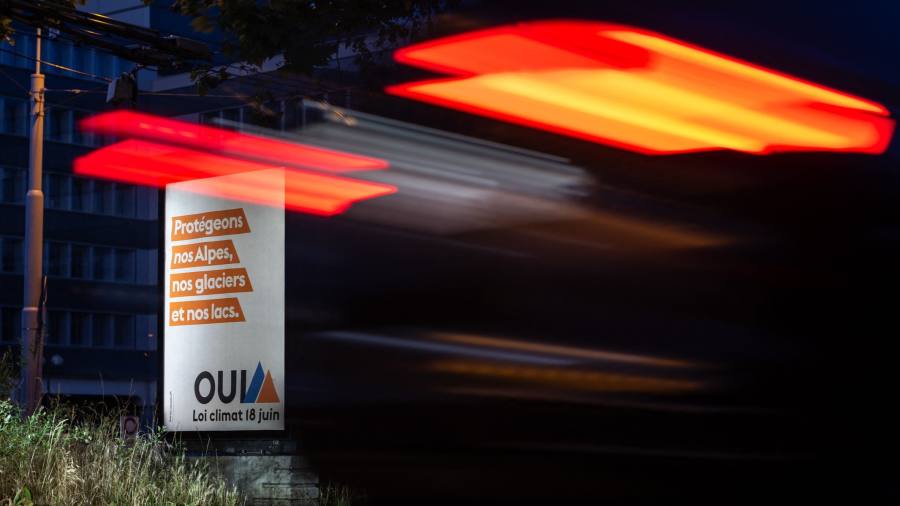
Switzerland’s commitment to reducing its carbon emissions by 2050 will be put to the test this weekend in a fractious national vote that has exposed the limits of green politics in one of the world’s wealthiest countries.
A draft Climate Law that goes to a referendum on Sunday underlines the peculiarly Swiss obstacles faced by Bern as it seeks to pass new measures aimed at curbing greenhouse gas emissions — even after the country’s green parties surged in popularity in the last federal election.
Switzerland has one of the cleanest energy records in Europe, and high levels of public concern and awareness around climate change. Yet faced with an environmental emergency, the celebrated strengths of the country’s political system — its highly devolved nature, consensus-based approach and hostility to legislative change without months, if not years, of deliberation — have made it a hostage to populist nimbyism and filibustering.
For weeks, a well-funded “No” campaign ahead of Sunday’s vote has depicted mountain vistas blighted by wind turbines. Pass the legislation, critics warn, and Switzerland will suffer the same fate as Germany, where an overly ambitious plan to replace gas boilers with systems powered by renewables has brought the ruling coalition to the brink. Pollsters predict at least 40 per cent of the electorate will vote against the law.
In 2019, Switzerland’s two green parties secured just over a fifth of the popular vote, in an electoral shake-up pundits said reflected the urgency with which the public regarded global warming. But in the years since, the greens have struggled to effect a single reform of note. In June 2021 their centrepiece legislative proposal — the CO₂ Law — failed in a national referendum.
“If the Climate Law passes, it will be something of a turning point in climate politics in Switzerland after two years of uncertainty,” said Lukas Golder, co-director of the pollster gfs.bern.
How much of a turn, given the modest nature of the proposals, remains to be seen. The law would commit Switzerland to carbon neutrality by 2050 and create a SFr2bn pool of subsidies to help households transition away from fossil fuels, with SFr1.2bn for businesses to invest in more sustainable energy technologies.
“Obviously a ‘no’ would be a disaster, but even with a ‘yes’, pro-climate activists have a very hard struggle ahead in Switzerland,” said Golder.
Critics on both sides point out that the law says nothing about where the green electricity it wants consumers to use will come from.
“Switzerland is resting on its laurels,” warned Christoph Brand, chief executive of the country’s largest electricity producer Axpo.
“When it comes to electricity generation, right now we look like stars when it comes to carbon intensity,” he said, pointing to the two-thirds of electricity generated by hydro and nuclear plants. “But by 2050, the country’s electricity consumption will rise from about 62 terawatt-hours to 90. The potential for additional hydro in Switzerland is essentially zero . . . and our solar and wind capacity are embarrassingly low.
“There is a tendency to move slowly in Switzerland — to say that everything has gone fine for the last 30 years so let’s just extrapolate that for the next 30,” he added. “But in this case, it doesn’t work.”
Swiss energy utilities blame Switzerland’s planning laws — a product of its devolved politics — for the lack of progress. In most countries central government can override local concerns, but Switzerland’s system in effect works the other way around and a single individual or determined group can block or delay almost any project. It took Axpo eight years to get permission to build five wind turbines on the uninhabited Gotthard pass.
Bern has introduced a series of workarounds designed to overcome some of the problems, such as limiting the number of times an individual or organisation can lodge a planning objection. Some projects have recently been approved as a result. Construction will commence next year on the Ovra Solara Magriel solar farm, an 80,000 sq m installation on the side of a mountain near Andermatt that will generate 10MW of power.
To meet the country’s 2050 targets, however, 80 sq km of solar panels must be constructed.
The political environment has meanwhile polarised. The populist SVP, the country’s largest political party — which has led the campaign against the Climate Law — has turned the environmental debate into one of its central issues, attacking policies as “un-Swiss” and “anti-freedom” while pointing to the broader European energy crisis as evidence that decarbonisation is impractical and damaging to ordinary people.
The issue sits along one of the SVP’s favoured faultlines: the urban-countryside divide. The party has galvanised support in rural communities, where farmers typically depend on fossil fuels and oppose external meddling in local decision-making.
Amid the domestic impasse, bigger Swiss energy companies have focused on building renewable plants elsewhere in Europe, and many in the industry believe the country will almost inevitably become a net importer of European electricity.
But even this option is problematic. Thanks to its ongoing diplomatic tussle with the EU over trade ties, Switzerland’s electricity trading treaty with the bloc will lapse next year. With Bern hamstrung by opposition from rightwing populist and socialist parties to making concessions to Brussels, there is no sign of a replacement.
“This . . . overshadows everything,” said Tobias Schmidt, head of the energy and technology policy group at ETH, the technical university in Zurich.
“We are facing a situation where Switzerland might be slowly decoupled from the European electricity system, which is crazy because we are literally at the centre of it, for example as the largest importer and exporter of electricity on the continent after Austria.”
But few see any signs a rapid compromise will emerge. “The [climate] debate in Switzerland is not at all realistic. At the moment we want everything,” said Schmidt. “We can’t both be more independent from the EU and also refuse to build more renewable energy.
“I hope we don’t get to the point of rolling blackouts before people realise that.”
Read the full article here

