


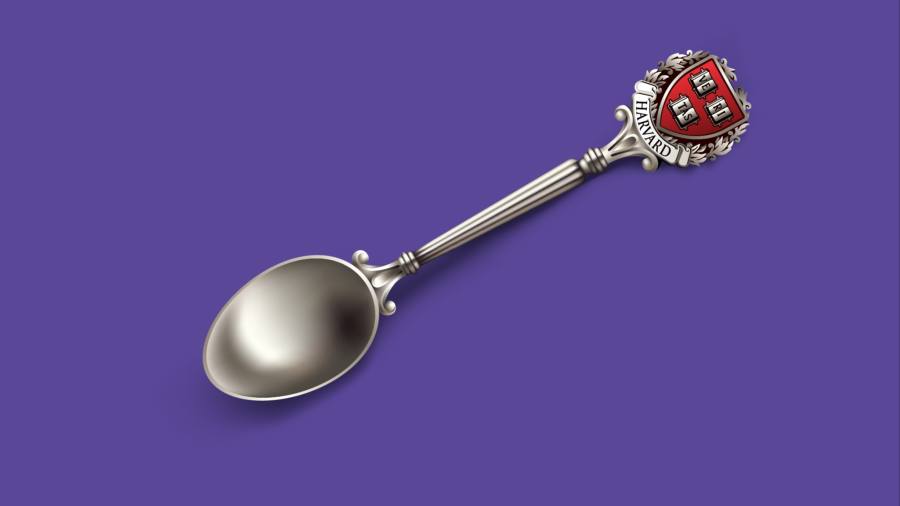
Both the US and UK preselect their adult elites early, by admitting a few 18-year-olds into brand-name universities. Everyone else in each age cohort is essentially told, “Sorry kid, probably not in this lifetime.”
The happy few come disproportionately from rich families. Many Ivy League colleges take more students from the top 1 per cent of household incomes than the bottom 60 per cent. Both countries have long agonised about how to diversify the student intake. Lots of American liberals worry that ancestral privilege will be further cemented at some point this month, when the Supreme Court is expected to outlaw race-conscious affirmative action in university admissions.
Whatever the court decides, US colleges have ways to make themselves more meritocratic. They could learn from Britain’s elite universities, which, in just the past few years, have become much more diverse in class and ethnicity. It’s doable, but only if you want to do it — which the US probably doesn’t.
Pressure from the government helped embarrass Oxford and Cambridge into overhauling admissions. (And yes, we have to fixate on Oxbridge because it’s the main gateway to the adult elite.) On recent visits to both universities, I was awestruck by the range of accents, and the scale of change. Oxbridge colleges now aim for “contextual admissions”, including the use of algorithms to gauge how much disadvantage candidates have surmounted to reach their academic level. For instance: was your school private or state? What proportion of pupils got free school meals? Did your parents go to university?
Admissions tutors compare candidates’ performance in GCSEs — British exams taken aged 16 — to that of their schoolmates. Getting seven As at a school where the average is four counts for more than getting seven at a school that averages 10. The brightest kid at an underprivileged school is probably smarter than the 50th-best Etonian.
Oxbridge has made admissions interviews less terrifying for underprivileged students, who often suffer from imposter syndrome. If a bright working-class kid freezes at interview, one Oxford tutor told me he thinks: “I will not let you talk yourself out of a place here.” And to counter the interview coaching that private-school pupils receive, Oxford increasingly hands candidates texts they haven’t seen before.
Oxbridge hosts endless summer schools and open days for underprivileged children. The head of one Oxford college says that it had at least one school visit every day of term. The pupils are shown around by students from similar backgrounds. The message to the kids is: “You belong here.”
It’s working. State schools last year provided a record 72.5 per cent of Cambridge’s British undergraduate admissions. From 2018 to 2022, more than one in seven UK-domiciled Oxford undergraduates came from “socio-economically disadvantaged areas”. Twenty-eight per cent of Oxford students identified as “black and minority ethnic”; slightly more undergraduates now are women than men. Academics told me that less privileged students are more likely to experience social or mental-health problems, but usually get good degrees. These universities haven’t relaxed their standards. On the contrary, by widening the talent pool, they are finding more talent.
Elite US colleges could do that even without affirmative action. First, they would have to abolish affirmative action for white applicants. A study led by Peter Arcidiacono of Duke University found that more than 43 per cent of white undergraduates admitted to Harvard from 2009 to 2014 were recruited athletes, children of alumni, “on the dean’s interest list” (typically relatives of donors) or “children of faculty and staff”. Three-quarters wouldn’t have got in otherwise. This form of corruption doesn’t exist in Britain. One long-time Oxford admissions tutor told me that someone in his job could go decades without even being offered a donation as bait for admitting a student. Nor do British alumni expect preferential treatment for their children.
The solutions to many American societal problems are obvious if politically unfeasible: ban guns, negotiate drug prices with pharmaceutical companies. Similarly, elite US universities could become less oligarchical simply by agreeing to live with more modest donations — albeit still the world’s biggest. Harvard’s endowment of $50.9bn is more than six times that of the most elite British universities.
But US colleges probably won’t change, says Martin Carnoy of Stanford’s School of Education. Their business model depends on funding from rich people, who expect something in return. He adds: “It’s the same with the electoral system. Once you let private money into a public good, it becomes unfair.”
Both countries have long been fake meritocracies. The US intends to remain one.
Follow Simon on Twitter @KuperSimon and email him at [email protected]
Follow @FTMag on Twitter to find out about our latest stories first
Read the full article here

