


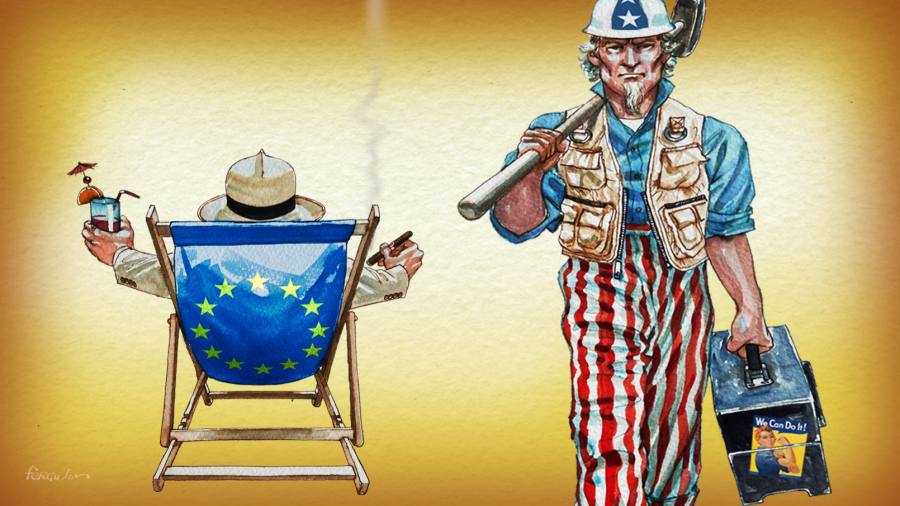
The Ukraine war has revived the transatlantic alliance. But the relationship between the US and its European allies is increasingly lopsided.
The US economy is now considerably richer and more dynamic than the EU or Britain — and the gap is growing. That will have an impact well beyond relative living standards. Europe’s dependence on the US for technology, energy, capital and military protection is steadily undermining any aspirations the EU might have for “strategic autonomy”.
In 2008, the EU and the US economies were roughly the same size. But since the global financial crisis, their economic fortunes have dramatically diverged. As Jeremy Shapiro and Jana Puglierin of the European Council on Foreign Relations point out: “In 2008 the EU’s economy was somewhat larger than America’s: $16.2tn versus $14.7tn. By 2022, the US economy had grown to $25tn, whereas the EU and the UK together had only reached $19.8tn. America’s economy is now nearly one-third bigger. It is more than 50 per cent larger than the EU without the UK.”
The aggregate figures are shocking. Underpinning them is a picture of a Europe that has fallen behind — sector by sector.
The European technology landscape is dominated by US firms such as Amazon, Microsoft and Apple. The seven largest tech firms in the world, by market capitalisation, are all American. There are only two European companies in the top 20 — ASML and SAP. Whereas China has developed domestic tech giants of its own, European champions are often acquired by American companies. Skype was bought by Microsoft in 2011; DeepMind was bought by Google in 2014. The development of AI is also likely to be dominated by American and Chinese firms.
The leading universities that feed the pipeline of tech start-ups in the US are lacking in the EU. The Shanghai and THE rankings of the world’s top universities both have only one EU institution in the top 30. (Britain does better — courtesy of Cambridge, Oxford, Imperial and others.)
In 1990, Europe made 44 per cent of the world’s semiconductors. That figure is now 9 per cent; compared with 12 per cent for America. Both the EU and the US are rushing to build up their capabilities. But while the US is expected to see 14 new semiconductor plants come on stream by 2025, Europe and the Middle East will add just 10 — compared with 43 new facilities in China and Taiwan.
Both the US and the EU are looking to turn this situation around with ambitious industrial policies that provide public finance and incentives for chip manufacturers and producers of electric vehicles. But the dollar’s status as the world’s reserve currency gives the Americans the ability to finance their ambitions, without spooking the markets. As one European industrialist puts it: “They can just swipe the credit card.” The EU, by contrast, has a much smaller budget and has only just begun issuing common debt.
Private capital is also much more readily available in the US. Paul Achleitner, chair of the global advisory board at Deutsche Bank, says that Europe is now “almost totally dependent on US capital markets”. He tells me that Europe has very few of the large pension funds that give depth to the US capital markets, adding that: “If you want to get anything sizeable done — whether it is an acquisition or an IPO — you always go back to American investors.” The EU has spoken a lot about creating a “capital markets union” to give Europe some of the scale of the US. But progress has been feeble.
Unlike Europe, the US also has plentiful and cheap domestic supplies of energy. The shale revolution means that America is now the world’s largest producer of oil and gas. Meanwhile, energy prices in Europe have soared. The Ukraine war and the loss of cheap Russian gas mean that European industry typically pays three or four times as much for energy as their American competitors. Gloomy European bosses say this is already leading to factory closures in Europe.
Some in Britain may be tempted to see all this as proof that, inside the EU, Britain was “shackled to a corpse” and that Brexit was a good move. But, outside the European single market, Britain suffers from an exaggerated version of the problems of scale that are hobbling the EU itself. British industry is already falling behind, as a result.
So are there really no areas where Europe is a world leader? Some point proudly to the fact that the size of the EU single market means that companies all over the world have had to adopt European regulations — the so-called “Brussels effect”. But it would clearly be better to lead the world in creating wealth, rather than regulating it.
Europe does outperform in “lifestyle” industries. Almost two-thirds of the world’s tourist arrivals are into Europe. The luxury goods market is dominated by European companies. Football, the world’s most popular sport, is dominated by European teams — although many of the biggest clubs are now owned by Middle Eastern, American or Asian investors.
Europe’s dominance of lifestyle industries underlines that life in the old continent is still attractive for many. But perhaps that is part of the problem. Without a greater sense of threat, Europe may never summon the will to reverse its inexorable decline in power, influence and wealth.
Read the full article here

