


To call recent trading in Tesla stock wild is to forget trading in
Tesla
stock is always wild.
Shares are up again. This time, a reason for what’s propelling shares higher is what didn’t happen.
Tesla shares (ticker: TSLA) were up 3.7% in late Tuesday trading, while the
S&P 500
and
Nasdaq Composite
were up about 1.2% and 1.7%, respectively.
The big news is no news; the stock didn’t get downgraded. Coming into Tuesday’s trading, Tesla stock had been downgraded four times in four days, by Barclays, Morgan Stanley, DZ Bank, and Goldman Sachs. The reasons for the downgrades were mostly valuation based. Tesla stock rose from about $183 to about $277, or about 50%, in five weeks following an EV charging deal with
Ford Motor
(F) and
Nvidia’s
(NVDA) blowout first-quarter results. Tesla, like
Nvidia,
is viewed as an AI play by some investors.
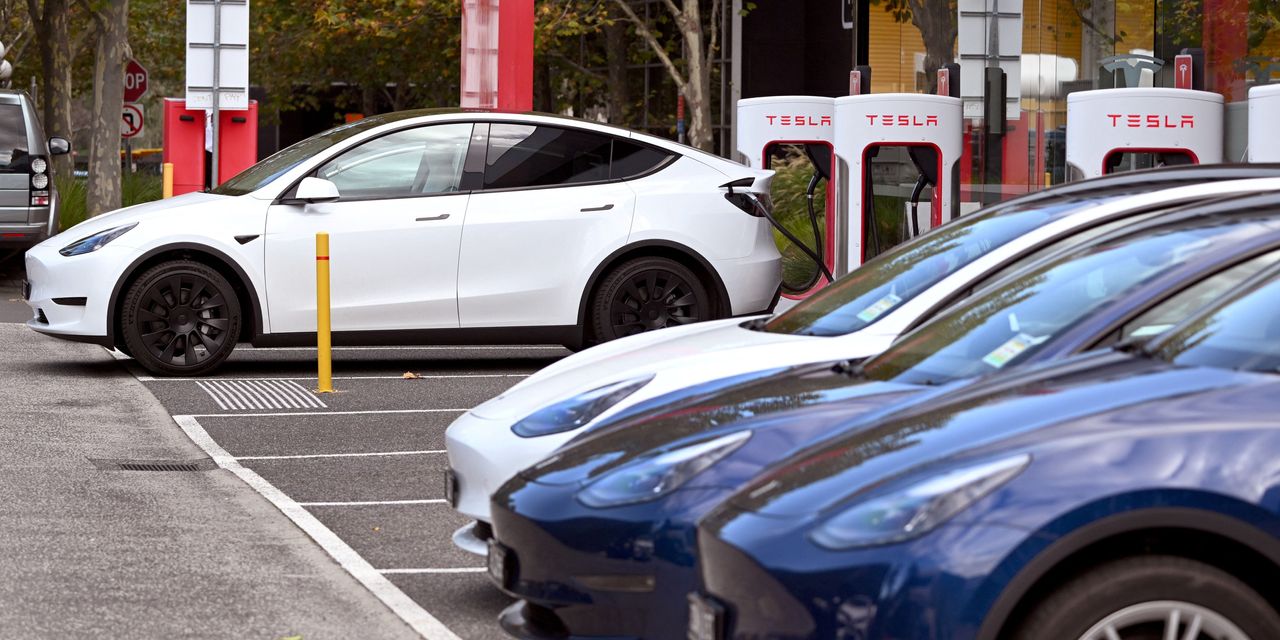
The charging conversion to the Tesla standard continues. Volvo also announced Tuesday the same thing as other auto makers. Starting in 2025 Volvo EVs will come with the Tesla plug and port. Before that, Volvo drivers can use Tesla charging stations with an adapter.
The gain since late May added the equivalent of a
Toyota Motor
(TM) and a
General Motors
(GM) to Tesla’s market value. But at $277, Tesla stock was roughly $75 beyond the average analyst price target. Wall Street just could not keep up.
Today the average analyst target price is about $208 a share, still $36 below where shares are trading. For the S&P 500, the average analyst price target is typically about 10% to 15% above where a stock trades.
The Tesla price target situation is one reason about 40% of analysts covering the stock rate shares Buy, down from roughly 65% at the beginning of the year. At the start of 2023, the average analyst target price was about $255 a share and Tesla stock was trading at roughly $125.
The plus-100% gain implied by those two numbers isn’t typical, either. Tesla stock was exceptionally weak heading into the end of 2023. Investors weren’t sure what to make of Elon Musk’s purchase of Twitter—and his use of Tesla stock to fund the buy. Shares fell roughly $100, or more than 40%, from late October (when the deal closed) into year-end.
Volatility is nothing new for traders. Wall Street has a harder time with it. What investors should do with all this volatility is an open question.
“There are two types of Wall Street downgrades. Downgrades on fundamentals and downgrades on price,”
Future Fund Active ETF
co-founder Gary Black tells Barron’s. “The first type I pay attention to.”
He is a Tesla shareholder and a portfolio manager. Black has a point. Investors can’t be buying and selling stocks with every Wall Street move. That’s the job of traders.
Traders don’t mind volatility. Goldman’s Monday downgrade was a “gift for traders,” one trader told Barron’s. “I am thankful.”
Write to Al Root at [email protected]
Read the full article here

