


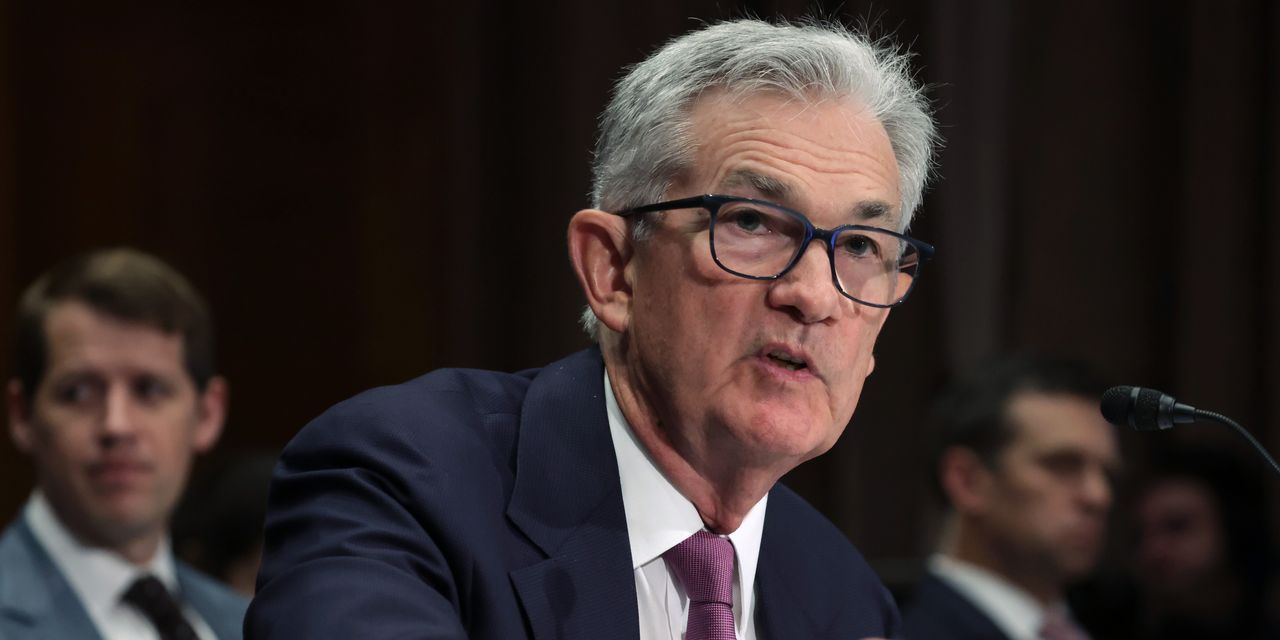
Federal Reserve officials may have voted unanimously to hold the benchmark interest rate steady in June, but Chair Jerome Powell says he wouldn’t take future consecutive rate hikes off the table “at all.”
When asked during an appearance at the annual ECB Forum on Central Banking on Wednesday if the U.S. can expect an increase at every other meeting of the central bank, Powell said officials haven’t made a conscious decision to go that route. “That may work out that way, it may not work out that way—but I wouldn’t take moving consecutive meetings off the table at all,” he said.
In discussing the decision to skip a rate hike in June, Powell said it was all about moderating the pace of decisions. “What we’re aiming for is a stance of policy that’s sufficiently restrictive to bring inflation down to 2% over time. As you get closer to that, you get closer to the place where the risks become more in balance.”
Inflation is hardly a U.S.-only problem. Nearly every major country is fighting significant price growth due to the effects of the Covid-19 pandemic, worldwide supply-chain disruptions, and the Russian invasion of Ukraine—in addition to other, localized issues.
That is the backdrop as central bankers gather in Sintra, Portugal. Wednesday’s panel focused on monetary policy will feature not only Powell, but other heavy hitters including the Bank of England Gov. Andrew Bailey, European Central Bank President Christine Lagarde, and Bank of Japan Gov. Kazuo Ueda.
The discussion comes as the Federal Open Market Committee opted to hold its benchmark interest rate steady in June, even as other central banks have moved to hike rates to help bring down inflation.
Powell has repeatedly said that while inflation was moving in the right direction in the U.S., the Fed had “a long way to go” in reaching its goal of a 2% target inflation rate. In May, the consumer price index recorded a 4% headline inflation rate, the slowest pace of growth since March 2021, yet still twice as high as the Fed would like to see.
Powell and other Fed officials have characterized the June decision as more of a “skip” that allows them to “moderate” the pace of decision making and study the wider effects of their aggressive monetary policy. The Fed has indicated that it will likely keep interest rates elevated for some time and that the bank will likely implement additional increases this year.
There is some evidence that Powell’s approach is working. The Council for Economic Advisors published a apples-to-apples analysis of recent inflation rates across G-7 nations on Tuesday. By harmonizing data on headline inflation, the CEA found that while prices surged earlier in the U.S., rates on a 12-month basis are now running lower than in other G-7 countries.
The CEA’s research also found that the U.S. rates for both headline inflation and core inflation, which strips out the more volatile food and energy prices, are lower than in other G-7 countries.
A huge factor playing on headline inflation, particularly for European countries, is the war in Ukraine. Still, differences in exposure to the continuing conflict can’t explain all of the variations. “Going forward, the near-term evolution of inflation remains considerably uncertain,” the CEA wrote.
Write to Megan Leonhardt at [email protected]
Read the full article here

