


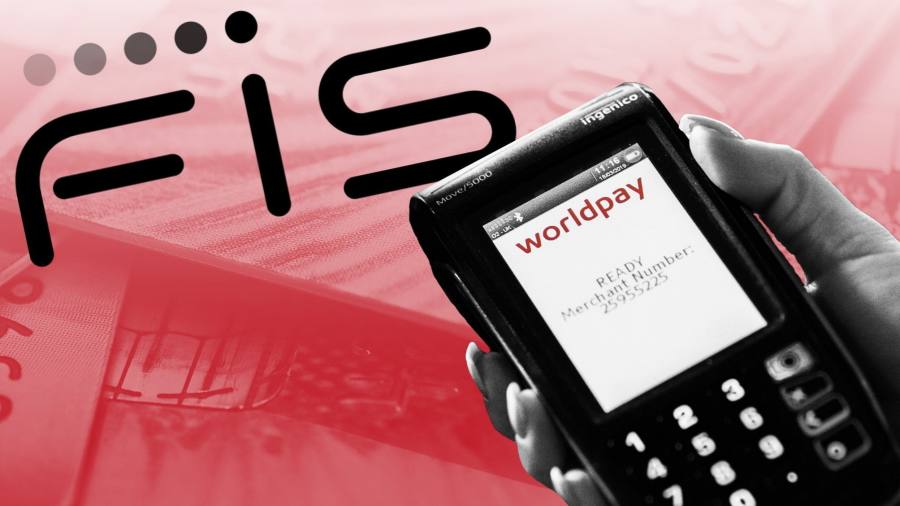
Since it was founded by former UK policeman Nick Ogden, Worldpay has been passed at great cost between a series of owners. Now, more than a quarter of a century later, the payments processor’s fortunes are back in its own hands.
US financial technology group FIS last month announced plans to spin off Worldpay just four years after paying $43bn for the group in a deal now seen as the high watermark for the consolidation then gripping the payments industry.
On paper, the deal had a logic: uniting FIS, which delivers payments process technology to banks, with Worldpay’s customer base of merchants, including retailers, would create a powerhouse in the fast-growing sector.
The admission by FIS, which took an almost $18bn writedown on Worldpay, is not just the latest case of buyers’ remorse over a company that was created in a wave of mergers and whose owners over the past two decades have included buyout firm Bain and fintech group Vantiv. It has also forced a reckoning over the industry’s mantra that scale must be prized at all costs.
“There was peer pressure to create these payment conglomerates . . . this should never have happened,” said Dan Dolev, an analyst at Mizuho.
Current employees at the company who spoke to the Financial Times on condition of anonymity said the two businesses were ultimately incompatible.
Scale, scale, scale
The payments industry had rapidly changed in the years before FIS bought Worldpay.
Big, slow-moving, incumbents were being scared into action by the growth of online shopping, declining cash usage and disruptive new companies such as Square — now known as Block — that pioneered portable, branded point-of-sale terminals allowing small businesses to take card payments more cheaply.
The older payment companies fought back to win market share and add capabilities, gambling on spending enough money to repel the upstarts.
The fundamental idea behind a wave of mergers — that began in 2019 when US payments processor Fiserv agreed to buy rival First Data for $39bn — was to establish a quasi-oligopolistic payments network as a moat against competition.
FIS’s takeover of Worldpay was the next big deal to follow, then came Global Payments’ acquisition of TSYS for $21.5bn and finally Worldline’s deal to buy Ingenico for €7.8bn.
All of the big players bought the ability to serve both merchants and banks. But the difficulties getting a huge payments merger right are shown in the diverging fortunes of the two biggest deals.
For Fiserv the addition of Clover — a rival to Square that was owned by First Data — gave it access to one of the biggest payments trends of the past few years: portable, branded point-of-sale terminals for small businesses, which make for the most profitable customers.
Worldpay, however, lacked similar access so was left vulnerable to the kind of disruption that had spurred mergers to begin with.
“Pre-acquisition Fiserv and FIS were incredibly similar companies — the Coke and Pepsi of legacy fintech. But Worldpay and First Data had very different product, client profiles, that largely explain why one deal worked well and one did not,” said a senior FIS employee.
Dolev at Mizuho said that the big mistake for FIS and Worldpay, both of which declined to comment, was combining in the first place, as integrating the companies was always going to be difficult.
“The original sin was . . . the board of FIS I believe felt obliged to get themselves a merchant acquirer” in response to the First Data deal, he said.
“One of the challenges WorldPay has had is that WorldPay itself has been a collection of acquisitions – how you knit all those together from a tech point of view so you can offer a unified proposition to your customer base. That’s a challenge they’ve been grappling with,” said Peter Keenan, chief executive of payments fintech Apexx Global.
Structural problems were exacerbated, say analysts, by Worldpay moving too slowly in response to changing customer needs during the coronavirus pandemic.
“A lot of merchants, especially small businesses, overnight had to find an online way to sell stuff because everyone was quarantined. [Worldpay] in the US was just too slow to react to those demands. They were very corporate America, and that slowness led to a lot of small merchants finding solutions elsewhere,” said Dolev.
“The Worldpay business would have struggled through the past 18 months with or without the merger,” said the senior employee.
Going it alone
FIS claims it extracted $1.65bn in annual revenue and cost synergies from the deal. However, the decision to split was a clear admission it had failed to sustainably combine the two businesses.
It was also an acknowledgment that Worldpay might now be better off outside FIS and that money matters less than the removal of fetters.
As FIS chief executive Stephanie Ferris said in announcing the spin-off: “The separation from FIS will allow Worldpay to pursue a more growth-oriented strategy.”
Keenan said that although the argument in favour of scale remained valid “there is a point where it becomes a law of diminishing returns, go beyond a certain point and you lose agility, which damages you more”.
There was also a fear that FIS was holding back Worldpay due to internal conflicts pitting its traditional bank clients against the merchants, according to several analysts.
“Worldpay was interested in following the likes of Stripe, who are getting into the issuing business as well to allow merchants to issue cards . . . arguably this competes with banks, which are the bread and butter of the FIS client base. It wouldn’t be surprising if there were some friction between the two sides of the business,” said Zilvinas Bareisis, an analyst at Celent.
Jack Henry, a smaller rival that remained independent during that wave of dealmaking, has done better than most by focusing on its core business of serving only banking clients.
Its stock is the second-best performer among its peers, up 34 per cent since 2019 when the race to scale up accelerated. Only Fiserv did better as its stock is up about 60 per cent during the same period, while Global Payments is up only 15 per cent and FIS is down 35 per cent.
The hope is that an unshackled Worldpay will now be free to challenge the newcomers as well as hunt for bolt-on acquisitions that can help it make up the lost ground. Some analysts have suggested that it could try to acquire a point-of-sale company such as Toast, shares of which are down 50 per cent from their 2021 IPO price.
The market is likely to look favourably upon a leaner and more focused Worldpay as it will be better placed to compete and grow, according to analysts. Meanwhile, FIS will also be free to deepen its ties with its banking clients.
The two separate groups — FIS and Worldpay — will have new leadership. Charles Drucker, who is highly regarded in the industry, is coming back to lead Worldpay, having left when it was sold to FIS. Ferris is stepping into the top job at FIS, having been chief financial officer at Vantiv.
Ferris has said the two companies will continue to work together but the real test will be less their ability to collaborate and more how quickly the two can grow apart.
Read the full article here

