


Receive free Indian business & finance updates
We’ll send you a myFT Daily Digest email rounding up the latest Indian business & finance news every morning.
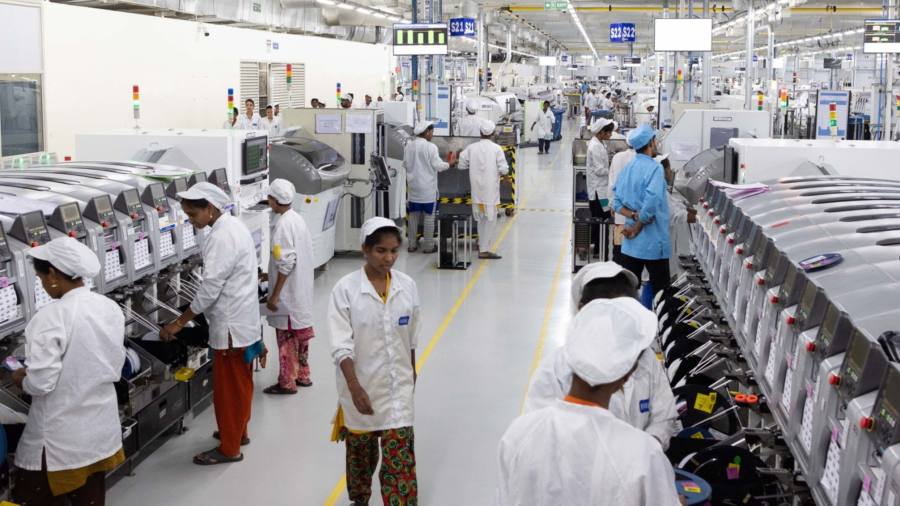
Two of India’s most business-friendly southern states, Karnataka and Tamil Nadu, recently amended laws to allow an increase the length of working shifts from eight to 12 hours in a reform urged by investors, including Apple and its contract manufacturer Foxconn.
Karnataka, where the Taiwanese supplier plans to build a major plant in Bengaluru, also amended legislation in February to allow for two-shift production, and to make it easier for women — a mainstay of electronics manufacturing in Asia — to work at night. Neighbouring Tamil Nadu, where Foxconn already makes iPhones for Apple, in April passed similar legislation.
The liberalisation moves came at a time when India bulls in New Delhi, Hong Kong and New York were hyping the country, now the world’s most populous, as an emerging factory hub that can serve as a strong alternative to China as companies diversify their supply chains. Narendra Modi’s government is working actively to attract the kind of high-tech investment Apple has long made in China and Vietnam, whose selling point to multinationals includes flexible working hours.
But no sooner than India appears to be heading down the same path of more business-friendly working hours, a backlash is forming. After an outcry from trade unions and opposition parties, Tamil Nadu’s chief minister MK Stalin announced on the May 1 Labour day public holiday in India that he was putting the state’s legislation on hold. In Karnataka, the opposition Indian National Congress last month trounced Modi’s Bharatiya Janata party in a state election. In its manifesto it said it would repeal the factories law amendment there too.
This is no doubt a blow for Apple and Foxconn. While the companies are keeping details of their expansion into India largely under wraps, several government officials say the two companies played an active role in pushing for Karnataka and Tamil Nadu’s amendments to how India’s factories act — a national law — are implemented in the two states.
Unlike China and Vietnam, one-party states whose rulers can make the bureaucracy jump to do their bidding, India is a democracy with strong powers for states in a federal system and vocal interest groups. While Indian unions are not all-powerful, they do have a voice for workers in manufacturing. This suggests a more unpredictable future lies ahead for Apple, Foxconn and others as they seek to make India a leading “China plus one” manufacturing location.
“If India wants to attract tech manufacturing and replace or at least become an alternative to east Asian competitors, the labour laws will need to be updated,” says Anirudh Suri, author of the book The Great Tech Game. However, he adds: “The reality of India is that the socio-economic and political complexity of the country often makes progress on those ambitions slower than you would want because you need to take the whole country along.”
Advocates of deregulation point out that India’s economy struggles to create enough jobs, and that decent factory work should be prized in a country where underpaid and informal work is ubiquitous. “The unions have taken a very regressive stance on this,” says an official in southern India, who asked not to be named because the topic is sensitive. “The women would stand to get higher wages, more overtime, and more time to go home.”
The Modi government’s push to reform the Indian economy has been thwarted before by powerful lobbies, including in 2020-21, when mass protests forced it to abandon three farm bills.
“If the government had its way, it would deregulate a lot of the key markets, particularly land and labour,” says Antara Haldar, an associate professor of law and economics at the University of Cambridge. “I think they would like to do it, but on the ground there is political resistance.”
Haldar says in China, authorities created a “whole ecosystem” for business including worker hostels allowing women to work long shifts feasibly and safely. This and other infrastructure that might support a major shift into formal factory work is largely missing in India.
At the central government level, the Modi cabinet in 2019-20 passed four labour codes meant to overhaul India’s way of working, but then quietly postponed implementing them after being forced to drop the farm laws in 2021.
The Modi government may now revisit the issue of labour market reforms after the next general election in 2024, if it is reelected, officials say — but if so, will probably do it cautiously.
Read the full article here

