


Receive free Artificial intelligence updates
We’ll send you a myFT Daily Digest email rounding up the latest Artificial intelligence news every morning.
The writer is founder of Sifted, an FT-backed site about European start-ups
The promise of artificial intelligence is that it will transform productivity. Nowhere is that needed more than in healthcare. With ageing populations, tight spending constraints and overstretched medical staff in many health systems, a productivity revolution cannot arrive quickly enough. As Dr Margaret McCartney wrote in an FT Weekend essay marking the 75th anniversary of Britain’s National Health Service, the job of a general practitioner today is “essentially undoable.”
But technologists have been promising to transform healthcare for decades, with mixed results. It is a sector pockmarked by hubris, hype and false dawns. Most famously, IBM claimed that its Watson supercomputer, which in 2011 won the quiz game Jeopardy!, could also tackle cancer, but it failed to emerge as “an all-purpose answer box.” The public also remains deeply suspicious about the use of AI in healthcare. A Pew Research Center poll from earlier this year found 60 per cent of US respondents were “uncomfortable” with AI being used to diagnose disease or recommend treatment.
Can the latest promise of a technology-powered healthcare revolution, accelerated by the emergence of generative AI, deliver this time?
One expert who thinks it will is Lloyd Minor, dean of Stanford Medical School, who argues that recent advances in AI will enable us to do what Watson’s creators envisaged. AI has long been used in specific areas of healthcare, helping to monitor the possible interactions of drugs and analyse scans of skin lesions, for instance. But Minor says today’s generative AI models are going to impact every aspect of healthcare, from patient care and routine administration to medical training and drug discovery. Whereas the internet has enabled us to access information, generative AI will allow us to assimilate knowledge, he says. “There are inflection points in human history: language, the printing press, the internet. I think generative AI is a similar inflection point.”
To make the most of the opportunity, Stanford’s medical school last month teamed up with the university’s Institute for Human-Centered Artificial Intelligence to address the ethical and safety issues surrounding the use of AI. Its joint RAISE-Health initiative will track promising applications of AI in life sciences and healthcare, accelerate research and help educate patients and healthcare providers about responsible uses of the technology.
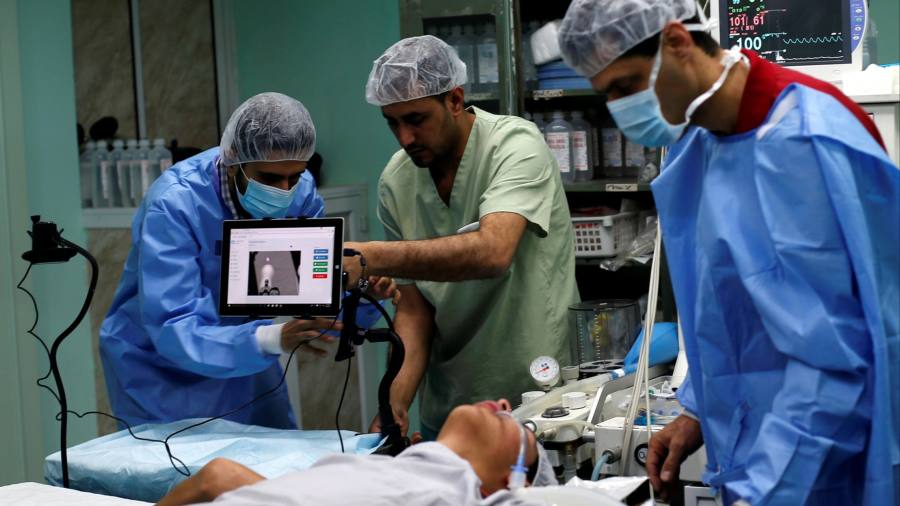
AI is already opening up possibilities for healthcare to be delivered in many more effective ways. One area is surgery. Proximie, a start-up founded by the surgeon Nadine Hachach-Haram, has videoed more than 20,000 procedures, with the consent of both surgical staff and patients, creating a new digital medical resource and infrastructure. The company’s mission is to build a global platform that can share best practice in real time and improve training, case reviews and patient safety. Proximie can use generative AI to provide data-rich summaries of procedures, track surgical instruments and generate patient reports.
Hachach-Haram says there is a lot of buzz around AI but it should only be used in specific use cases that demonstrably benefit patients and medical staff. Her challenge has been to persuade the “scrubs and suits” that technology can produce better outcomes and save money. But she has also had to persuade patients that the use of intrusive technology can improve safety while preserving privacy. “We can use generative AI to analyse data in a secure way,” she says. “Data saves lives.”
Some of the big technology companies, which have a poor reputation for use of personal data, are also training specialist generative AI models for the healthcare sector. Google is trialling the medical chatbot Med-PaLM 2, which provides expert advice to doctors, at the Mayo Clinic in the US. Google is rightly cautious about releasing this model more widely before its potential flaws are fixed.
But one of the researchers who has worked on the project is excited by how, once proven, the technology could transform global healthcare. Vivek Natarajan, an AI researcher at Google Health, recently told the RAAIS conference in London that when he was growing up in India, he knew people who had never seen a doctor in their lives. “Where is AI going to have the most impact? . . . Access to healthcare,” he said. It would allow us to imagine “a world class doctor in the pockets of billions.”
That is a tantalising prospect. But in a sector that revolves around organisational complexity, personal sensitivity and life-and-death decision making, we had better use AI wisely.
Read the full article here

