


Receive free German economy updates
We’ll send you a myFT Daily Digest email rounding up the latest German economy news every morning.
Germany warned its companies to reduce their dependence on Beijing as it adopted its first China strategy, stressing that the government would not pick up the tab if they fell victim to mounting geopolitical risk.
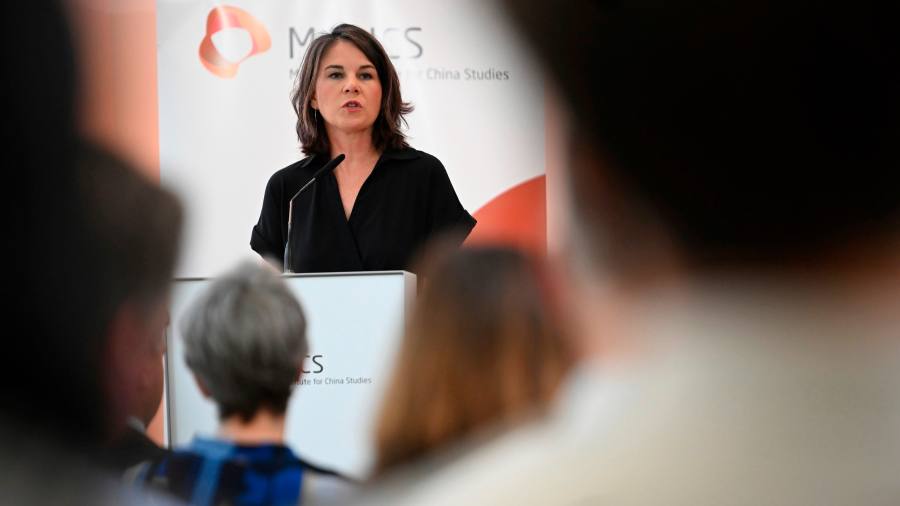
Foreign minister Annalena Baerbock told companies overly-dependent on China that they would “have to bear more of the financial risk themselves” in future. She delivered the stark message on Thursday as she unveiled the landmark document with a focus on “de-risking” economic relations between Europe’s largest economy and its biggest trading partner.
Baerbock said the responsibility for “risky corporate decisions” must become clearer as her country strives to learn the lessons of Russia’s full-scale invasion of Ukraine, which exposed how reliant Germany had become on Russian gas supplies.
“The approach of trusting the invisible hand of the market in good times and demanding the strong arm of the state in times of crisis doesn’t work in the long run,” she said. “Even one of the strongest economies in the world can’t stem that.”
The milestone strategy was long delayed by disagreements between the foreign ministry headed by Baerbock, a Green politician who has long supported a tough stance on China, and the chancellery headed by Olaf Scholz, a Social Democrat who has promoted a more cautious approach.
The 64-page report rejects the notion of “decoupling” from China but stresses the need for Germany to “de-risk” — that is, diversify its supply chains and export markets away from the country and so reduce its vulnerability to external shocks.
The EU labelled China a systemic rival in 2019 and European Commission president Ursula von der Leyen has promoted the idea of “de-risking” the bloc’s most sensitive economic sectors to limit their dependence on China.
Scholz himself said last month that the bulk of the work of reducing dependence on China should fall on the shoulders of companies rather than governments.
But the report used tough language to reinforce that message, warning that companies needed to work harder to ensure that message was “more strongly internalised”.
Baerbock said that, while China remained a partner for Germany, its role as “systemic rival” was beginning to “dominate” as it became “more repressive internally and more aggressive externally”. She added: “Germany has changed and so we have to change our China policy too.”
Jürgen Matthes, of the Cologne Institute for Economic Research, described the strategy as “the beginning of the end of naivety” for Germany, which before the war in Ukraine had long sought to avoid difficult debates about conflicts between its economic and geopolitical interests.
Noah Barkin, a Europe-China expert at the US-based research firm Rhodium Group, said that it sent an important signal about the need to consider geopolitical risk when doing business.
He added, however, that the government had stopped short of introducing instruments similar to those being used by the US to “raise hurdles for companies wanting to do business in China.” He added: “There’s no indication that Germany will strengthen export controls and the language on outbound investment screening is quite weak.”
China’s embassy in Berlin responded to the report by calling on Germany to view the country’s development “rationally, comprehensively and objectively”. It said: “Forcibly ‘de-risking’ based on ideological prejudice and competition anxiety will only be counterproductive and artificially intensify risks.”
China is Germany’s largest trading partner, with the volume of bilateral trade reaching a record €300bn last year. The relationship was long seen as a pillar of Germany’s economic success and a model of globalisation in practice.
But Germany’s misgivings have gradually grown since the ascent of President Xi Jinping, China’s most powerful leader since Mao Zedong, who this year started an unprecedented third term.
The country’s increasing authoritarianism, its crackdown on civil rights and ethnic minorities, its sabre-rattling over Taiwan and aggressive posture in the South China Sea have forced Berlin to undertake a fundamental rethink of the relationship, one that accelerated when the China-sceptic Greens entered government in late 2021.
Germany is particularly alarmed at the prospect of a Chinese invasion of Taiwan, a move that would throw global supply chains into disarray and potentially shut off the Chinese market to German companies.
Still, despite the growing warnings from the federal government in Berlin as well as high tensions between Beijing and Washington, Germany’s powerful carmakers — Volkswagen, BMW and Mercedes-Benz — all continue to count China as their largest market. They have invested to defend their market share amid growing competition from Chinese brands.
Executives at the chemical giants BASF and the industrial powerhouse Siemens have also vowed to defend and expand their presence in the country.
Volkswagen Passenger Cars chief operating officer Ralf Brandstätter on Thursday welcomed the document’s aim of working “to strengthen our own position . . . to reduce one-sided economic dependencies, and to create incentives for more diversification”.
He insisted that the carmaker did not “look naively at the economic superpower China has become”, adding that Germany must reduce dependencies, strengthen its position in other regions and “create autonomously controllable value chains”.
Germany’s largest business association, the BDI, said that the strategy struck the right balance between addressing geopolitical risks and emphasising Germany’s interest in continuing “substantial economic relations and co-operation with China” on global challenges such as climate change.
Read the full article here

