


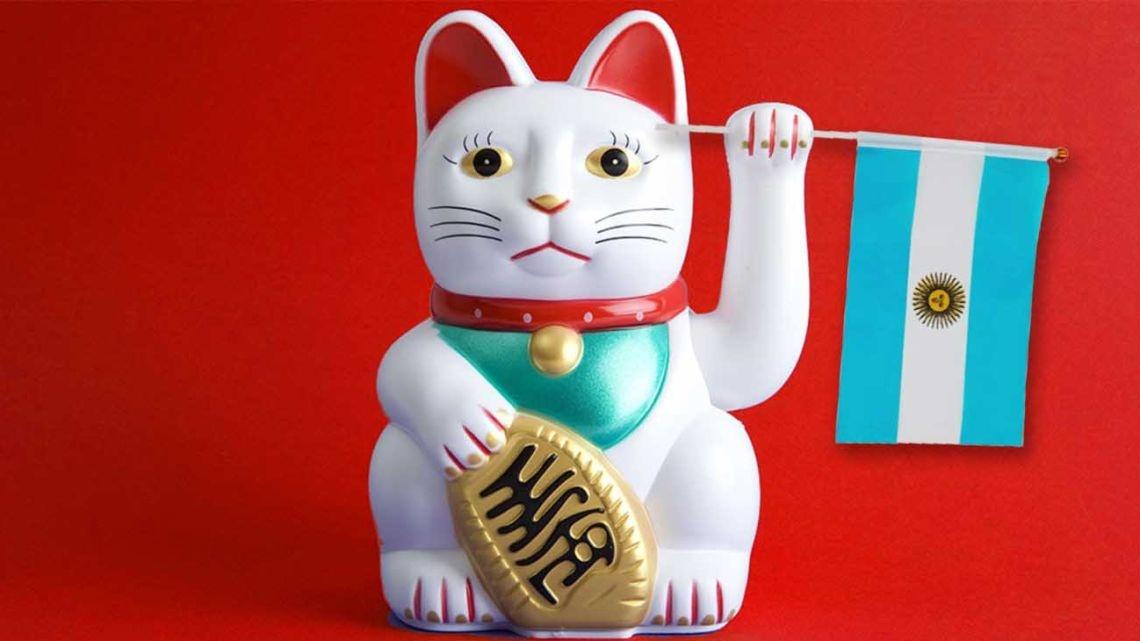
Was Sergio Massa’s rcent visit to China to “beg” for a couple billion yuan humiliating, as some of the government’s detractors suggest, or a pragmatic necessity in order to keep Argentina from imploding, as sources in the Economy Ministry suggest? Why was Máximo Kirchner, a national deputy who is clearly the vice-president’s political ambassador, even there? Was he there for a behind-the-scenes political negotiation with Massa regarding who would lead the presidential ticket in the upcoming PASO primaries, or was it an intelligent demonstration of political continuity that should be well received in a culture with a different relationship to time and cherishing the long term? As has become the norm in the times of polarization, any and all questions traversed by political subjectivity will be analyzed according to one’s preconceptions which are determined by the binary logic of “la grieta.” The best antidote, therefore, is critical scepticism.
One of the defining features of Massa’s tenure at the Economy Ministry has been to project an image of swiftness lacking in his real predecessor, Martín Guzmán. Massa, like Buenos Aires City Mayor Horacio Rodríguez Larreta, pride themselves in being politicians that get things done. “Gestión,” which literally translates as management, direction or administration, has gained a connotative charge in the world of Argentine politics. It is the desired concept by which they would like to be described in focus groups and opinion polls, and it is generally cultivated by releasing multiple and consistent photo-ops, giving many press conferences, and making constant announcements. Being associated with procrastination, on the other hand, can be a death sentence. Just ask President Alberto Fernández and former minister Guzmán. Both of them would retort that they weren’t allowed to be efficient and productive, given the intrusion of Cristina Fernández de Kirchner and her acolytes. Ah, the beauty of Peronism.
Looking to show some “gestión,” Massa jetted over to China last month in the new presidential plane, christening the main bedroom before any president had even the chance to. He brought along a large delegation includig key officials such as Central Bank Governor Miguel Ángel Pesce and Energy Secretary Flavia Royón. Yet, the most exceptional and unexpected name from an Argentine perspective was Máximo Kirchner.
Massa’s objective was marked by short-termism, as the cash-strapped coffers of the Central Bank and a massive deficit put continued pressure on the peso-dollar exchange rates with inflation remaining stubbornly high. The delegation was looking to secure some hard cash, namely in the extension of a currency swap with China, along with a series of other commitments to shore up the depleted foreign exchange reserves. The ongoing negotiation with the International Monteary Fund, where China is a major stakeholder, was also on the table. The agro-exporting sector, mining, Vaca Muerta, hydroelectric power projects in the Patagonian region, were among the key issues being discussed. “Cooperation without conditioning,” in the words of deputy Máximo during his speech at the influential Chinese Academy of Social Sciences (CASS), trying to mark a difference with the International Monetary Fund and therefore the bilateral relationship with the United States.
Therein lies our first contradiction. China is, with Brazil, Argentina’s major trading partner and has the potential to be an important ally. Not only do they need to import what Argentina produces but also the size of its economy makes it a potential investor in developing the infrastructure Argentina needs to thrive. This, in part, is what the Belt & Road initiative is all about, and if harnessed correctly it could be beneficial to Argentina and China at the same time. Yet, the belief that there are no conditions proves the naïveté of the Argentine delegation. While Massa’s hyperactive pragmatism allows him to concentrate on the immediate need for hard currency, Máximo’s supposed geopolitical vision attempts to push Argentina closer to China and therefore away from the United States in the grand chessboard of global politics.
The affinity between the Kirchnerites and anti-US sentiment runs in the family. Néstor Kirchner was the first to snub the superpower when he invited George Bush Jr. to the 2005 Americas Summit held in Mar del Plata, only to criticize the US in his speech and surround the then-POTUS with the likes of Hugo Chávez and Evo Morales. Out in the streets Diego Maradona led a 40,000-strong parade against the “Yankee empire.” While Néstor repaid most of Argentina’s debts with the IMF and foreign creditors, once the global economy went from overdrive to crisis and the commodities super-cycle went bust, the US judiciary went to war with his wife. The late judge Thomas Griesa sentenced Argentina to a painful debt default with his infamous “pari passu” ruling, locking the nation out of international markets and eventually forcing it to cough up serious cash to pay up, which occurred during the Mauricio Macri administration — a marked turn toward pro-US policy while still keeping friendly ties with China.
Once the economy imploded under the Macri administration, political affinity with US president Donald Trump led to the IMF’s largest-ever bailout. With Joe Biden in the White House, Argentina has secured flexible terms from the IMF as it attempts to avoid another default. Currently, Massa and his team are looking to extend the Fund’s flexibility, possibly by fronting up all of the outstanding tranches of its emergency loan in advance.
The US and China have seen a crescendo of political tensions which promise to be the defining geopolitical feature of this decade. As they dispute regional spheres of influence, both superpowers have identified Argentina as a relevant actor. With a vast reserve of multiple coveted natural resources in a lightly populated territory in the Southern Atlantic, Argentina presents an enticing opportunity. The country’s foreign policy over the last two administrations has sought to keep a careful and self-interested balancing act, understanding the geopolitical importance of both behemoths. Food, energy, and access to the Southern Atlantic — despite the dispute with the UK over Malvinas which is a clear continuation of colonialist policies despite the outcome of the war — as Antarctica becomes a disputed territory are all key features making the country geopolitically attractive. Yet, nothing comes without conditions. Be it from one side or the other.
This piece was originally published in the Buenos Aires Times, Argentina’s only English-language newspaper.
Read the full article here

