


Receive free EU foreign policy updates
We’ll send you a myFT Daily Digest email rounding up the latest EU foreign policy news every morning.
On paper, the EU should be an attractive partner for many low- and middle-income countries across the globe. It is the biggest market in the world, its social model is widely admired and it is less pushy on foreign policy alignment than either China or the US.
Also on paper, Latin America should be the most promising place for the EU to press this advantage home. The region is culturally close to Europe, it is largely democratic and shares the EU’s founding values, and immigration from it into the bloc has been relatively easy to absorb.
But when European and Latin American leaders meet this week for their first summit in almost a decade, their attempts at collaboration will feel like starting, if not from square one, then not much further than square two. At best, the EU-Mercosur trade agreement, under way for decades, will get a political push towards ratification.
The likely underwhelming summit is a sign that the EU has not contemplated, let alone articulated, what deeper forms of relationship it can offer non-members beyond traditional trade deals and association agreements.
The pandemic and Russia’s war against Ukraine woke European leaders up to their continent’s dangerous dependence on others for the foundations of its security, from energy to microchips. They also found their geopolitical priorities were less widely shared than they may have assumed when this mattered less.
The first step to solving the problem — recognising that it exists — is happening, then. Not before time. The construction of post-1945 European unity around economic integration conditioned leaders to seeing the world stage as a market square: a place to sell exports and source raw materials.
A marketplace, however, is so easy to take for granted that one forgets it requires political underpinnings — which Europe was long content to let the US sustain. After the 2008 crisis, European leaders were too consumed by internal problems to adapt to America’s increasing dereliction of this role.
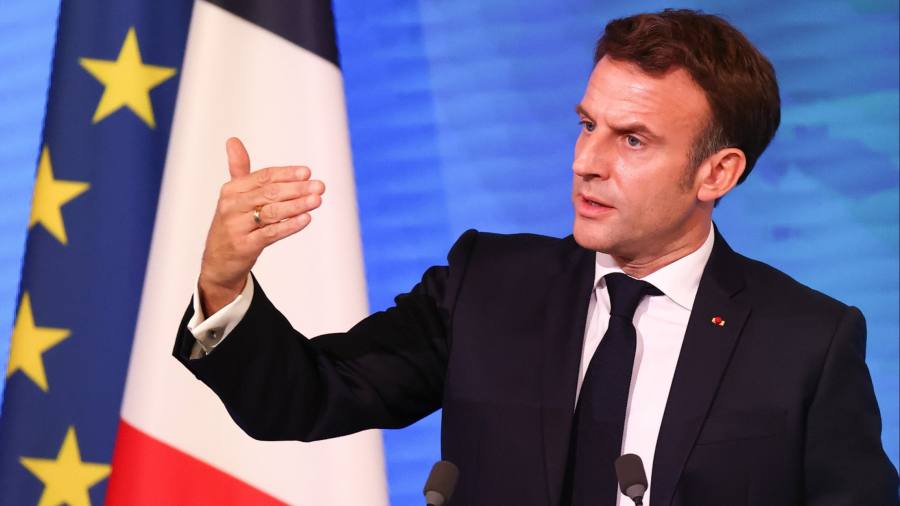
The pandemic and the war have boosted French president Emmanuel Macron’s concept of “strategic autonomy”, but even this comes with a dose of solipsism. More than standoffish autonomy, the EU needs strategic engagement to get other countries more firmly on its side.
Europe’s neglect of the world contrasts with China’s Belt and Road Initiative, which uses geopolitics and infrastructure to reshape trade patterns to its advantage — including by turning the heads of some EU states. The fact that Beijing has not fully succeeded does not mean it has been wrong to try.
The EU is, to be fair, catching up. Its pandemic recovery fund, new energy policy and drive to promote technological and industrial investment have righted the balance that made some member states look kindlier on Beijing than on their neighbours. The war has rekindled the political will to use membership prospects to mould others in the EU’s image. The current difficult dealings with Turkey should be a cautionary tale: that country was reforming until it was convinced in the 2000s that the EU’s door was not open in good faith. The EU cannot afford to lose Ukraine in the same way.
What is missing still is a committed strategy for deep relationships with countries beyond the conceivable membership candidates. This is not just a matter of, say, securing critical minerals and metals supplies (though it is that too). It is about shaping a world where the EU remains relevant because it has more and closer allies on global issues such as the geography of supply chains, tech rules, multilateral governance and climate change.
That is a much higher-stakes ambition than the EU has shown to date. It would require a commensurate devotion of both financial and political resources, and partnership forms going deeper than conventional trade deals. This could mean new forms of participating in the single market itself, or large-scale migration partnerships.
As EU leaders contemplate how they adapt their institutions to a larger membership, they should also consider how to create tighter links with far-flung non-members. They should match China’s ambition and aim for a global economy as centred on Europe as possible. But they should aim higher than Beijing in attracting countries not through financial entrapment but by offering deeper, mutually beneficial links.
Think of this more-for-more approach as “Belt and Road with liberal democratic characteristics”. That may seem unrealistic. Yet it is of the deepest realism, for nothing less can protect Europe’s interests if the US gives up on the liberal rules-based order after next year’s presidential election.
Read the full article here

