



A hawkish Fed and subsequent rising U.S. recession risk are clearly bullish for risk-free assets like U.S. Treasuries, but USD-denominated EM bonds also look favorable in the current environment.
- Big levels everywhere: Apple has $3tn market capitalization, US Treasury 10-year and 30-year are yielding 4%, and the 2-year is yielding 5%, and every chart from EUR to ZAR looks poised…for something. What something might that be?
- A hawkish Fed and resultant rising recession risk are the thing. This should be bullish for risk-free market rates (like the US 10-year), and bearish for “risk”. EM US dollar-denominated bonds now look very attractive. EM local currency denominated bonds now look unattractive.
- China cuts two ways. On one side, higher US rates relative to Chinese rates puts downward pressure on CNY, which is a risk to EMFX (while also exporting disinflation and a US rates rally). On the other side, Chinese stimulus, however targeted and modulated, could support commodities markets and thus specific EMs.
In June, the VanEck Emerging Markets Bond Fund (EMBAX) was up 2.66% compared to 2.75% for its benchmark (50% J.P. Morgan Government Bond Index-Emerging Markets (GBI-EM) Global Diversified and 50% J.P. Morgan Emerging Markets Bond Index (EMBI)). Year to date as of 6/30/2023, the Fund is up 5.93%, in line with its benchmark, which is up 5.95%. We continue to increase duration and exposure to US dollar-denominated EM bonds, while reducing exposure to Asian currencies (EMFX) and high-beta EMFX (no Thailand, South Africa, or Mexico local currency, for example) with the exception of Brazil (and selected others), which appears very attractive following its weakness. We end June with carry of 5.88%, yield-to-worst of 7.71%, duration of 5.6, and roughly 48% in local currency. The risk we worry about is that ongoing/excessive exuberance could boost high-beta/high-risk local currency markets to which we have limited exposure. We are now defensively positioned.
| Average Annual Total Returns (%) as of June 30, 2023 | |||||||
| 1 Month† | 3 Month† | YTD | 1 Year | 3 Year | 5 Year | 10 Year | |
| Class A: NAV (Inception 07/09/12) | 2.66 | 2.27 | 5.93 | 14.28 | 2.09 | 3.12 | 1.74 |
| Class A: Maximum 5.75% load | -3.24 | -3.61 | -0.16 | 7.71 | 0.10 | 1.90 | 1.14 |
| Class I: NAV (Inception 07/09/12) | 2.85 | 2.51 | 6.01 | 14.78 | 2.40 | 3.44 | 2.07 |
| Class Y: NAV (Inception 07/09/12) | 2.84 | 2.46 | 6.13 | 14.79 | 2.36 | 3.38 | 2.00 |
| 0% GBI-EM/50% EMBI | 2.75 | 2.36 | 5.95 | 9.43 | -2.22 | 0.48 | 1.18 |
| Average Annual Total Returns (%) as of March 31, 2023 | |||||||
| 1 Month† | 3 Month† | YTD | 1 Year | 3 Year | 5 Year | 10 Year | |
| Class A: NAV (Inception 07/09/12) | 1.50 | 3.58 | 3.58 | -0.38 | 8.30 | 0.85 | 0.33 |
| Class A: Maximum 5.75% load | -4.34 | -2.38 | -2.38 | -6.11 | 6.19 | -0.34 | -0.26 |
| Class I: NAV (Inception 7/9/12) | 1.52 | 3.42 | 3.42 | -0.04 | 8.60 | 1.14 | 0.63 |
| Class Y: NAV (Inception 7/9/12) | 1.49 | 3.58 | 3.58 | -0.16 | 8.54 | 1.08 | 0.57 |
| 50 GBI-EM GD / 50% EMBI GD | 2.54 | 3.51 | 3.51 | -3.81 | 0.48 | -1.43 | 0.29 |
† Returns less than one year are not annualized.
Expenses: Class A: Gross 2.55%, Net 1.27%; Class I: Gross 2.51%, Net 0.97%; Class Y: Gross 2.91%, Net 1.02%. Expenses are capped contractually until 05/01/24 at 1.25% for Class A, 0.95% for Class I, 1.00% for Class Y. Caps excluding acquired fund fees and expenses, interest, trading, dividends, and interest payments of securities sold short, taxes, and extraordinary expenses.
The performance data quoted represents past performance. Past performance is not a guarantee of future results. Investment return and principal value of an investment will fluctuate so that an investor’s shares, when redeemed, may be worth more or less than their original cost. Performance may be lower or higher than performance data quoted. Please call 800.826.2333 or visit vaneck.com for performance current to the most recent month ended.
The “Net Asset Value” (NAV) of a Fund is determined at the close of each business day, and represents the dollar value of one share of the fund; it is calculated by taking the total assets of the fund, subtracting total liabilities, and dividing by the total number of shares outstanding. The NAV is not necessarily the same as the ETF’s intraday trading value. Investors should not expect to buy or sell shares at NAV.
Big levels everywhere: Apple has $3tn market capitalization, US Treasury 10-year and 30-year are yielding 4%, and the 2-year is yielding 5%, and every chart from EUR to ZAR looks poised…for something. What something might that be?
Well, the latest FOMC could be it. In it, the Fed accepted staff recession forecasts, while remaining hawkish. Clearly, the Fed is willing to “bring it on” and will use this opportunity to correct its mistaken initial expectation of “transitory” inflation. The next several months could see improved inflation outcomes in the U.S. and a handle-change to 3% from 4% on CPI. Yields at current levels could be fighting the inflation tape for months. Keep in mind that big rate moves tend to happen very quickly. Now is the time to at least prepare intellectually.
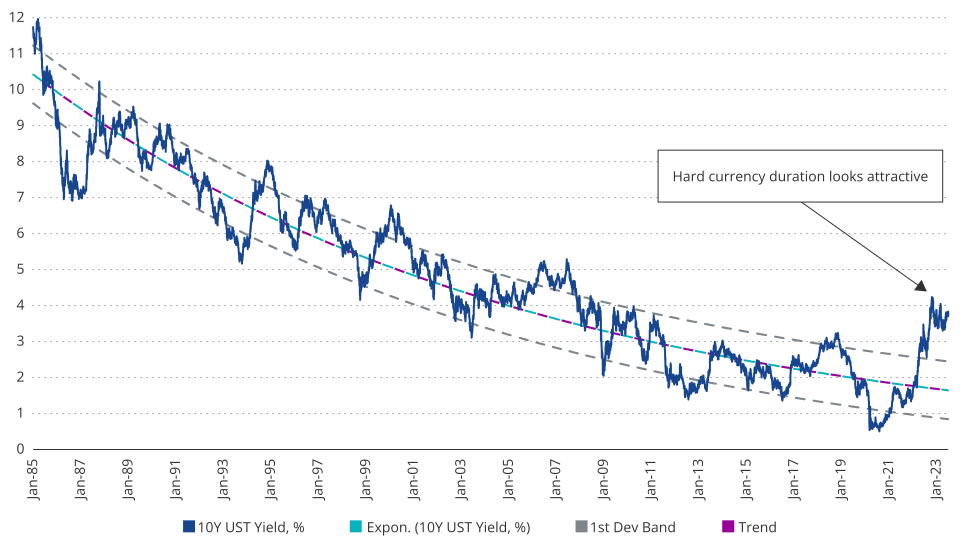
A hawkish Fed and resultant rising recession risk are the thing. This should be bullish for risk-free market rates (like the US 10-year), and bearish for “risk”. EM US dollar-denominated bonds now look very attractive. EM local currency denominated bonds now look unattractive. This marks a big change for us. For the past year, we’ve been attracted to the high real rates of Asian and some Latin local currency markets. And this stance paid off with outperformance. But now EM local rates have simply rallied too much and don’t offer obvious cheapness. Exhibit 1 below gives a superficial version of this. On the left graph, we show US treasury yields with their volatility bands. These yields now deviate well over 1 standard-deviation from trend. The graph on the right, though, shows EM local currency yields minus US treasury yields. These yield differentials are now over 2 standard-deviations lower than trend yield differentials. UD dollar-denominated bonds look attractive, EM local currency-denominated bonds appear unattractive.
Exhibit 1 – USD Rates Look Like a Buy, EM Local Rates Look Like a Sell
10Y UST Yield with Volatility Bands, %
GBI-EM/5Y UST Yield Differential vs. Trend and Volatility Bands, bsp
Source: VanEck Research. Data as of June 30, 2023. Past performance does not guarantee future results.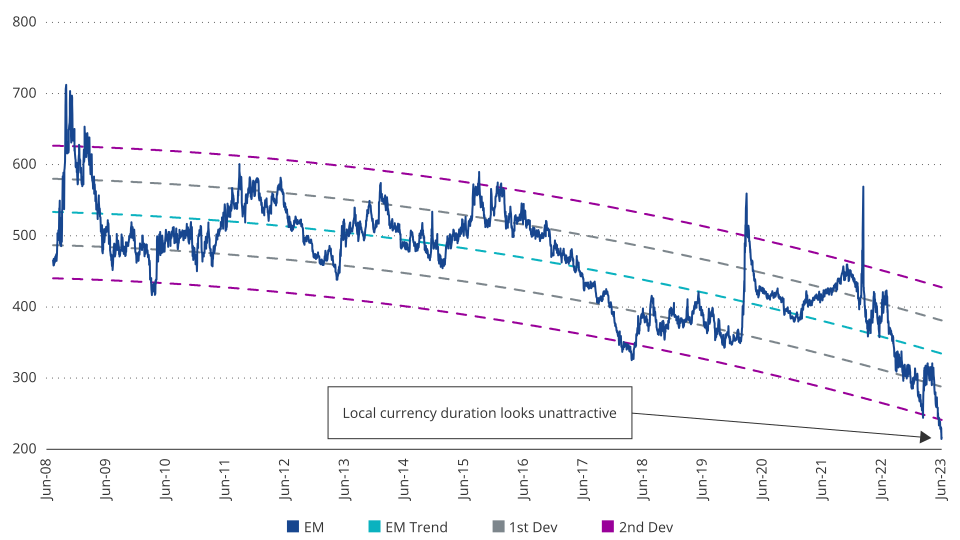
China cuts two ways. On one side, higher US rates relative to Chinese rates put downward pressure on CNY, which is a risk to EMFX (while also exporting disinflation and a US rates rally argued for above). On the other side, Chinese stimulus, however, targeted and modulated, could support commodities markets and thus specific EMs. China is a relatively mature country that does not need to be a stimulus-junkie due to its low inflation, low government debt, and very high domestic credibility/popularity. As a result, a firehose of economic support should not be expected. But, tailored projects could easily be part of the policy mix. What this means is that we need to be wary of potential renminbi (CNY) weakness. CNY has followed Chinese yield differentials with the US, and EMFX has high correlation and beta with CNY. Moreover, CNY weakness would export disinflation, further supporting our constructive view on US rates. But this also means we need to be on the watch for potential winners of any tailored Chinese policy responses. These could be very “commodities supportive”, so countries like copper-exporting Chile (as one example) could be specific winners. Exhibit 2 below shows that CNY has weakened along with the interest rate differential between China and the US. The US looks to be relatively more hawkish than a China contemplating shades of stimulation, and this could present risks for a lot of EM local currency markets.
Exhibit 2 – Chinese Currency Declined as Chinese Interest Rate Differential with US Declined
Source: VanEck Research. Data as of June 30, 2023. Past performance does not guarantee future results.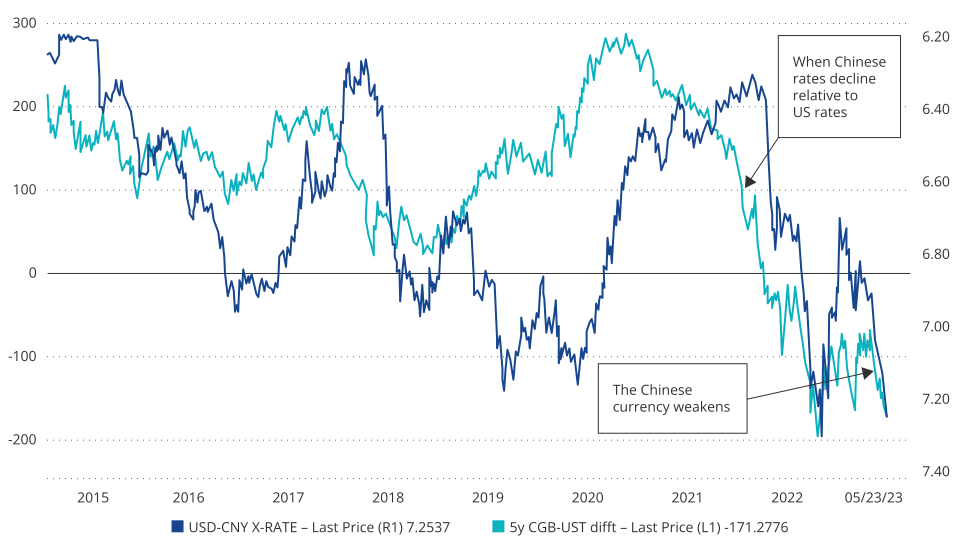
Exposure Types And Significant Changes
The changes to our top positions are summarized below. Our largest positions in June were Indonesia, Brazil, Mexico, Colombia, and Peru:
- We increased our hard currency sovereign exposure in Nigeria and Egypt, as well as hard currency corporate exposure in Nigeria. Nigeria’s post-election policy U-turn was much faster than expected, with ambitious announcements about the exchange-rate unification and the elimination of fuel subsidies. The new administration has a very long “to-do” list and there are numerous implementation risks, but at the very least the measures should reduce pressure on international reserves. The main drivers in Egypt were indications of faster-than-expected privatization and more substantial support from the Gulf. In terms of our investment process, these developments improved the policy test scores for the two countries.
- We also increased our hard currency exposure in Mexico and Colombia, and local currency exposure in the Dominican Republic. The Dominican Republic’s disinflation progress improves the country’s economic test score and leaves room for yield compression. Colombia’s current account adjustment eases pressure on the international reserves (and also improves the economic test score). The market positioning in Mexico’s local bonds and FX is getting stretched, but sovereign bonds’ valuations remain attractive (the solid technical test score), and there are no glaring external imbalances.
- Finally, we increased our local currency exposure in Sri Lanka, and hard currency sovereign exposure in Qatar and Morocco. Changes in Sri Lanka’s exposure mostly reflected price appreciation, following a series of encouraging announcements about debt restructuring. Morocco is a solid sovereign credit with low beta to China, which improved the country’s technical test score in the current environment. Qatar was the best candidate to meet our risk limits in the region, as there are increasing concerns about Saudi Arabia’s fiscal situation against the prospect of softer oil prices.
- We reduced our hard currency sovereign exposure in Pakistan and Guatemala. The main driver in Pakistan was the country’s ability to meet the IMF program’s benchmarks, which worsened its policy test score. Guatemala’s presidential elections raised legitimacy concerns, as the frontrunner was excluded from the polls shortly before the elections. In terms of our investment process, this worsened the country’s policy test score.
- We also reduced our local currency exposure in Malaysia and Thailand. The key motivating factor was potential contagion from China’s soft growth patch – both in terms of economic impact and currencies’ beta to the Chinese renminbi. In terms of our investment process, this worsened the technical test score for these countries.
- Finally, we reduced our local currency exposure in Brazil, despite several seemingly supportive factors such as very successful disinflation, a less bad fiscal outlook, and no changes in the official inflation target that opened room for policy rate cuts before the year-end. These positives, however, are mostly priced in, and the market positioning both in rates and FX is very elevated. Brazil’s technical test score has weakened as a result, but we are open to revisiting this trade if valuations start to look more attractive in the coming months.
Disclosures
This is not an offer to buy or sell, or a recommendation to buy or sell any of the securities, financial instruments or digital assets mentioned herein. The information presented does not involve the rendering of personalized investment, financial, legal, tax advice, or any call to action. Certain statements contained herein may constitute projections, forecasts and other forward-looking statements, which do not reflect actual results, are for illustrative purposes only, are valid as of the date of this communication, and are subject to change without notice. Actual future performance of any assets or industries mentioned are unknown. Information provided by third party sources are believed to be reliable and have not been independently verified for accuracy or completeness and cannot be guaranteed. VanEck does not guarantee the accuracy of third party data. The information herein represents the opinion of the author(s), but not necessarily those of VanEck or its other employees.
International Monetary Fund (IMF) is an international U.S.-based organization of 189 countries focused on international trade, financial stability, and economic growth.
The World Government Bond Index (WGBI) measures the performance of fixed-rate, local currency, investment grade sovereign bonds. The WGBI is a widely used benchmark that currently comprises sovereign debt from over 20 countries, denominated in a variety of currencies, and has more than 30 years of history available. The WGBI is a broad benchmark providing exposure to the global sovereign fixed income market. The Blended 50/50 Emerging Markets Debt Index is an appropriate benchmark because it represents the various components of the emerging markets fixed income universe.
Duration measures a bond’s sensitivity to interest rate changes that reflects the change in a bond’s price given a change in yield. This duration measure is appropriate for bonds with embedded options. Quantitative Easing by a central bank increases the money supply engaging in open market operations in an effort to promote increased lending and liquidity. Monetary Easing is an economic tool employed by a central bank to reduce interest rates and increase money supply in an effort to stimulate economic activity. Correlation is a statistical measure of how two variables move in relation to one other. Liquidity Illusion refers to the effect that an independent variable might have in the liquidity of a security as such variable fluctuates overtime. A Holdouts Issue in the fixed income asset class occurs when a bond issuing country or entity is in default or at the brink of default, and launches an exchange offer in an attempt to restructure its debt held by existing bond holding investors. Carry is the benefit or cost for owning an asset. Yield to worst is a measure of the lowest possible yield that can be received on a bond with an early retirement provision.
All indices are unmanaged and include the reinvestment of all dividends, but do not reflect the payment of transaction costs, advisory fees or expenses that are associated with an investment in the Fund. Certain indices may take into account withholding taxes. An index’s performance is not illustrative of the Fund’s performance. Indices are not securities in which investments can be made.
The Fund’s benchmark index (50% GBI-EM/50% EMBI) is a blended index consisting of 50% J.P. Morgan Government Bond Index-Emerging Markets (GBI-EM) Global Diversified and 50% J.P. Morgan Emerging Markets Bond Index (EMBI). The J.P. Morgan GBI-EM Global Diversified tracks local currency bonds issued by Emerging Markets governments. The J.P. Morgan EMBI Global Diversified tracks returns for actively traded external debt instruments in emerging markets, and is also J.P. Morgan’s most liquid U.S. dollar emerging markets debt benchmark.
Information has been obtained from sources believed to be reliable but J.P. Morgan does not warrant its completeness or accuracy. The Index is used with permission. The index may not be copied, used or distributed without J.P. Morgan’s written approval. Copyright 2023, J.P. Morgan Chase & Co. All rights reserved.
You can lose money by investing in the Fund. Any investment in the Fund should be part of an overall investment program, not a complete program. The Fund is subject to risks which may include, but are not limited to, risks associated with active management, credit, credit-linked notes, currency management strategies, derivatives, emerging market issuers, energy sector, ESG investing strategy, foreign currency, foreign securities, hedging, high portfolio turnover, high yield securities, interest rate, LIBOR replacement, market, non-diversified, operational, restricted securities, investing in other funds, sovereign bond, and special risk considerations of investing in Latin American issuers, all of which may adversely affect the Fund. Emerging market issuers and foreign securities may be subject to securities markets, political and economic, investment and repatriation restrictions, different rules and regulations, less publicly available financial information, foreign currency and exchange rates, operational and settlement, and corporate and securities laws risks. Derivatives may involve certain costs and risks such as liquidity, interest rate, and the risk that a position could not be closed when most advantageous.
ESG integration is the practice of incorporating material environmental, social and governance (ESG) information or insights alongside traditional measures into the investment decision process to improve long term financial outcomes of portfolios. Unless otherwise stated within an active investment strategy’s investment objective, inclusion of this statement does not imply that an active investment strategy has an ESG-aligned investment objective, but rather describes how ESG information may be integrated into the overall investment process.
ESG investing is qualitative and subjective by nature, and there is no guarantee that the factors utilized by VanEck or any judgment exercised by VanEck will reflect the opinions of any particular investor. Information regarding responsible practices is obtained through voluntary or third-party reporting, which may not be accurate or complete, and VanEck is dependent on such information to evaluate a company’s commitment to, or implementation of, responsible practices. Socially responsible norms differ by region. There is no assurance that the socially responsible investing strategy and techniques employed will be successful. An investment strategy may hold securities of issuers that are not aligned with ESG principles.
Investors should consider the Fund’s investment objective, risks, charges, and expenses of the investment company carefully before investing. Bond and bond funds will decrease in value as interest rates rise. The prospectus and summary prospectus contain this and other information. Please read them carefully before investing. Please call 800.826.2333 or visit vaneck.com for performance information current to the most recent month end and for a free prospectus and summary prospectus.
No part of this material may be reproduced in any form, or referred to in any other publication, without express written permission of Van Eck Securities Corporation.
© 2023 Van Eck Securities Corporation, Distributor, a wholly-owned subsidiary of Van Eck Associates Corporation.
© 2023 VanEck. VanEck®, VanEck Access the opportunities®, and the stylized VanEck design® are trademarks of VanEck Associates Corporation.
Original Post
Editor’s Note: The summary bullets for this article were chosen by Seeking Alpha editors.
Read the full article here

