


Receive free Chinese employment updates
We’ll send you a myFT Daily Digest email rounding up the latest Chinese employment news every morning.
The writer, author of ‘Red Flags: Why Xi’s China is in Jeopardy’, is a research associate at the University of Oxford’s China Centre
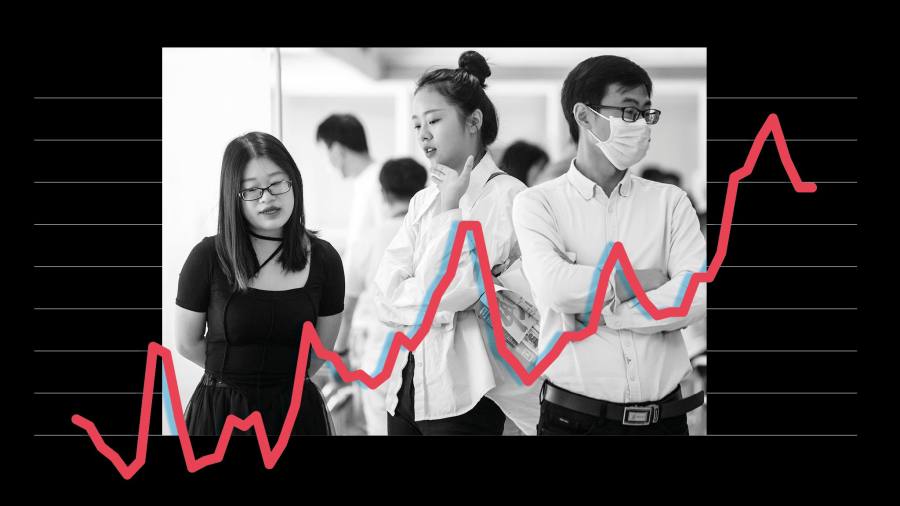
Strictly speaking, a country that has one of the fastest ageing populations on earth and a slump in fertility should be running into labour shortages, especially among younger age cohorts. Yet China has just reported that youth unemployment reached a record 21.3 per cent in June, with some speculating that inactivity may be far higher. Finding work for the young is of paramount importance — youth unemployment is socially corrosive as well as a blight on the economy.
Since 2021, a social phenomenon known as tang ping, or lying flat, has taken root among young Chinese. It is essentially about disillusionment and doing whatever it takes to simply get by in the face of a weak economy, low social mobility and the dearth of good jobs. Now a new term, bai lan, translated as “let it rot”, is popular among the young. It conveys a deeper sense of pessimism, and of not striving at all.
With good jobs in short supply and stiff labour market competition in a weak economy, increasing numbers of younger people are reported to have also become full-time children, staying at home to work for and be paid for by their parents.
The biggest problem for out of work young people, however, is the risk of what economists call “hysteresis”. This is the danger that the longer they stay out of the formal labour market, the greater the difficulty becomes of ever getting back into it as skills and experience atrophy.
Even allowing for the fact that China’s youth unemployment rate would be a bit lower if International Labour Organization definitions applied, a worrisome pattern has emerged in the five years since national data were first published. There is an annual cycle operating in which the unemployment rate rises into the summer when graduates flood the labour market and then ebbs in the second half of the year, but every year has seen a ratcheting up of unemployment rates throughout.
The problem in China is acute for three reasons. First, the young are significant consumers, contributing as much as a fifth of spending in urban areas, according to a report by Goldman Sachs. Taken together with their slightly older peers, those under 35 account for over three-fifths of luxury goods spending. Weak consumption in China is certainly more complex than just rising youth unemployment but there is a link.
Second, a marked change in the occupational structure of jobs has meant that the proportion of low pay, low skill, informal sector jobs has been rising at the expense of higher paid, high skill jobs in manufacturing and construction. According to Stanford University professor Scott Rozelle, the ratio of informal to formal sector jobs 15 years ago was 40:60, but has now flipped. This is a particular problem for younger workers who are over-represented in low pay sectors and the gig economy.
Third comes three sets of mismatches. There is a mismatch of skills between those that many graduates acquire and those that employers, especially in engineering, finance and manufacturing, demand. Job and salary expectations, especially on the part of highly educated graduates, are unrealistic. There is also, importantly, a lack of aggregate demand reflecting the official focus on supply side policies and increasingly apparent shortcomings in China’s economic development model with its emphasis on state enterprises.
With another 11-12mn graduates coming on to the market this summer, China watchers will be paying close attention to the unemployment numbers — and to economic decisions expected from the Politburo.
Talk of stimulus is in the air, underscored by weak second quarter numbers. But the traditional remedies of credit creation, rural revitalisation and infrastructure programmes have been limited because of severe financing and debt difficulties for the local and provincial governments charged with implementing them. Chinese economists have become more vocal in urging their government to adopt measures to boost consumption.
Ultimately, youth unemployment in China may not be resolvable until the national development model gets a makeover: service industries need to be expanded and opened up, and the government needs to embrace enthusiastically income redistribution and social security, education and tax reforms with a switch in strategy priorities back to the private sector. These require a formidable political transformation.
Earlier this year, the Communist Youth League urged young Chinese to “take off their suits, roll up their sleeves, and go to the farmland” but the young seem to be hoping for something different.
Read the full article here

