


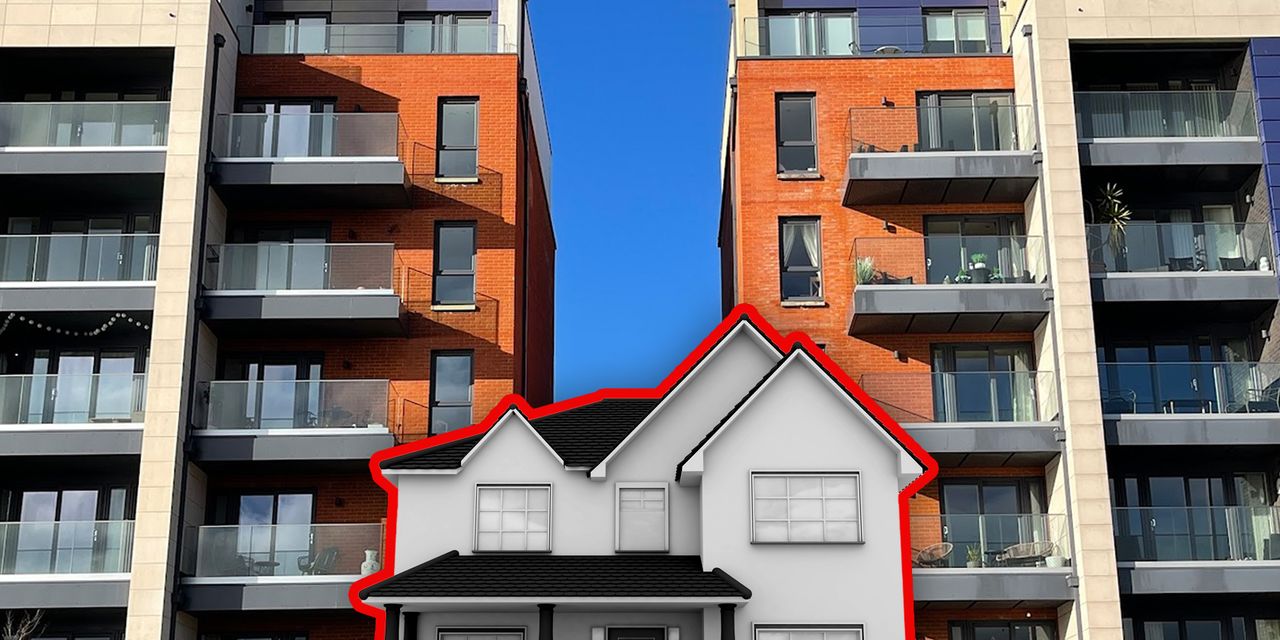
Over the last five years, a number of cities and states in the U.S. — from Minneapolis to Maine, Oregon and California — have overturned rules that previously only allowed developers to build single-family homes in certain neighborhoods.
The push to eliminate single-family housing is premised on the desire to to create more housing units, while also making them more affordable and easing the cost of living.
The U.S. suffers from a national housing shortage — “the product of local restrictive zoning policies and other regulatory barriers that make it difficult to build a range of housing types at different price points,” according to a 2023 report by the Joint Center for Housing Studies at Harvard University. The group estimated that 75% of land in many cities is zoned only for single-family homes.
“Ending single-family zoning would, in theory at least, give way to builders constructing, and put more people in more homes on the same plot of land previously zoned to fit a single-family home. ”
Ending single-family zoning would, in theory at least, give way to builders constructing duplexes, fourplexes, or even multi-storey apartments, that would put more people in more homes on the same plot of land previously zoned to fit a single-family home.
Have changes to zoning regulations in California and elsewhere created more housing units and met the nation’s intense demand for homeownership? It may be too soon to tell, but the U.S. housing market seems to be increasingly leaning towards zoning as a key way to fix its supply problem.
“The important thing to remember is this is an incremental change — this is not a cure-all to the housing crisis across the country,” Daniel Kuhlmann, assistant professor of urban planning and real estate at the University of Arizona, told MarketWatch. Kuhlmann’s research has examined the impact of ending single-family zoning in Minneapolis.
How zoning helps housing supply
Zoning refers to municipal code or local laws that divide land based on how it’s used. For instance, some neighborhoods are zoned as agricultural, commercial, industrial, and residential. Cities can also zone residential neighborhoods such that developers can only build single-family homes, versus building apartments and condos.
And for many industry experts, zoning may be one of the more long-term levers that could help heal the housing market.
The U.S. housing market is currently at a standstill, as it finds itself running out of homes to sell to people. In June, the U.S. had fewer than one million previously-owned single-family homes available for sale to buyers, which is the lowest level in 40 years, while pent-up demand from home buyers leaves many competing against one another to win bids, driving up home prices.
In addition to changing zoning regulations, a desperate call to increase housing supply has led many groups — from home builders to politicians — to propose various ways to address the supply shortage, including doubling the amount of capital-gains tax exclusions to turning offices into homes.
“Zoning is now much higher on the political agenda,” Richard Kahlenberg, author of “Excluded: How Snob Zoning, NIMBYism, and Class Bias Build the Walls We Don’t See,” told MarketWatch in a recent episode of Barron’s Live. The reason is simple, he added: “Housing prices have skyrocketed.”
Zoning law is not a silver bullet
Three years after the pandemic began, people continue to move away from big cities, in a large part because of higher prices, Kahlenberg added. “It’s bad for the economy, it’s bad for individual families, when you artificially constrain the supply of housing and ban multi-family housing.”
Recent analysis by Yonah Freemark, a senior associate at the Urban Institute, found that areas that were recently re-zoned for denser housing in the short term may not necessarily experience more housing construction, but in the long term “likely experience small increases” compared to areas where no zoning changes were made.
But Freemark also noted that there may still not be enough data to make a clear conclusion. Early data suggests that “upzoning” — whereby density of housing is increased in a certain neighborhood — generates positive effects on regional construction and affordability, “but more research is needed,” he stated.
In Minneapolis, which ended single-family zoning at the end of 2018, there hasn’t been a giant surge of new duplexes and triplexes. The local government said that between January 2020, when the regulation took effect, and 2022, 41 new projects were approved for construction.
“Eliminating single-family zoning is not a silver bullet for creating more housing choice or affordability,” Jason Wittenberg, a code development manager for the city of Minneapolis, told MarketWatch last year.
It takes a “multi-faceted approach that’s required of a municipality to tackle housing,” he added, from thinking more boldly about land use, and encouraging the political leadership to champion efforts to make housing more affordable and increase supply.
To be clear, not everyone agrees that zoning is the fix to the housing shortage: Zoning reform, or “upzoning,” has met considerable resistance from those who oppose new development, dubbed as NIMBYs, or Not In My Backyard. Many of these homeowners cite multiple reasons for opposing the construction of, say, a multi-unit dwelling in their neighborhood. Chief among those reasons: it would considerably change the look, feel, and traffic of the area.
And for now, builders — and subsequently, new homeowners — seem to be adjusting to the existing zoning rules by looking for housing further away from expensive areas. With remote and hybrid work being more common today than before, “you’ve seen people adjusting to where they live,” Mark Palim, vice president and chief economist at Fannie Mae
FNMA,
told MarketWatch.
“And the builders have been able to take advantage of that,” he added. “As you move into less congested areas, it has historically been easier to build — there’s more vacant land, and there’s a little bit less NIMBYism than in the suburbs.”
Nonetheless, as new and existing home prices in the U.S. exceed $400,000, zoning is still being pushed as a solution to permanently address the housing shortage.
“Housing prices have become so unsustainable that a broad swath of Americans now recognize that the government is creating a problem, and the government needs to fix it,” Kahlenberg said. “And so I think we will see over time a move towards less exclusion, less restrictive zoning, and the country will be better off because of it.”
Read the full article here

