


Receive free Chinese business & finance updates
We’ll send you a myFT Daily Digest email rounding up the latest Chinese business & finance news every morning.
From slowing global demand to rising geopolitical tensions and a tentative post-Covid recovery, China’s manufacturers are facing some of the strongest headwinds in years.
The tale of three factories — spanning footwear and electronics — illustrates how manufacturers are experiencing a slowdown in the world’s second-biggest economy.
Factory activity, one of the main pillars of economic growth through the pandemic, has slowed for four consecutive months through July. The Chinese Communist party’s politburo last week acknowledged the economy’s “tortuous progress” since the lifting of pandemic restrictions, vowing measures to “actively expand domestic demand”, such as spurring consumer spending.
“Things are pretty bad,” said Alicia García-Herrero, chief Asia-Pacific economist at French investment bank Natixis. Domestic demand “will only recover with a big stimulus”, she added, and “industrial production overall will underwhelm”.
This picture has been complicated by President Xi Jinping’s desire for “high-quality” growth, a strategy that favours tech industries over the vast manufacturing hubs that churn out basic consumer goods.
‘Our sector is in misery’
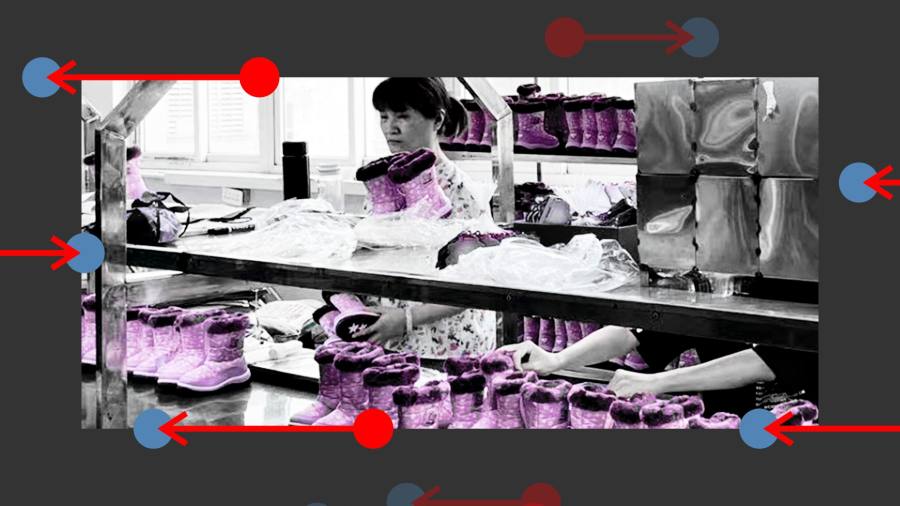
Feng Tai Footwear exemplifies the difficulties faced by the low-technology manufacturers on which China’s economic success has been built. Prior to the pandemic it sold some 5mn pairs of shoes a year to clients such as Walmart and Target. This year it will do well to sell 3mn. Orders for the second half of this year — typically filled by July — are down at least a third compared with last year.
“Our sector is in misery,” said chief executive Eddie Lam, who runs more than 10 manufacturing plants in China and employs more than 3,000 workers. “Orders often get cancelled halfway . . . Some buyers say they no longer have sufficient budgets. The sentiment is poor.”
“We are basically at a standstill,” he added. “Our workers are sometimes not even working their full-time hours.”
China’s monthly export delivery value of goods made with leather, fur or feathers as well as footwear has fallen more than a third from 2019, hitting nearly Rmb17bn ($2.4bn) in May this year.
The domestic market is tough, too, the company added, as shoes sell for a “much lower price” online. Still, that is where Lam is pinning his hopes for growth, along with new markets opening up under China’s Belt and Road international infrastructure development initiative.
Some of the company’s clients have asked if it can set up factories outside China, but Feng Tai has no plans to do so yet.
“The US knows very well that it cannot risk decoupling from China,” Lam said. “I just don’t see the advantage of moving production to south-east Asia with higher supply chain costs and additional investments required.”
Tien Sung Group
‘We can’t put all our eggs in one basket’
Geopolitical tensions between Beijing and Washington, as well as supply chain disruption during the Covid-19 pandemic, have spurred more manufacturers to shift out of China.
Rex Ho’s family business, which makes clothes for Adidas, Puma and New Balance, was an early adopter of a “China plus one” strategy, shifting some garment manufacturing to south-east Asia more than a decade ago.
“We have to consider [China] ‘plus one’ or even more,” said Ho, managing director of Tien Sung Group, referring to geopolitical tensions and supply chain disruptions. “We can’t put all our eggs in one basket.”
The Hong Kong-headquartered company, which has about 5,000 employees, began operations at its second factory in Vietnam in April. It also has a factory in Cambodia and one in China’s southern city of Guangzhou.
About 80 per cent of its revenue comes from exports to Europe and the US. “Our clients are still talking about how they do not want their products to be ‘made in China’,” he said. Labour costs are also a factor. Sewers, for example, are paid about $800 a month in China, compared with roughly $400 and $600 in Cambodia and Vietnam respectively.
But moving out of China offers little protection from global economic headwinds. Ho, also of the industry group Hong Kong Apparel Society, said some of his peers reported orders falling 20 per cent or more in the first half of this year as retailers cleared excess inventory. With rising interest rates, some buyers have demanded payment extensions.
Anhui Tiger
‘Growth has been really, really rapid’
When Xi declared “forceful” measures this year to encourage high-end manufacturing development, electronic components manufacturers such as Anhui Tiger were in prime position to benefit from the policy shift.
The company, based in Hefei in China’s eastern Anhui province, makes electronic parts such as high-frequency transformers and power inductors for cars and green power generation.
They also supply components for clients including US-based Whirlpool and Swiss industrial group ABB.
While demand for consumer electronics has fluctuated, the company grew about 30 per cent annually each year during the pandemic, recording revenue of about Rmb150mn in the first half of 2023. “Europe is accelerating the transition to clean, renewable energy, so we’ve seen an increase in demand in these sectors,” said general manager Xing Xuhua. “Growth has been really, really rapid.”
This is part of a wider trend. China’s industrial production of electrical equipment and machinery rose 15.4 per cent year on year in May, according to Natixis. Exports of vehicles jumped 110 per cent year on year in dollar terms in the first half of the year, while the dollar value of textiles and garments exports dropped 8.3 per cent, customs data showed.
Western companies are highly reliant on Chinese equipment and products for their transition to clean energy, said Xing.
Still, Anhui Tiger is not immune to pressure to expand outside China. The company is in the process of setting up its first plant in Vietnam. “When clients threaten to drop orders,” Xing said, “we have to say yes.”
Additional reporting by Thomas Hale in Shanghai
Read the full article here

