


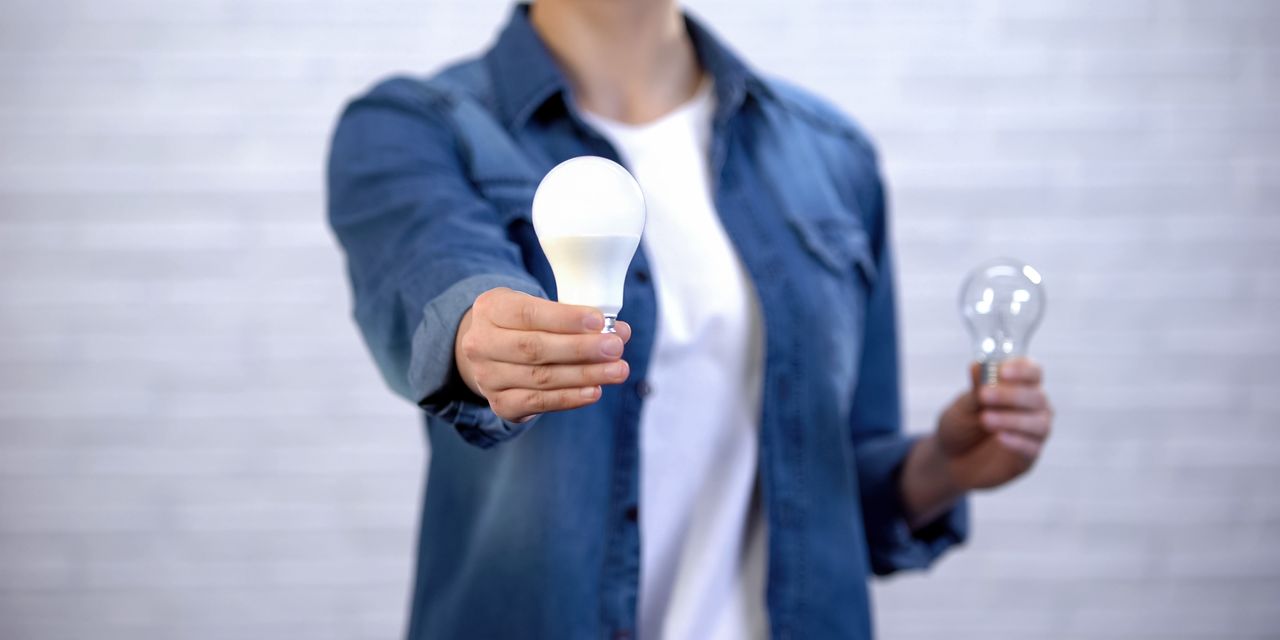
Aug. 1 means lights out for traditional incandescent bulbs, making way for greater LED adoption.
A Department of Energy rule set last year and effective beginning Tuesday bans the manufacture and sale of what the department has deemed inefficient “general service lamps.” That’s the official way of saying standard light bulbs screwed into lamps and ceiling fixtures, mostly in homes. You might picture a slightly updated version of Thomas Edison’s 1870s patent, although still with a thin coil of wire called a filament. And you’d be correct.
Most incandescent and halogen bulbs, an incandescent option that includes halogen gas to boost brightness and longevity, fail to meet new energy-efficiency standards and are banned by the rule. Manufacturers and retailers face a fine if they violate the ban, but consumers can’t be penalized for using up old inventory.
Separate action by President Joe Biden’s DOE last year, and likely put into practice in 2025, targets compact fluorescent bulbs (CFLs), which also have a gas component inside the bulb. CFLs were a relatively short-lived solution initially seen as more efficient than incandescent bulbs, though consumers could opt for either.
Combined, the elimination of this trio of light bulbs makes LEDs, which stands for light-emitting diodes, the bulb most households will have to opt for, with some exceptions, such as heat lamps.
It’s a bulb type that consumer groups and environmental advocates say saves money and energy, largely because traditional bulb styles, unlike LEDs, don’t turn the electrical energy they use directly into light, but first into heat. There’s a reason a toy Easy-Bake Oven, powered by a bulb, turns out a small cake.
Instead, with LEDs, an electrical current passes through a microchip, which illuminates the tiny light sources to create visible light.
LEDs: Costlier up front, but coming down
LEDs can cost more up front than the older styles, in fact, more than double the price of incandescent bulbs, but then save in energy bills over their lifespan.
This comparison, by Virginia-based service company Hutton Electric, Heating & Air, was done using two bulbs of similar brightness: A 60-watt incandescent and a 12-watt LED:
- The 60W incandescent bulb uses 60 kilowatt-hours (kWh) of electricity every 1,000 hours. At a sample electricity rate of $0.11 per kWh, it would cost $6.60 to operate the incandescent bulb for 1,000 hours.
- The 12W LED bulb uses 12 kWh of electricity every 1,000 hours. At the rate of $0.11 per kWh, it would cost $1.32 to operate the LED bulb for 1,000 hours.
And even those upfront prices are coming down. The Energy Department has said that the average cost of LED bulbs has dropped by nearly 90% since 2008.
“LEDs have become so inexpensive that there’s no good reason for manufacturers to keep selling 19th-century technology that just isn’t very good at turning electrical energy into light,” said Steven Nadel, executive director of the American Council for an Energy-Efficient Economy (ACEEE).
That cost shift may not be true in all communities. For certain, the public’s access to LEDs hasn’t been uniform, with communities underserved by retail options finding less choice. Minimal choice typically means shoppers pay up for the rarer LEDs relative to what’s spent per bulb in more affluent shopping districts. One Michigan study from 2018 revealed that not only were LED bulbs less available in poorer areas, they also tended to cost on average $2.50 more per bulb than in wealthier communities.
There are other ways to crunch the numbers. Because lighting accounts for around 15% of an average home’s electricity use, the average household saves about $225 in energy costs per year by using LED, DOE projects.
And despite initial sticker shock and for the most part, a range of options, LED sales have increased even before the regulatory changes. Globally, residential-only LED sales had increased to about 50% of sales in 2022, up from just 5% of the market in 2013, according to the International Energy Agency. Home-furnishings chain Ikea, for one, had switched to selling only LEDs as of 2015, including in U.S. stores.
As recently as 2020, 30% of U.S. sales were still incandescent or halogen incandescent bulbs, according to DOE data. Compact fluorescent light bulbs were just 1% of sales in 2020.
Less electricity, lasts longer
The Aug. 1 rule would more than double the current minimum light-bulb efficiency level, from its current standard of 45 lumens per watt to over 120 lumens per watt for the most common bulbs.
The DOE says LEDs use at least 75% less electricity than incandescent bulbs and last up to 25 times longer. According to the department, installing LED bulbs in just your most frequently used light fixtures can save hundreds of dollars over the lifetime of the bulbs.
The Natural Resources Defense Council (NRDC) offered different figures: LEDs use one-sixth the amount of energy to deliver the same amount of light and last at least 10 times longer than incandescent bulbs.
Some of the discrepancies may lie with the fact that LEDs don’t burn out with the pop of the filament as older bulbs do. LEDs grow weaker over time, and according to industry standards, their useful life ends when their brightness is diminished by 30%. Households may then replace them at varying times.
DOE has projected U.S. consumers collectively can save nearly $3 billion on their annual utility bills resulting from the rules, which it says will also cut planet-warming carbon emissions by 222 million metric tons over 30 years. That’s equivalent to the emissions generated by 28 million homes in one year.
The main industry group representing lightbulb manufacturers and importers, the National Electrical Manufacturers Association (NEMA), representing major sellers including GE
GE,
said companies are falling in line with the regulations.
“NEMA members are complying and ready to meet the enforcement deadline,” Alex Baker, director of regulatory affairs at NEMA, said in a statement. The group had earlier asked the DOE to push back the compliance date.
Households who rely on special bulbs can rest easy. DOE has carved out exceptions.
“It does not ban the sale or manufacture of ALL incandescent bulbs, just those common household incandescent (and other) bulbs that are not energy-efficient,” the Environmental Protection Agency (EPA) says of the new ban. “Many bulbs, including specialty bulbs, like heat lamps, three-way bulbs, chandelier bulbs, refrigerator bulbs, plant grow lights and others, are exempt from the law’s requirements.”
Political target
The rule to phase out the old-fashioned incandescent bulbs capped a decades-long effort to update American bulbs that started in the George W. Bush administration. That transition was complicated by former President Donald Trump in 2019, whose administration undid a previous Obama-era light-bulb rule that favored LEDs. Now, Biden’s DOE is turning these long-simmering proposals into rules.
Some politics-watchers say the light-bulb wars, which broadly speaking, pitted environmental-minded Democrats against leave-it-up-to-consumers Republicans, have quieted. That may be due in part to new friction: increased reviews of the safety and environmental impact of gas stoves.
Again, Republicans, for the most part, want to leave the choice in the hands of consumers. That stance isn’t slowing the appliance industry’s upgrades to electric options, including induction cooktops and ovens that some cooks champion for their gas-like heat control and sleek look. Federal tax incentives, on top of some state programs, under the Biden administration also reward consumers for opting for all-electric home appliances, although some consumers want to stick with gas for as along as possible.
Read the full article here

