


Receive free Science updates
We’ll send you a myFT Daily Digest email rounding up the latest Science news every morning.
The writer is a science commentator
If you haven’t yet heard of LK-99, where have you been? Over the past week and more, this pebble-sized dark rock — made of lead, phosphorus, copper and oxygen — has pushed social media into meltdown, sent stock markets surging and put Silicon Valley investors into a spin.
Scientists all over the world struggled to make sense of the hallowed lump. One enthusiast livestreamed his effort to bake a replica, with 16,000 Twitch viewers tuning in to stare at a kiln.
According to scientists in South Korea, LK-99 is a room-temperature superconductor that can work at normal pressure. If true, it represents colossal progress. Superconductors are materials that can conduct an electrical current with zero resistance, which means zero energy loss. They generally operate only at impractically low temperatures or fantastically high pressures. MRI machines, for example, use a niobium-titanium alloy cooled by liquid helium to below minus 263C.
But a room-temperature, ambient-pressure superconductor made from cheap materials would pave the way for perfectly efficient high-capacity power grids, desktop quantum computing, fusion reactors and even levitating trains. Hence the race in Europe, the US, Russia and Japan to find so-called high-temperature superconductors. Any breakthrough would be a Nobel Prize shoo-in.
But there’s a catch: proof remains elusive. Superconductivity, first discovered in 1911, is notoriously difficult to confirm in the lab. Mistaken sightings are so common they are nicknamed USOs, or Unidentified Superconducting Objects.
An electrical current, essentially a flow of electrons, is a messy affair — a bit like a dance floor of rowdy partygoers attempting a conga. But below a critical temperature, many materials become superconducting: the electrons abruptly pair up and begin to move smoothly. It is as if the partygoers disappear amid clouds of dry ice — and instantly reappear as pairs of ballroom dancers gliding effortlessly in unison.
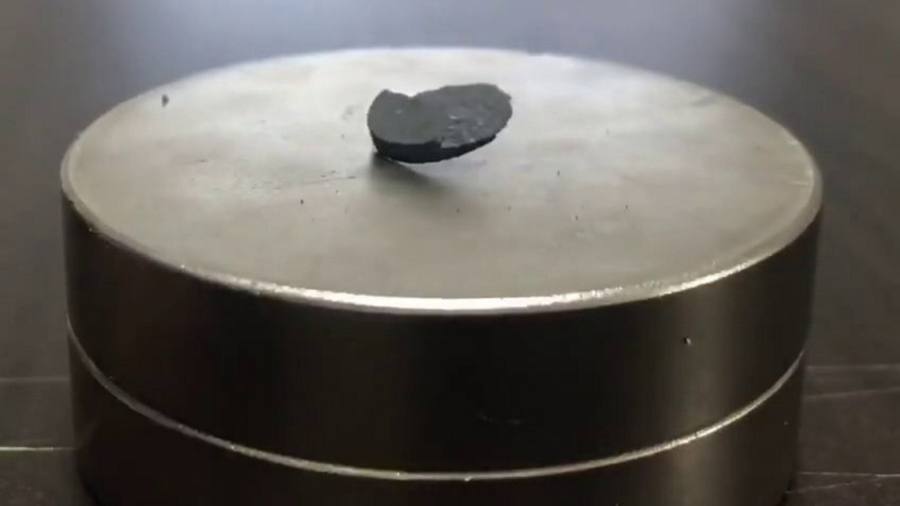
There are two giveaway signs of that transition: first, measured resistance drops to zero; and, thanks to a curious phenomenon called the Meissner effect, a superconductor will levitate above a magnet.
On July 22, a preprint — a draft scientific paper that has not undergone peer review — surfaced, claiming that LK-99 had met both tests. Scepticism was immediate. The researchers, from the Korea Institute of Science and Technology and the country’s Quantum Energy Research Centre, were respectable but not superstars. The method for making this miracle material — bearing the initials of two authors, Sukbae Lee and Ji-Hoon Kim — seemed incredibly simple, including use of a pestle and mortar, but lacked detail. A linked video appeared to show partial, rather than full, levitation.
Strangely, another paper by Lee and Kim quickly followed, this time with four other authors. As Scientific American notes, critics pointed to graphs featuring an oddly scaled axis, though a researcher at Lawrence Berkeley National Laboratory in California said the Korean claim was theoretically plausible. One team in China reported limited success at replication; another in India reported failure.
The matter is not yet closed but the odds seem unfavourable. A hastily convened verification committee set up in South Korea issued a cautionary note on August 2, suggesting a lack of concrete evidence.
Given superconductivity’s history of false dawns, our trusty pebble, now with its own Wikipedia page, is most likely to be an unremarkable rock with accidentally interesting properties. But what a gripping spectacle — one that tells us less about physics and more about the collective human need, even among scientists and investors, to dream.
Read the full article here

