


PNC Financial Services Inc., Citizens Financial Group Inc. and Cullen/Frost Bankers led a retreat in bank stocks on Tuesday after Moody’s published 27 ratings actions on U.S. banks.
The three stocks all posted losses of more than 3% as Moody’s downgraded the debt of 10 banks, issued negative outlooks on 11 other banks and put six banks on review for a downgrade.
Moody’s cited the impact of a potential U.S. recession in 2024 and higher interest rates on the quality of corporate debt. All downgrades were by one notch. A one-notch downgrade on debt could mean an extra 0.1% in the cost of borrowing for the largest banks and up to 1% more for smaller banks depending on balance-sheet holdings of each bank, according to industry estimates.
“U.S. banks continue to contend with interest rate and asset-liability management (ALM) risks with implications for liquidity and capital, as the wind-down of unconventional monetary policy drains systemwide deposits and higher interest rates depress the value of fixed-rate assets,” Moody’s analyst Jill Cetina said. “Meanwhile, many banks’ second-quarter results showed growing profitability pressures that will reduce their ability to generate internal capital.”
Also read: JPMorgan, Goldman and Morgan Stanley win praise in Jefferies Q2 bank earnings wrap
Brian Mulberry, client portfolio manager at Zacks Investment Management, said the Moody’s downgrade doesn’t mean that banks face any of the solvency issues that caused the demise of three regional banks earlier this year.
Rather it’s a signal that net interest income will continue to be under pressure as banks pay more to hold deposits, while interest payments they get from loans fail to keep up.
Mulberry said bank stocks had a muted reaction to last week’s U.S. sovereign debt downgrade by Fitch, because investors seemed to look past the negative development on the heels of positive employment data.
“Today’s move seems to be more of an emotional overreaction, but it’s no surprise given the pressure on net interest income by banks,” Mulberry said.
Reaction to the downgrade has been more muted in the corporate bond market, where spreads have widened only slightly between the prices being asked by sellers and the prices offered by buyers for three of the more prominent names in the Moody’s action: State Street Corp., U.S. Bancorp and M&T Bank.
For his part, Mulberry has been keeping an eye on retail sales and tightness in the labor market as indicators of when interest rate hikes by the U.S. Federal Reserve may end.
But for now, it seems like interest rates will stay higher for longer, he said. When Wall Street sees gets more visibility on whether interest rates will level off or drop, deal-making and bank profit margins may start to improve, he said.
“Historically speaking a 5% interest rate is not a hard stop for business to get done,” Mulberry said. “It’s an adjustment.”
Cullen/Frost Bankers Inc.
CFR,
Citizens Financial Group Inc.
CFG,
and PNC
PNC,
moved more deeply into the red than other bank stocks.
Among the group of 27 banks covered in Moody’s review, U.S. Bancorp
USB,
had the worst score of negative 98% in a measure of interest rate risk, funding and asset-liability management, weaker capital and exposure to commercial real estate.
U.S. Bancorp’s score of negative 98% reflects unrealized available-for-sale and held-to-maturity losses and more than 15% residential mortgages as a percentage of tangible capital equity, as of March 31. (See chart below)
Zacks analyst Mulberry said U.S. Bancorp’s balance sheet still reflects its $8 billion acquisition of Union Bank, which closed late last year. The cost of the merger has been a headwind on profits for the moment, he said.
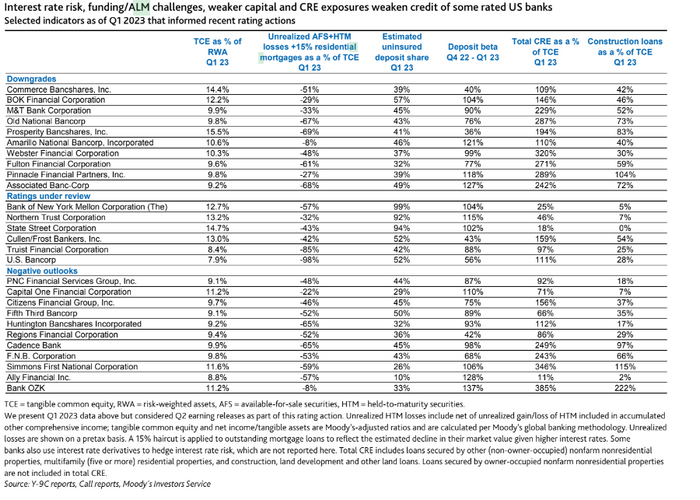
For its part, Cullen/Frost has one of the highest figures of 13% for tangible common equity as a percentage of risk-weighted assets as of March 31.
All told, Moody’s downgraded Commerce Bancshares Inc.
CBSH,
baseline credit assessment to a2 from a1 while cutting BOK Financial Corp.
BOKF,
M&T Bank Corp.
MTB,
Old National Bancorp
ONB,
and Prosperity Bancshares
PB,
to a3 from a2.
Moody’s also downgraded Amarillo National Bancorp Inc. (private), Webster Financial Corp.
WBS,
Fulton Financial Corp.
FULT,
and Pinnacle Financial Partners Inc.
PNFP,
to baa1 from a3, and cut its view on Associated Banc-Corp.
ASB,
to baa2 from baa1.
Bank of New York Mellon Corp.
BK,
Northern Trust Corp.
NTRS,
State Street Corp.
STT,
Cullen/Frost Bankers Inc., Truist Financial Corp.
TFC,
and U.S. Bancorp were all placed under review.
Banks with negative outlooks rom Moody’s are: PNC Financial Services Group Inc.
PNC,
Capital One Financial Corp.
COF,
Citizens Financial Group Inc.
CFG,
Fifth Third Bancorp
FITB,
Huntington Bancshares Inc.
HBAN,
Regions Financial Corp.
RF,
Cadence Bank
CADE,
F.N.B. Corp.
FNB,
Simmons First National Corp.
SFNC,
Ally Financial Inc.
ALLY,
and Bank OZK
OZK,
R.C. Whalen, chairman of Whalen Global Advisors LLC, said the fate of bank ratings is tied to U.S. sovereign debt, which was cut by Fitch last week.
“When the sovereign goes down, everything else in the world or ratings that depends upon it goes down,” he said. “The sovereign credit of the US is now AA+. And it may go lower before we are done. Large banks will definitely move lower.”
As for regional banks, they will likely consider mergers to boost returns as they look for ways to grow profits in coming years, according to an S&P bank outlook study.
While bank activity in mergers has been “abysmal” challenges to future profit expansion may lead to more acquisition activity in 2023 and 2024, said S&P analysts Zain Tariq and Nathan Stovall.
“The competitive landscape has changed, with many institutions responding to the fight for deposits by bolstering liquidity with higher-cost funding deposits like brokered deposits, borrowings from the Federal Home Loan Banks and certificates of deposits (CDs),” said the study.
Also read: JPMorgan CEO Jamie Dimon says U.S. should have the highest credit rating in the world
Read the full article here

