


China is making a push to dominate the trading of lithium carbonate futures, as it seeks to wrest the financial plumbing linked to metals vital to the clean energy revolution away from the western dollar-based financial system.
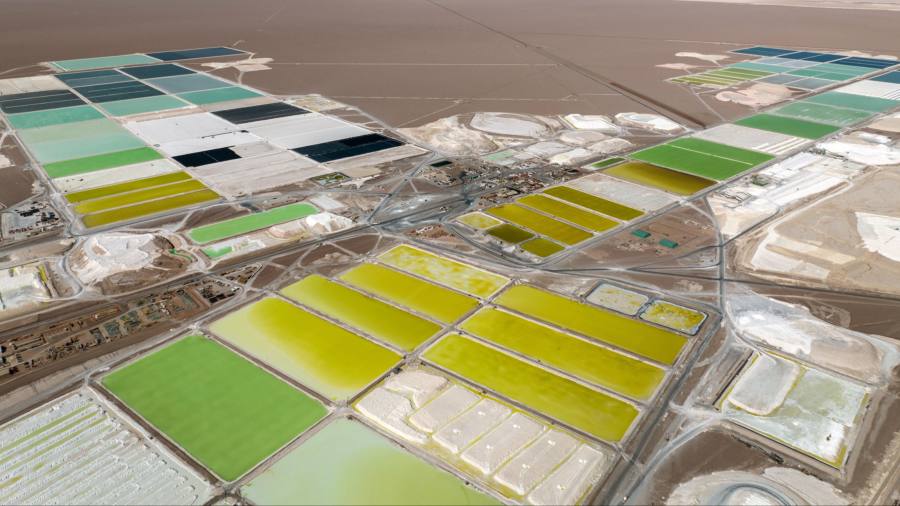
Last month Guangzhou Futures Exchange became the fourth global commodities exchange to launch contracts tracking the price of lithium carbonate, a mineral used in the manufacture of electric-vehicle batteries.
Within three weeks open interest — a key measure of the size of the market — had risen to more than 20,000 lots and far outstripped activity at rivals London Metal Exchange, Singapore Exchange and the US’s CME Group, which had launched its own version just days earlier.
The proliferation of futures contracts on crucial elements of electric-vehicle products such as nickel, copper and lithium carbonate in part reflects the growing importance of the industry, as companies up and down the supply chains seek to hedge against price swings.
But the early lead established by Guangzhou has underscored how China is seeking to seize greater control over trading in what it sees as a group of metals critical for the 21st century. By establishing its own trading hubs and benchmarks priced in renminbi, the drive is part of Beijing’s efforts to lessen the commodities market’s reliance on the US dollar — which has intensified following the US sanctions imposed on Russia over the Ukraine war.
“China certainly wants to be a pricing power for all these markets,” said Tiger Shi, chief executive of Hong Kong-based broker Bands Financial. “It will take time, but that’s going to be the direction.”
Chinese companies own a large number of mines and the products flow almost exclusively into Asia’s largest economy. The drive to build a trading system to match is a growing threat to the exchanges in the west that have traditionally dominated the market.
“China will in time be a powerhouse not just for domestic but international derivatives,” said Marc Bailey, chief executive of Sucden, a London-based metal broker with a strong presence in China.
It comes at a time when the dominance of London Metal Exchange, which has been the locus of global metals trading during most of its 146 years in operation, has come severely under threat.
The LME’s reputation has been hit since the nickel crisis in March last year when prices surged out of control and the exchange suspended, then cancelled billions of dollars worth of trades.
“The original metal benchmarks followed the flow from the rest of the world to London,” said Martin Abbott, former chief executive of the LME. “We can no longer assume we’re a natural home for all this stuff.”
Even so, China’s drive to convert its dominance over the flow of commodities into global pricing power faces substantial hurdles, including using a currency that cannot be freely traded, and the absence of a global warehousing network for any of China’s five domestic futures exchanges.
The LME, which is owned by Hong Kong Exchanges and Clearing, does have a network of warehouses outside of China. It also argues its nickel futures contract — which represents the worst quality piece of metal in the worst part of the world — is more representative of the global market.
Its pricing system is based on the value traded on its exchange, supplemented with “regional premiums” to reflect local problems such as distribution.
“We have a huge amount of respect for the Chinese commodity exchanges. We think they do a very strong job of domestic Chinese pricing,” said Matthew Chamberlain, chief executive of the LME. He added that “we have to make sure we’re reflecting the reality of how metals flow and members’ clients use it globally.”
The potential for Chinese bourses to go toe to toe with the LME was also driven home by reports this year that the Shanghai Futures Exchange was considering plans for a warehousing network outside of China.
“The most important thing, the first big step, is you need to grant access to global players to make your contract widely used as a pricing benchmark,” said Shi, at Bands. “And if possible, certainly a global warehousing and delivery system will help.”
Warehouses are important for an exchange to function as the “market of last resort” by providing a physical place to put or take metal from when there is too much or not enough being produced, as well as underpinning price discovery.
“To create a global competitor to the LME they will need a network of warehouses, not just one or two sprinkled around Asia,” said Raju Daswani, chief executive of Fastmarkets, a UK-based price reporting agency. “It’s a long way off.”
Part of the LME’s stumble on nickel, executives say, has been a failure to adapt quickly enough to changing nickel production. The rival contract on the Shanghai Futures Exchange tracks daily data that includes nickel sulphate, a chemical compound used in EV batteries. It is closely watched by producers, traders and consumers.
However, the futures contracts on the Shanghai market are not yet accessible to foreign suppliers who might be in a position to begin embracing renminbi pricing for orders out of China.
International traders may also balk at the idea of trading in a market where officials can step in with little warning in the name of stability. Beijing often warns speculators to pull back from trading or halts it altogether when commodity prices get volatile — as it did when Shanghai nickel futures shot higher in response to the LME’s pricing crisis.
Abbott, who now runs Global Commodity Holdings, a commodity pricing platform, does not necessarily see China as any worse than others. “The political impetus to get involved in volatile markets is a global phenomenon,” he said.
Yet even if China is slow to become a global force in commodity futures because of these factors, analysts and traders warn that Beijing will carry significant weight simply because of the size of its domestic market and the strings it can pull to control supply.
“China has not only the scale to really move these markets,” said Trevor Allen, head of sustainability research at BNP Paribas, “but also the kind of penetration [for EVs] that’s not present in Europe or the US.”
Read the full article here

