


Receive free Russian economy updates
We’ll send you a myFT Daily Digest email rounding up the latest Russian economy news every morning.
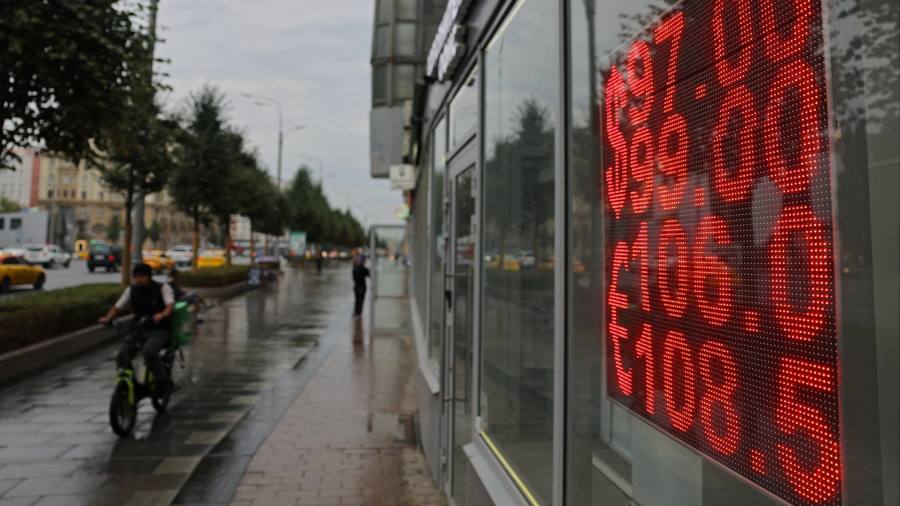
Russia’s central bank has raised its key interest rate 3.5 percentage points to 12 per cent at an extraordinary meeting, after the rouble fell below Rbs100 to the dollar.
The currency strengthened ahead of and immediately after the large rate rise on Tuesday, which exceeded market expectations, before paring some gains to trade at Rbs98 to the dollar.
The collapse in the rouble, which fell to Rbs102 against the dollar on Monday, highlights jitters about Russia’s economic prospects almost a year and a half into President Vladimir Putin’s full-scale invasion of Ukraine.
The country’s economic policymakers are struggling to balance the competing demands of growing the economy and steering it through western sanctions while keeping the rouble stable.
But the central bank said an additional rate increase might be needed “in case of intensifying inflation risks” and in order to stabilise the currency, with many analysts arguing that excess rouble liquidity was the main factor driving up imports and, consequently, price pressures.
After Russia plunged into recession last year, fuelling the country’s recovery and funding Putin’s war machine have required a borrowing bonanza amid low interest rates that has sped up inflation while weakening the rouble.
The central bank said it had decided to “limit risks to price stability” after some inflation indicators rose to more than 7 per cent. But it added that increased pressure on the rouble was driving inflation expectations.
“Increased internal demand beyond the possibilities of expanding [monetary] supply strengthens persistent inflationary pressure and affects rouble exchange dynamics by raising demand for imports,” the central bank said.
It said further price growth would create a “significant risk” that Russia would not meet its target of reducing inflation to 4 per cent next year, arguing the rate rise would help it meet that target.
The central bank, which dropped exchange rate targeting and switched to a free float in 2014, said a decision on whether to lift interest rates further would be based on inflation data and Russia’s success in adapting to western sanctions and other internal and external “risks”.
“The decision to raise rates higher than market expectations indicates, in our view, that the tightening cycle will be over quickly,” wrote analysts at Sinara, a Russian investment bank.
Sofya Donets, chief Russia economist at Moscow investment bank Renaissance Capital said: “More time will be needed to talk about a sustainable stabilisation and appreciation trend [for the rouble]. The hike is clearly negative for Russia’s growth, but should work well to curb inflation risks.”
Russian policymakers have few instruments available to support the rouble slide after western countries froze about $300bn of the country’s foreign currency reserves last year, leaving the central bank unwilling to boost the rouble by selling dollars and euros.
Last week, the central bank said it would stop foreign currency purchases until the end of this year to “reduce volatility”.
One key reason behind the rouble depreciation is Russia’s shrinking current account surplus, which fell by 85 per cent year on year in the first seven months of 2022.
Russia’s loose monetary policy has helped fund ballooning military spending and social programmes such as subsidised mortgages or payouts for soldiers’ families.
But while that toolkit has helped stimulate growth, a drop in export revenues under sanctions has widened Russia’s budget deficit and left the country more reliant on imports — factors that drive inflation.
Despite July’s rise in oil prices, export revenues remain low, not only because of western price caps but also because exporters do not repatriate a significant portion of their foreign currency earnings.
When they do, an unprecedented 40 per cent of Russia’s exports in June were denominated in roubles, adding pressure to the exchange rate.
“Measures to lower excess rouble liquidity are also required,” Denis Popov, chief analyst at Promsvyazbank, a Russian state-owned bank, wrote in a note.
The central bank’s decision would not have a substantial impact on the rouble, analysts said.
“The rate adjustment mechanism will transmit into the exchange rate with a certain lag and may not become a quick solution for stabilising it,” said Natalia Lavrova, chief economist at BCS Global Markets.
Elvira Nabiullina, the central bank governor, who has prioritised economic stability through a hawkish inflation policy during her decade in charge, has faced rare public criticism from statist hardliners as the rouble depreciated.
But with the Kremlin reluctant to cut social or military spending, the range of instruments Russia has to stop the rouble’s depreciation are confined to non-market mechanisms such as capital controls.
The central bank could turn to more unorthodox measures if it so chose, said Konstantin Sonin, a professor at the University of Chicago.
“The arsenal of financial repression is essentially endless. What’s stopping them? The possibility of a black market could appear. In the Soviet Union one could buy dollars to travel abroad or shop in ‘premium’ stores selling goods for dollars, but it was expensive — including the risk of getting arrested.”
Read the full article here

