


Receive free FIFA World Cup updates
We’ll send you a myFT Daily Digest email rounding up the latest FIFA World Cup news every morning.
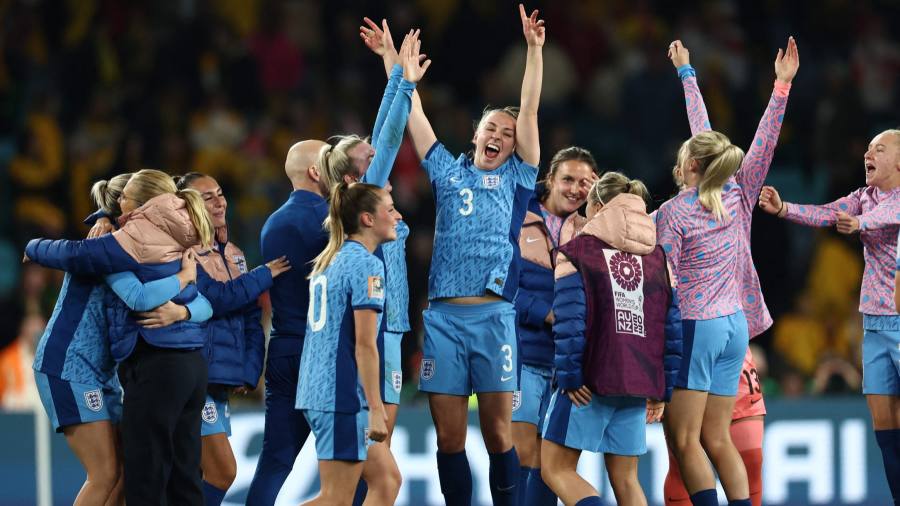
The England women’s football team are through to their first World Cup final after beating co-hosts Australia in a landmark game in front of more than 75,000 fans in Sydney.
Forwards Lauren Hemp and Alessia Russo took England two goals clear after Australia star Sam Kerr had cancelled out Ella Toone’s first-half strike.
The Lionesses’ 3-1 victory sets up a final against Spain at a tournament that has delivered record broadcast audiences and attendances, with a first-time World Cup champion guaranteed after heavyweights including the US, Germany, Japan and Norway bowed out early.
The win gives the Lionesses a shot at the game’s biggest prize and another chance of silverware following victory in last year’s European championships and the inaugural Finalissima in April against Brazil.
“This is the one thing I’ve always wanted, to make the final of the World Cup,” defender Lucy Bronze said after the match. “We all dreamed of being in the final.”
Thousands of fans flocked to the Western Sydney stadium early to prepare for the game with some wearing the colours of both teams as split loyalties in Australian households were on show.
The spectacle of an England-Australia semi-final had entranced the two nations who have traditionally competed fiercely in cricket, rugby and netball. Yet the two women’s sides showed no enmity before the match and dismissed the notion that a game between the two historically entwined sporting rivals was more important than any other.
The Matildas started the game as underdogs even with home advantage and the support of a country that has embraced a team that achieved a series of knockout victories over higher-ranked rivals.
Despite containing one of the world’s best players in Kerr, who carried a thigh injury throughout the tournament, Australia are 10th in the Fifa world rankings, with England fourth.
England adopted an aggressive approach in the match, testing Kerr’s match fitness with a number of heavy challenges in recognition of the threat she posed. By midway through the second half the visitors had committed 10 fouls to Australia’s one.

The Lionesses entered the match as favourites after winning Euro 2022 on home soil, England’s first major trophy in football since the men’s team won the 1966 World Cup. Both victories came against Germany.
Led by Dutch coach Sarina Wiegman, England played their patient, technical game, building attacks from defence, running hard and having almost 60 per cent of the possession.
When Manchester United midfielder Toone, who scored in the Euro 2022 final, struck the ball into the top corner to break the deadlock 36 minutes in, it sucked the air out of the full-capacity stadium.
Cries of “Come On Tillies” — the colloquial name for the Matildas — then grew as Australia’s Katrina Gorry shot straight at England’s goal moments later.
Kerr led Australia’s fightback, scoring a long-range effort on 63 minutes, beating three defenders with a sensational shot that deflected in. Australia looked to be in the ascendancy before poor defending seven minutes later allowed Hemp to score.

Despite their loss on Wednesday, the success of the Matildas in the tournament has captivated Australia, a country where sport is largely dominated by the domestic Australian rules football and Rugby league competitions as well as cricket, basketball and tennis.
The local women’s league is hoping to capitalise on the success of the national team and has asked the government for A$12mn in funding to strengthen the sport in Australia.
The funds, matching an amount from the league, would be used to expand the number of teams and to keep emerging stars such as Cortnee Vine, the Sydney player who scored the winning penalty against France, in Australia for longer.
For the Lionesses, whether they win or lose against Spain on Sunday, their success at the tournament will lend further momentum to the women’s game in England.
A government-backed review by former England player Karen Carney in July found that minimum salaries, a dedicated broadcast slot and “stringent” financial regulations are required to grow the game.
Read the full article here

