


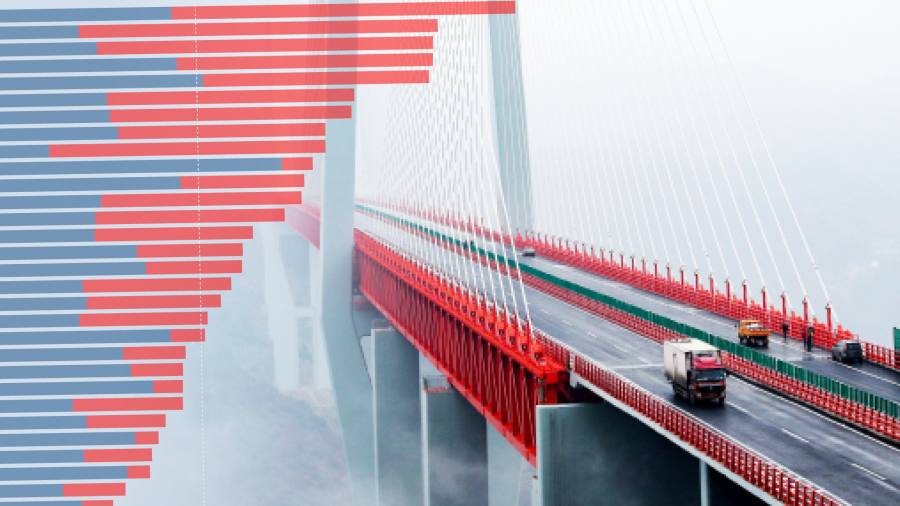
Once known as one of China’s most impoverished provinces, the mountainous region of Guizhou has over the past decade become famous for a different reason: it is home to some of the world’s tallest bridges.
From the 565-metre-high Duge Beipan river bridge that links Guizhou and neighbouring province Yunnan to the 332-metre-high Pingtang bridge that spans the Caodu river canyon, Guizhou’s investment in infrastructure has helped lift the province out of poverty, earning it special praise from President Xi Jinping.
But the high ground has come with a high cost. Guizhou’s debt totalled Rmb1.2tn ($165.7bn) at the end of 2022. With a debt-to-gross domestic product ratio of 62 per cent, it is one of the most indebted provinces in the country. Including off-balance-sheet debt, the figure could be as high as 137 per cent, according to one estimate.
The enormous amount of borrowing accumulated by China’s provinces, much of it through opaque local government financing vehicles — investment companies that raise debt and build infrastructure on behalf of local governments — has become a huge problem for the world’s second-largest economy. Increased tension between local and central governments over the debt comes as Beijing searches for new models of regional economic growth.
“LGFVs are a legacy of the old supply-expansion growth model that relied on heavy investments to create jobs and income,” said Chi Lo, senior investment strategist at BNP Paribas Asset Management in Hong Kong. “China’s growth structure is now changing . . . when it changes, the old funding vehicles catering for the old economy have become outdated.”
Local governments, typically sustained by funding from Beijing and the profits from land sales, have long been encouraged to borrow money to fund regional development.
The first LGFV was set up around 1998 to fund the construction of a highway. The practice gained momentum after a Rmb4tn stimulus package in 2009 that encouraged provinces to invest and boost growth. Banks saw LGFVs — implicitly backed by local governments — as safe clients, and by the end of 2022, China’s official local government debt totalled Rmb94tn, according to an estimate from Goldman Sachs.
Local government finances collapsed during the coronavirus pandemic, in part because of a surge in Covid-related public spending and a drop in land sales on which they relied for revenue. With a massive pile of onshore debt repayments due in 2023 and 2024, the stress on local governments, already struggling during an economic slowdown, has intensified.
“Local debt is going up in a very uncontrollable fashion,” said Victor Shih, professor of Chinese political economy at the University of California, San Diego. “Local governments’ reliance on central government, and on debt issuance, is getting worse and worse in a very rapid way.”
A near default by Guizhou’s second-largest city Zunyi in December fuelled concerns of a systemic financial crisis and hopes for central government bailouts. Zunyi restructured its Rmb15.6bn loan with banks in January, shocking creditors. The China Securities Regulatory Commission last week vowed to prevent LGFV bond defaults.
Beijing has decided to send teams of officials from the central bank, finance ministry and securities watchdog to more than 10 of the financially weakest provinces to scrutinise their books and find ways to cut their debts. They will assess the governments’ balance sheets and decide how best to cut bad assets and reduce debt. Scholars, experts and others have briefed officials including China’s premier Li Qiang, according to representation documents obtained by the Financial Times.
One suggestion is swapping some of the estimated Rmb59tn in “hidden debt” — borrowing that is off the books and often raised through private channels into official local government bonds. Chinese financial media outlet Caixin reported on Sunday that as much as Rmb1.5tn could be swapped. But as former finance minister Lou Jiwei has repeatedly argued in public speeches, too many of these swaps would only delay resolution of the problem, ultimately increasing leverage.
Experts are also expected to suggest increasing the maturity of loans to LGFVs to 25-30 years and cutting interest rates, giving LGFVs some breathing space to find new sources of revenue. Banks would indirectly absorb the costs. The risk of such restructuring has prompted some investment banks to reassess the ratings of state banks with high exposure to LGFVs. Commercial banks’ profits would be 6 per cent lower if 10 per cent of their LGFV loan holdings were restructured, according to a historical stress simulation conducted by Wang Jian, an analyst with Guosen Securities.
The most straightforward way to reduce debt would be to sell assets. In the case of Guizhou, experts for years have suggested the sale or pledge of some of its stake in Kweichow Moutai, the world’s most valuable liquor maker, a person familiar with the talks said. But despite central government pressure for disposals, local governments have proved reluctant.
“The central government’s assumption is that the asset is more than enough to pay the debt, which is true to a certain extent,” said Ivan Chung, managing director at Moody’s Investors Service. “But it’s a matter of how quickly those assets can be turned into cash, especially in weaker western provinces.”
This reluctance speaks to a tension between local and central governments over the debt problem.
“The underlying mentality [of resistance] is political,” said a senior state banker who deals with Guizhou local government debt. “Bridges and roads are built in response to calls for economic growth and poverty alleviation. But why should the localities now shoulder all the cost on behalf of the central government?”
In a statement directed at local authorities, the Ministry of Finance in February said: “If it’s your baby, you should hold it yourself . . . The central government won’t bail [you] out.”
In May, the finance bureau of Guiyang, the province’s capital, said in a statement that it had “done everything possible” to deal with its debt. The statement was later taken down from the bureau’s website.
In the long run, experts argue the role of LGFVs in China’s economy needs to be fundamentally reformed.
In a presentation to Premier Li in July, Luo Zhiheng, chief macroeconomic analyst at Yuekai Securities said local governments should reduce their debt-fuelled spending and rely more on tax revenues or funds from the central government for investment. This would be in line with China’s attempt to “rebuild the foundation of tax revenues”, Luo said, according to a copy of the presentation seen by the FT. More taxes on real estate and personal income could be rolled out when the time is right, other experts said.
Another solution is to allow the central government to raise more money. “There is still some room for the central government to run deficits. But I think it’s widely understood by economists in China to be the last fiscal ‘ammunition’ that the Chinese government has,” said Shih.
The impact of the debt crisis has been apparent in the services provided by local governments.
In the northernmost province of Heilongjiang, residents struggled to heat their homes in the winter after local gas providers restricted supply. The companies blamed a lack of government subsidies.
In the city of Zhangjiakou in Hebei province, where part of the 2022 Beijing Winter Olympics Games were held, local budgets are increasingly strained.
One civil servant in Zhangjiakou, who requested anonymity because he was not authorised to talk to the media, said he was no longer confident about getting paid. “Receiving wages is just like throwing dice,” said the civil servant. “You never know how much you will get for the next monthly payment.”
Construction of the bridges in Guizhou was a decades-long process. Unpicking the complex web of local finance may also take years.
“The cleansing process is likely to be costly and economically painful,” Lo from BNP Paribas said. “It’s a controlled default process to weed out bad assets and to deleverage the system by allowing the more bad LGFVs to fail . . . as debt restructuring and reduction processes move ahead.”
Additional reporting by Edward White in Seoul
Read the full article here

