


After enjoying the beaches, outdoor activities, and warm weather for a few months at a friend’s house in Florida during the pandemic, Josh Strange and his family eventually moved from Northern Virginia to the Sunshine state.
When Hurricane Ian hit Florida last summer, Strange, 42, learned how to put up sandbags to protect his home. “I mirrored what my neighbor did,” he says. “It was a surreal experience.” Still, he doesn’t regret relocating to an area prone to hurricanes. “Risks are present in any decision….This is just one of those situations where we felt the benefits outweigh the risks.”
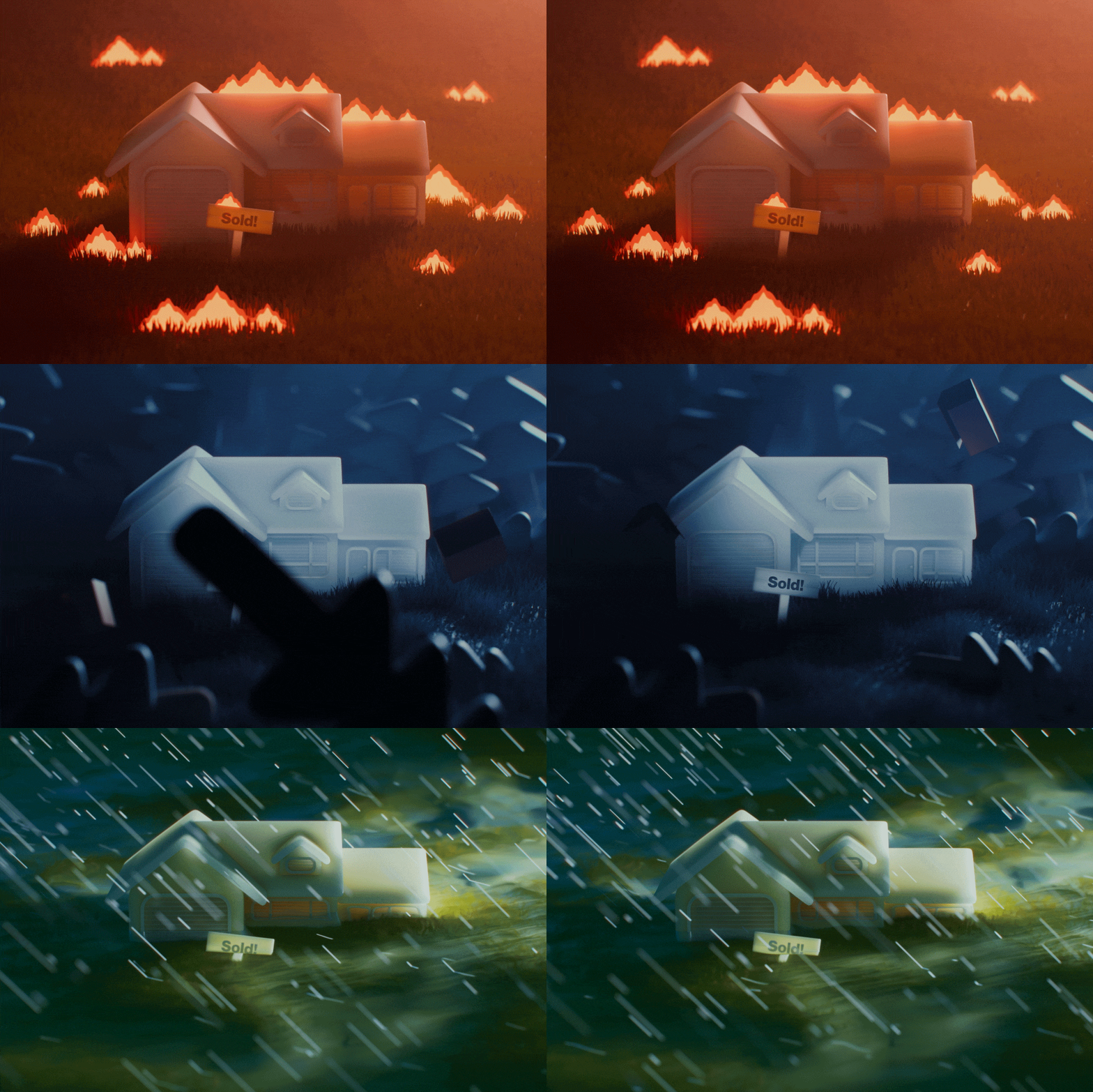
Warming temperatures and rising sea levels are projected to bring more-frequent and severe natural catastrophes in the coming decades—whether it’s wildfires, extreme heat, hurricanes, or flooding caused by heavy rainfall. That will make living situations increasingly difficult in many places.
Yet millions of Americans continue to move to areas exposed to high climate risks, drawn by affordable housing, booming local economies, family ties, and access to nature. Home builders continue developing to meet demand, while disaster-hammered communities keep rebuilding. Many of these areas have seen home prices rise higher and faster than the national average.
For instance, Fort Myers and Cape Coral in Florida suffered some of the biggest losses during last year’s Hurricane Ian—in part because of rapid development. Population in Lee County, where the two cities are located, has increased more than 600% since 1970, ahead of the nation’s 63% average. In the 12 months to July 2022, more than 30,000 new residents moved in, a 4% jump.
In the next 30 years, about 16 million U.S. properties will be subject to extreme heat of more than 104 degrees in the hottest month of the year, and 15 million are likely to experience winds of over 77 miles an hour from hurricanes, according to climate analytics company First Street Foundation.
Home values could also be at risk. Properties exposed to flood risk are overvalued by as much as $237 billion, according to research published in February by monthly journal Nature Climate Change. “A lack of consistent information and awareness regarding these risks means that markets have yet to fully price them in,” wrote Capital Economics researchers in a separate report in July, referencing the journal’s research.
More people are recognizing the risk of the changing climate around them. A recent survey from the Insurance Information Institute, an industry association, found that 32% of homeowners said they have been affected by weather events in the past five years, and nearly 60% expect to be affected in the next 10 years.
When choosing where to live, however, there are many factors to consider. “Just 10 years ago, climate wasn’t even on people’s radar,” says Jesse Keenan, associate professor of real estate and urban planning at Tulane University. “It is now, but it doesn’t necessarily mean it’s shaping major life decisions.”
According to a 2021 survey by real estate start-up PropertyNest, nearly two-thirds of home buyers said they didn’t consider the impact of climate change when deciding where or what to buy. Some said the issue simply hadn’t occurred to them, while others didn’t see it as related to homebuying. More than 12% didn’t believe in climate change.
Of course, many people have moved away from high-risk areas, either on their own or with the help of the federal government, which has paid thousands of homeowners to leave their flood-prone properties and relocate.
But climate’s impact on migration is still in the early days, says Adam Kamins, senior director at
Moody’s
Analytics, who has researched climate change and the U.S. economy. “People are seemingly undeterred,” he says. “The impact of affordability, availability of jobs, and economic health of an area just trumps [climate risks] by orders of magnitude.”
Phoenix recently experienced one of its hottest summers ever as temperatures stayed above 110 degrees for over a month. The region’s water supply is also being squeezed, with its groundwater running low and the Colorado River drying up.
But heat and drought haven’t deterred people from seeking the desert life. Since 1970, the population in Maricopa County, where Phoenix is located, has more than quadrupled to 4.5 million. It is now the fourth most populous county in the nation. From July 2021 to July 2022, nearly 57,000 people moved in.
“Our lifestyle out here really is designed to stay cool. Everything is air-conditioned 24/7,” says Butch Leiber, a real estate agent who has lived in Phoenix for 30 years. “You get used to it. You adapt your life to it.” While summer heat is hard to get through, milder winters are a big draw, he says.
Climate is one of Florida’s greatest assets when it comes to attracting new residents, says Aaron Buchbinder, a real estate agent based in Boca Raton, on the southeast coast—but it’s a double-edged sword. It’s like one of those end-of-the-world movies, he says. “You see the tsunami coming, and I go: ’this could always happen to us.’ But we chose to live here because we want this lifestyle.”
The desire to be closer to nature was accelerated during the pandemic as people spent more time at home. “People continue to move to places where the environment—such as oceanfront—is considered an amenity,” says Timothy Judge, head of modeling and chief climate officer at
Fannie Mae.
“The problem is, it also puts you in some of the higher-risk areas.”
Many move to climate-vulnerable areas for economic reasons. Despite strong growth in value in recent years, homes in Arizona and parts of Florida are much cheaper than in California and the Northeast—places from which many transplants are departing.
Their new destinations also have some of the lowest tax rates in the country. “Not having state income tax is a pretty significant consideration for people with high earnings,” says Strange, who works as a financial advisor in Florida.
After New Orleans lost more than half of its population following Hurricane Katrina in 2005, people have been moving back. But the recovery is uneven. St. Bernard Parish, where the median home value is 22% lower than in nearby Orleans Parish, nearly tripled its population from 2006 to 2022, a much stronger bounceback than the latter’s 60% growth in the same period.
The areas where people move back quickly are often places where people don’t have other options. “A lot of people knowingly move to high-risk areas because it’s the cheapest place to live,” says Tulane’s Keenan. “They’re just doing the basics to survive.”
Most people still aren’t feeling the costs associated with climate change. The population in Collin County, a suburban area northeast of Dallas, ballooned 17 times since 1970. From July 2021 to July 2022, it added more than 44,000 new residents.
Despite hotter Texas summers and high demand for air conditioning, utility costs aren’t prohibitive to people’s homebuying decisions, says Shana Acquisto, president of Collin County’s Realtor association. “I see more people concerned with the costs of a pool.”
There are some efforts to mitigate climate’s impact. Florida has enforced stronger building codes, including roof-to-wall connections, hurricane shutters, and impact-resistant windows. In hotter places like Arizona and Texas, people are building more insulated and energy efficient housing, while conserving and recycling water with new technologies.
But those measures are expensive and often apply only to newer houses. Many people will be left behind. “What we see is a very clear picture throughout the U.S. of the haves and have-nots,” says Keenan. “There’s a lot of rural America that simply does not have the institutional capacity or money to do anything other than begging the Congress for postdisaster recovery dollars.”
In Arizona, the scramble for water sources is driving a wedge between communities. In 2018, Queen Creek, a quickly developing suburban town southeast of Phoenix, paid millions of dollars for the water rights from a farm on the Colorado River. Three rural counties, worried about drought in their own areas, have sued the government for approving the deal.
While private insurers have been pulling out of some high-risk areas, government-backed plans have stepped in to provide coverage. But the situation isn’t sustainable, says Moody’s Kamins. “Eventually, they are not going to have the revenue to do that and insurance costs will become prohibitively higher, and at that point, we will start to see some impacts on migration,” he says.
There are signs of a tipping point: According to a 2022 Redfin survey of people who plan to buy or sell a home in the next year, two in five said risk of natural disasters, extreme temperatures, and rising sea levels played a role in their decision to move, and nearly two-thirds said they are hesitant to move to high-risk areas. The rates are particularly high among Gen Zers, who grew up learning about climate change and will spend a longer portion of their lives dealing with it.
New Orleans is already feeling the pain. Despite a decade of population growth, thousands of residents left the city last year after Hurricane Ida hit in 2021, and insurance costs soared. The recent restructuring of the federal flood insurance program will further boost rates in flood-prone areas—leading more residents in those zones to leave, says Gary Wagner, an economics scholar at University of Louisiana at Lafayette.
Meanwhile, Phoenix continues to attract tens of thousands of new residents each year. “Hopefully, people will keep moving here, we keep building, and prices continue to go up,” says Leiber, the real estate agent. “If this is the first of a string of superhot summers, will we start to see an exodus? I don’t know. I guess people don’t want to deal with the future.”
Write to Evie Liu at [email protected] and Shaina Mishkin at [email protected]
Read the full article here

